Agritech Data Analytics NZ: Closing the Interpretation Gap
3 August 2026 · 6 min read
Agritech Data Analytics NZ: Closing the Interpretation Gap
New Zealand farms already have plenty of sensors — soil probes, livestock collars, weather stations. What most are missing is a layer that turns those separate data streams into one clear decision each morning. Fieldays 2026 and AgriTechNZ's own research point to data interoperability, not more sensor deployment, as the sector's real bottleneck.
Farms have the hardware. What's actually missing?
For years the NZ agritech pitch was about deploying more sensors — soil moisture probes, GPS livestock collars, in-shed monitoring gear. That hardware race is largely won on most properties. AgriTechNZ chief executive Brendan O'Connell has said AI has moved from a future promise to something farmers reach for to solve problems today, which points to a market that's matured past pure experimentation.
NZ Herald's coverage of Fieldays 2026 backs this up. The innovation frontier has shifted away from the sensor or collar itself, toward what the data behind those devices can tell a farmer — and do on their behalf. Halter's product director is on record describing AI as making decisions throughout the Halter system, not just logging readings for someone to read later.
What's actually blocking daily decisions?
AgriTechNZ's ongoing Data Interoperability project names the problem plainly: most farms are running several sensor and software systems that don't talk to each other. That's the binding constraint on getting to a single daily call — not a shortage of data.
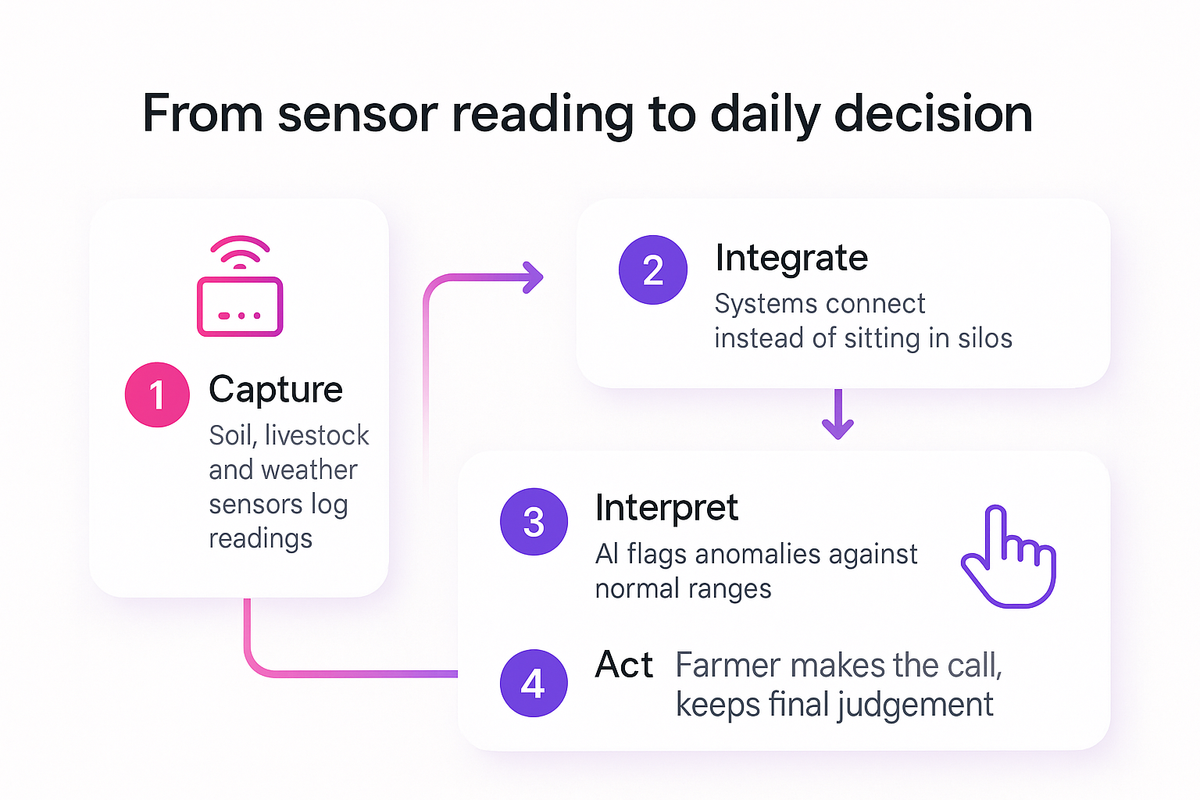
What this looks like in practice:
- Soil probes report into one dashboard, livestock collars into another, weather stations into a third
- A farmer or their advisor has to manually cross-reference three or four screens before making one decision
- Every new sensor purchase adds another silo rather than another insight
This is the gap that separate point solutions can't close on their own — no matter how good each individual sensor is.
Proof that narrow, targeted AI beats all-in-one platforms
AgriTec's June 2026 "Self-Aware Farm" analysis argues NZ agriculture is genuinely shifting from reactive to predictive use of sensor data. But it's careful to draw a line: the technology's job is early awareness, while the farmer keeps interpretation and the final call. Its practical advice for anyone starting out is to pick one targeted data stream first, rather than attempting an all-in-one platform from day one.
Local research and this year's Fieldays results both back the narrow-focus approach:
- Lincoln Agritech, a New Zealand applied-research institute, is building tailored sensor-plus-AI tools for specific jobs — from meat quality assessment to greenhouse gas tracking — and explicitly blends this work with mātauranga Māori for local grounding.
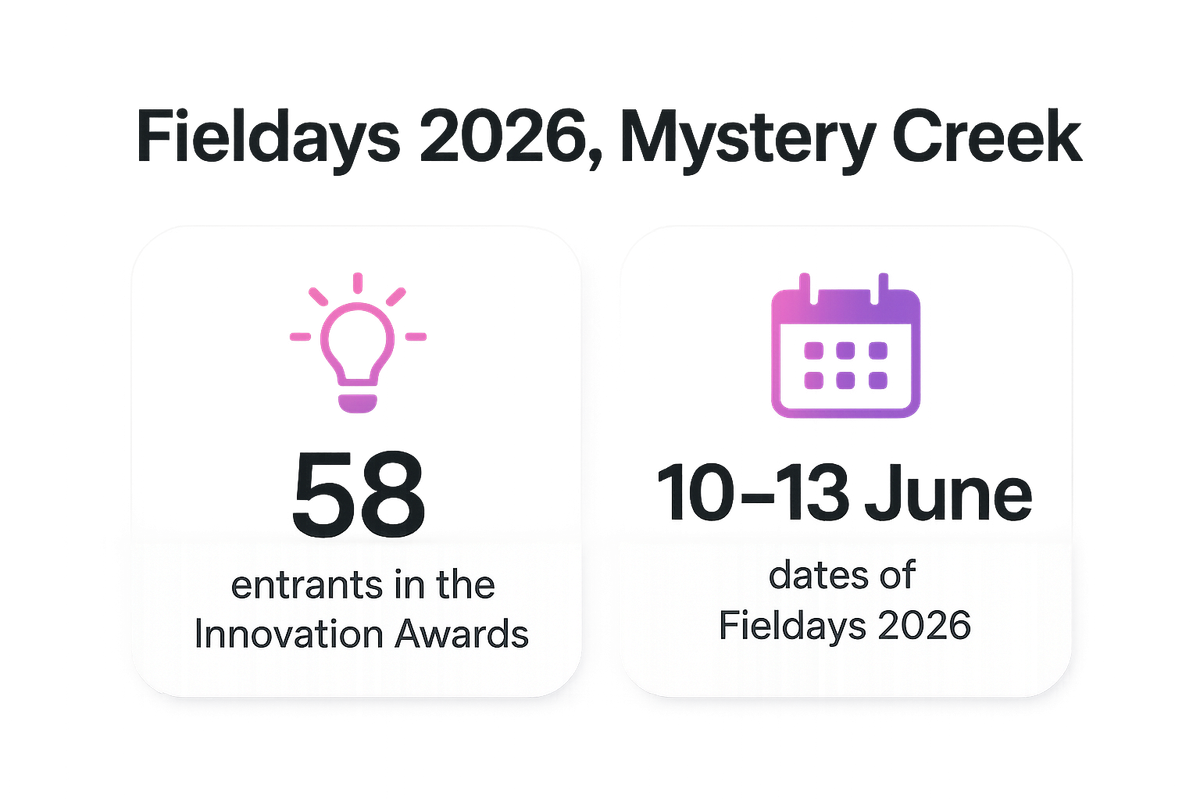
- Fieldays 2026's Innovation Awards drew 58 entrants, several of them scoped tools solving one job well: Scanabull's LiDAR weight-scanning app and Micron Kit's rapid faecal egg count testing among the standouts.
- AWS joined Fieldays 2026 as overall sponsor for the first time, a signal that major cloud and AI providers are now actively courting NZ agritech builders, not just hardware vendors.
Where's the funding for a lower-risk pilot?
Government and industry-backed programmes are opening up funded routes to test these narrow tools without a farm betting its whole operation on one platform:
- The Land Use Flexibility programme, with AgriTechNZ supporting the Responsible Dairy strand
- AgriZeroNZ's Early Adoption Accelerator, aimed at getting proven tools onto farms faster
For NZ-focused AI developers, this creates a near-term commercial opening: pilot on one well-defined use case, demonstrate the return, then scale — rather than trying to sell a farmer on a platform that replaces everything they already run.
Key takeaways
- NZ's agritech conversation has moved past sensor deployment — the competitive frontier is now the interpretation layer that turns fragmented readings into one decision.
- AgriTechNZ's Data Interoperability project confirms most farms already juggle multiple disconnected sensor and software systems; integration, not more data capture, is the real constraint.
- Fieldays 2026 (10–13 June, Mystery Creek) drew 58 Innovation Awards entrants and AWS as first-time overall sponsor, showing cloud and AI providers now see NZ agritech builders as a serious market.
- Local proof points — Lincoln Agritech's tailored sensor-plus-AI tools, Scanabull's LiDAR weight app, Micron Kit's rapid testing — show the ROI sits with narrow, high-value applications, not sprawling all-in-one platforms.
- Funded pathways such as Land Use Flexibility and AgriZeroNZ's Early Adoption Accelerator give farmer-facing AI pilots a lower-risk route to market right now.
Our take
The sector's own data backs a fairly blunt conclusion: buying another sensor won't fix a farmer's decision problem if the last three sensors already sit in silos. The providers with the clearest advantage over the next couple of years will be the ones who build the connective layer between existing systems — soil, stock, weather, financials — rather than the ones adding yet another standalone dashboard. AgriTec's advice to start with one targeted data stream is sound, and it maps onto a broader truth in applied AI generally: narrow, well-integrated tools that solve one job properly tend to outperform ambitious platforms that try to solve everything and end up solving nothing well. Funded pilot pathways like AgriZeroNZ's accelerator lower the risk of proving that out on real farms, which is exactly where this thesis needs to be tested next.
Where does your own farm or operation still have sensor data sitting in separate silos, waiting for someone to connect the dots each morning?
FAQ
What is the main barrier to precision agritech in New Zealand right now? According to AgriTechNZ's Data Interoperability project, the main barrier isn't a lack of sensors or data — it's that most farms run multiple disconnected sensor and software systems that don't integrate, forcing manual cross-referencing before any decision gets made.
What did Fieldays 2026 reveal about the direction of NZ agritech? Fieldays 2026 (10–13 June, Mystery Creek) drew 58 Innovation Awards entrants and welcomed AWS as overall sponsor for the first time. NZ Herald coverage and AgriTechNZ commentary both noted the focus has shifted from the sensor or collar itself to what the underlying data can tell a farmer and do on their behalf.
Should a farm build one big data platform or start with a narrow tool? AgriTec's June 2026 "Self-Aware Farm" analysis recommends starting with one targeted data stream rather than an all-in-one platform, arguing that technology should provide early awareness while the farmer retains interpretation and the final decision.
Are there funded ways to trial AI tools on an NZ farm? Yes. The Land Use Flexibility programme, supported in part by AgriTechNZ's Responsible Dairy work, and AgriZeroNZ's Early Adoption Accelerator both offer funded pathways for farmer-facing AI pilots, giving providers and farmers a lower-risk route to prove value before scaling.
What kind of local research supports the sensor-to-decision approach? Lincoln Agritech, a New Zealand applied-research institute, is developing tailored sensor-plus-AI tools for specific jobs — including meat quality assessment and greenhouse gas tracking — and combines this work with mātauranga Māori, giving the approach local scientific and cultural grounding.