AI Assessment Writing for NZ Unit Standards: Buyer Guide
8 September 2026 · 7 min read
Yes, but only for internal assessment. NZQA's guidance permits training providers to use AI tools to help draft internal assessment material, provided the organisation has an academic integrity policy covering acceptable AI use and its moderation process stays intact. NZQA explicitly rules out generative AI for external assessment content.
That distinction is the whole ballgame for anyone shopping for an "AI assessment writing" tool in New Zealand right now. It's tempting to frame this as a speed question — how fast can a tool spit out a draft against a unit standard? But speed isn't the risk. The risk is a provider submitting content for moderation that was never properly checked against a standard's actual outcome statements, performance criteria and range statements, or that skipped a genuine human sign-off. Buying this kind of software is really a governance decision wearing a productivity hat.
Is AI allowed for NZQA unit standard assessments?
NZQA's position, set out in its guidance on academic integrity and AI, draws a firm line between internal and external assessment.
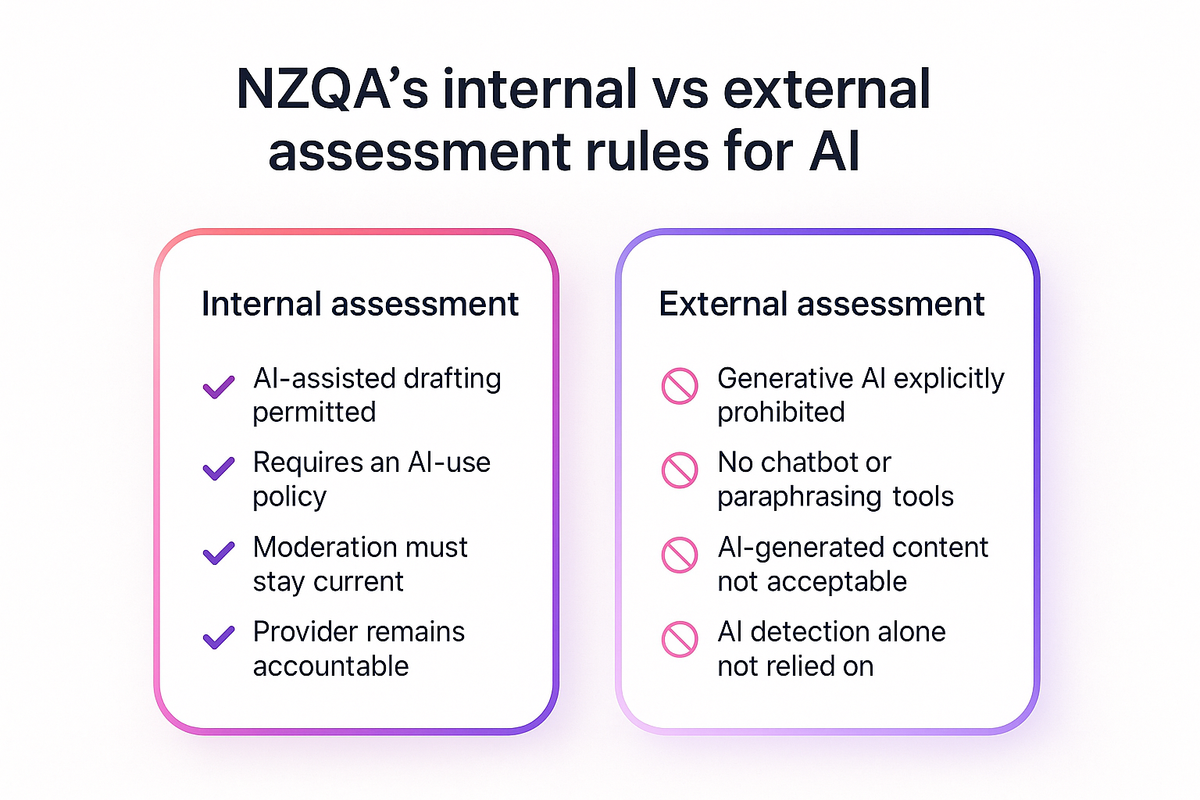
For internal assessment — the kind PTEs, ITPs and Wānanga run themselves against unit standards and increasingly against skill standards — NZQA does not ban AI outright. What it requires is that the provider has a policy explicitly addressing acceptable AI use, and that moderation systems remain current and effective. In other words, the provider stays accountable for what the tool produces.
For external assessment, the position is different: NZQA states that chatbots, generative AI and paraphrasing tools must not be used to produce content submitted as a candidate's external assessment work. NZQA has also flagged that AI-detection tools carry known limitations, including false positives, so it cautions against relying on a checker alone to police this.
Interestingly, NZQA's own use of AI — its Automated Text Scoring tool for Literacy Writing — is framed the same way it expects providers to frame theirs: as support for human marking and quality checks, not a replacement for them. That's a useful benchmark. If a vendor's pitch implies their tool removes the need for assessor judgement, that's a mismatch with how the regulator itself treats AI.
What to look for when choosing a tool
Once you've accepted that this is a compliance decision as much as a productivity one, the evaluation criteria change. Here's what actually separates a defensible tool from a fast one.
How to choose an AI assessment-writing tool that keeps you accountable
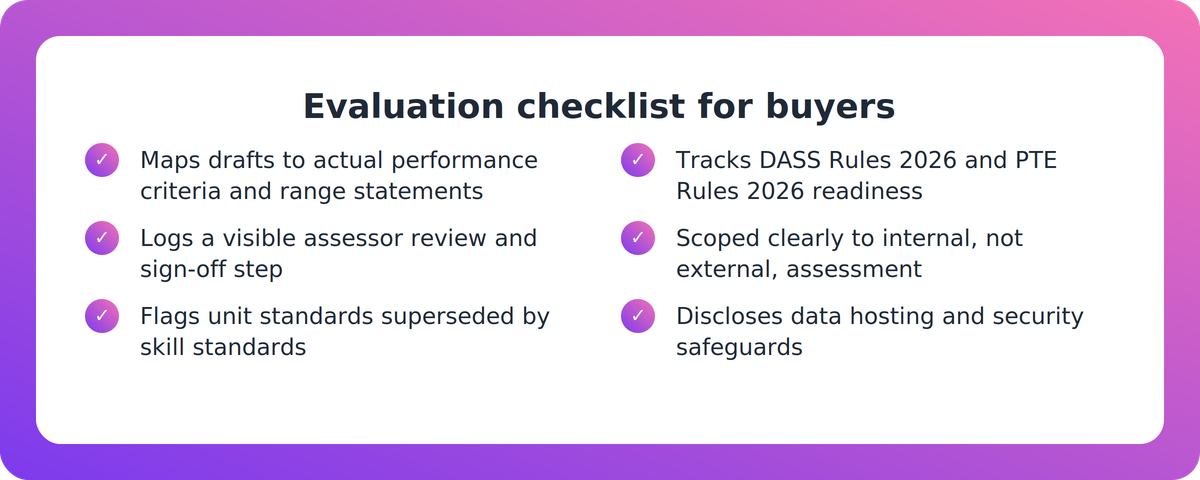
- Standards-mapping accuracy. Does the draft genuinely align to the outcome statements, performance criteria and range statements of the specific unit standard or skill standard, or does it just reference the right standard number while producing generic content?
- A visible, logged review step. Can an assessor or moderator edit, query and formally sign off the draft before it's used with learners — and is that review step recorded, not just assumed?
- Handling of the unit standard to skill standard shift. As unit standards are progressively replaced by skill standards on the Directory of Assessment and Skill Standards, typically with a two-year transition window set by the relevant standard-setting body, does the tool flag when a standard you're using has been superseded or is mid-transition?
- Currency with upcoming rule changes. From 19 January 2026, the Consent to Assess Against Standards on the DASS Rules 2026 and the Private Training Establishment Rules 2026 take effect. Ask a vendor directly how they're tracking these, rather than taking a marketing claim at face value.
- Scope to internal assessment. Given NZQA's clear internal/external split, a credible vendor should be explicit that their tool supports internal assessment drafting, not external assessment content.
- Data hosting and security posture. What safeguards exist for storing assessment material and any learner-related content?
Will the tool catch a unit standard being replaced by a skill standard?
This is worth testing before you sign anything, not after. Ask a shortlisted vendor to show you — live, not in a slide — what happens when you draft against a unit standard that's already been reviewed or is inside its transition window. A tool that quietly keeps generating content against a superseded standard, with no flag, is a liability at moderation time regardless of how polished its output looks.
Checking a vendor's time-saved or ROI claims
Category marketing in this space leans heavily on before/after numbers — hours saved per assessment, weeks cut from mapping. Treat these as illustrative unless a vendor can show you how the figure was measured, on what task, and for whom. NZQA doesn't endorse or verify any commercial tool in this category, so a claim being repeated confidently isn't the same as it being independently checked. Ask for a reference from another New Zealand PTE or ITP using the tool for a comparable qualification, and ask what their assessors actually changed in the AI draft before it went to moderation — that tells you more than a headline percentage.
Key takeaways
- NZQA permits AI-assisted drafting for internal assessment when a provider has an AI-use policy and keeps moderation current, but bans generative AI from external assessment content.
- The strongest tools map drafts to a standard's actual outcome statements, performance criteria and range statements — not just the standard number.
- A logged, editable human sign-off step is what makes AI-drafted content defensible at moderation, not the drafting speed itself.
- Test how a tool handles the live shift from unit standards to skill standards on the DASS, and check its readiness for the DASS Rules 2026 and PTE Rules 2026.
- Treat vendor ROI and time-saved claims as a starting point for questions, not proof.
Our take
The category is going to keep marketing itself on speed, because speed is the easy story to tell. We think that's the wrong axis for a buyer to optimise on here. The providers who get burned at moderation aren't the ones who drafted slowly — they're the ones who couldn't show a clear trail from AI draft to qualified human decision. If a tool can't show you that trail during a demo, its speed doesn't matter. We build Supahuman's VET Workspace around exactly this idea: draft assessments through an authoring engine with theory and practical modes, keep a version-controlled library of standards with audit logs, and route anything ambiguous back to a qualified assessor whose decision gets recorded. It's a starting point for review, not a finished product — and we'd say the same about any tool worth buying in this category.
FAQ
Is it legal or allowed to use AI to draft assessments against NZQA unit standards? Yes, for internal assessment. NZQA's guidance allows AI-assisted drafting where the provider has a policy covering acceptable AI use and keeps its moderation process current. AI is explicitly prohibited from producing content submitted as part of a candidate's external assessment.
Does using an AI tool remove the need for assessor sign-off? No. Every AI draft still needs review by a qualified, accountable assessor before it's used with learners. NZQA frames its own AI marking tools the same way — as support for human marking and quality checks, not a substitute for them.
What happens when a unit standard I assess against is replaced by a skill standard? Unit standards are being progressively replaced by skill standards on the Directory of Assessment and Skill Standards, usually with a transition window set by the standard-setting body. Ask any vendor to demonstrate, live, how their tool flags a standard that's superseded or mid-transition.
How do the January 2026 NZQA rule changes affect assessment tools? From 19 January 2026, the Consent to Assess Against Standards on the DASS Rules 2026 and the Private Training Establishment Rules 2026 take effect. Vendors serving New Zealand providers should be able to show how their compliance features are being updated ahead of these changes.
Should I trust a vendor's claimed time savings from using their tool? Treat published time-saved or ROI figures as illustrative unless the vendor can explain how they measured them and on what task. NZQA doesn't verify or endorse commercial AI tools, so ask for a comparable reference from another New Zealand provider before relying on a headline number.
If you're evaluating this category, start by asking any vendor to show you the standards-mapping and sign-off step live, against a standard you actually assess — not a generic demo. That single test will tell you more about whether the tool fits your compliance obligations than any feature list.