AI Data Residency in NZ: What the Privacy Act Demands
27 July 2026 · 7 min read

There's no rule in New Zealand law forcing you to keep business data or AI systems onshore. But the Privacy Act 2020 — through IPP 12's cross-border test, a new third-party notification duty landing in 2026, and rising Office of the Privacy Commissioner (OPC) scrutiny of AI training data — means the question of where your AI lives now carries real legal weight, and the arrival of a Government-certified Azure New Zealand region gives you a genuine local option for the first time.
Does New Zealand law actually require onshore hosting?
No. New Zealand imposes no statutory data localisation requirement for AI systems or business data generally. The Privacy Act 2020 doesn't require prior government approval or registration before you send personal information overseas — compliance is self-assessed against Information Privacy Principle 12 (IPP 12), the cross-border disclosure rule.
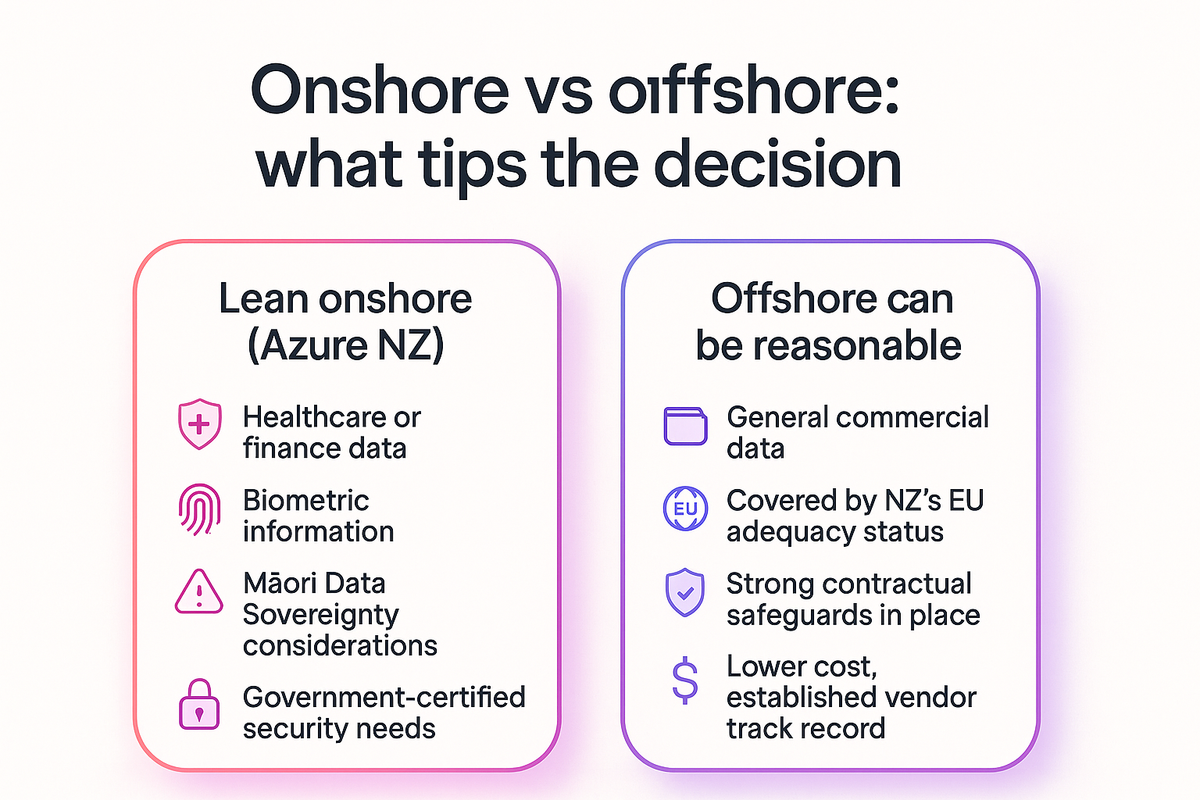
In practice, plenty of New Zealand organisations — including government agencies — already store data in Australia without penalty. Data residency here is a proportionate, sector-driven decision, not a default requirement, except in fields where the regulatory or cultural stakes are higher: healthcare, finance, and anything touching biometric data or Māori data sovereignty considerations.
What does IPP 12 actually test?
IPP 12 is the operative test for whether sending personal information to an overseas AI vendor or cloud region is acceptable. Broadly, you need to be satisfied the recipient jurisdiction offers comparable privacy protection, or that adequate contractual safeguards are in place.
New Zealand's own EU adequacy status — reaffirmed by the European Commission in 2024 — actually works in your favour here. It supports transfers of comparable personal information without needing extra safeguards layered on top, which is one reason many local businesses have been comfortable running workloads through established offshore cloud regions for years.
Why is a new notification duty about to matter for AI?
A fresh obligation — IPP 3A — takes effect from 1 May 2026. It requires notifying individuals when their personal information is collected from a third-party source rather than directly from them.
This lands squarely on AI practices many businesses haven't scrutinised closely:
- Models fine-tuned on purchased contact lists or third-party datasets
- Systems built on scraped web data
- Tools trained on aggregated public-register information
If your AI system's training data came from anywhere other than the individual themselves, IPP 3A puts a notification obligation on you from that date. Auditing your training data provenance now, before the duty bites, is cheaper than untangling it after.
Does hosting offshore get you off the hook?
No — and this is the part businesses most often get wrong. Section 11 of the Privacy Act 2020 has extraterritorial reach: it extends obligations to overseas AI and large language model vendors serving New Zealand residents.
That means choosing an offshore vendor doesn't remove your, or your provider's, accountability under the Act. If a breach happens on a server in another hemisphere, the Privacy Act still expects you to have made a reasonable, documented decision about why that vendor and that jurisdiction were appropriate.
Are regulators actually paying attention to this?
Yes, and the pace is picking up. The OPC has signalled active monitoring of AI-related privacy risk, joining a February 2026 joint statement alongside more than 50 international privacy regulators addressing misuse of AI content-generation systems.
The OPC has also been explicit on a point worth repeating to anyone building or buying AI tools internally: using an automated system does not transfer responsibility away from the business making decisions with it. If your AI recommends a credit decision, a hiring outcome, or a customer risk score, you still own that decision under the Act — the algorithm is not a legal shield.
What changed with the Azure New Zealand region?
Microsoft's Azure New Zealand region is the country's first hyperscale public cloud region, and the first certified by the Government Chief Digital Officer against public sector security standards. For businesses that have been quietly uneasy about routing AI workloads offshore, that's a meaningful shift — a credible, locally hosted option now exists where previously there wasn't one.
This matters most where:
- Data is subject to Māori Data Sovereignty (Te Mana Raraunga) principles
- Biometric or highly sensitive personal information is involved
- The sector — healthcare, finance, government — carries heightened regulatory expectation of local control
So where should your AI actually live?
For most general business use cases, offshore processing backed by New Zealand's EU adequacy status or solid contractual safeguards remains a reasonable, lower-cost choice. There's no blanket rule saying onshore is always better — it depends on your sector, your data type, and how defensible your reasoning is if the OPC ever asks.
What should drive the decision:
- Sector risk: regulated industries lean onshore; general commercial use often doesn't need to.
- Data sensitivity: biometric, health, or iwi/Māori data carries a stronger case for local hosting.
- Vendor accountability: confirm your AI vendor's obligations under Section 11 in writing, regardless of where servers sit.
- Training data provenance: know exactly where your AI's training data came from before IPP 3A takes effect.
For businesses building or commissioning purpose-built AI tools — rather than plugging into a generic off-the-shelf model — this is also the moment to bake data residency and provenance decisions into the design brief, not bolt them on afterwards.
Key takeaways
- New Zealand has no data localisation law; IPP 12 governs cross-border AI hosting decisions on a self-assessed basis.
- IPP 3A, effective 1 May 2026, requires notifying individuals when their data was sourced from a third party — a direct hit on AI trained on purchased or scraped datasets.
- Section 11 extends Privacy Act accountability to offshore AI vendors; hosting overseas doesn't remove your liability.
- The OPC is actively monitoring AI risk internationally and has confirmed automation doesn't shift decision-making responsibility away from the business.
- The new Azure New Zealand region gives regulated sectors and Māori data sovereignty-sensitive use cases a genuine onshore option for the first time.
Our take
The honest answer to "where should our AI live" is: it depends, and most New Zealand businesses have never actually worked out on what. Treating hosting as a checkbox — pick a cloud provider, tick IPP 12, move on — misses that the real exposure sits in training data provenance and vendor accountability, not server geography. IPP 3A is going to force a lot of businesses to finally document where their AI's training data actually came from, which is overdue. Our view: the Azure New Zealand region is a genuine option worth having, but it's not a substitute for doing the sector-risk assessment properly — onshore hosting with sloppy data provenance is still a compliance problem.
If you're weighing up where a new AI system should sit, and what that means for training data, vendor contracts, and notification obligations, it's worth mapping the decision against your specific sector risk before you build anything — not after.
FAQ
Does New Zealand law require AI systems to be hosted onshore? No. There's no statutory data localisation requirement in New Zealand. IPP 12 of the Privacy Act 2020 governs cross-border transfers on a self-assessed basis, and offshore hosting remains legal provided the destination offers comparable privacy protection or adequate contractual safeguards.
What is IPP 3A and when does it start? IPP 3A is a new Information Privacy Principle taking effect on 1 May 2026. It requires notifying individuals when their personal information has been collected from a third-party source rather than directly from them — relevant to any AI system trained on purchased, scraped, or aggregated data.
If our AI vendor is based overseas, are we still liable under the Privacy Act? Yes. Section 11 of the Privacy Act 2020 extends obligations to overseas AI and LLM vendors serving New Zealand residents. Offshore hosting doesn't remove your accountability, or your vendor's, for how personal information is handled.
What does the new Azure New Zealand region change? It's New Zealand's first hyperscale public cloud region and the first certified by the Government Chief Digital Officer against public sector security standards. It gives regulated industries and Māori Data Sovereignty-sensitive use cases a credible local hosting option that didn't previously exist.
Do we still need to worry about compliance if we use an automated AI tool to make decisions? Yes. The Office of the Privacy Commissioner has reiterated that businesses remain accountable for decisions made using AI tools regardless of automation — the tool doesn't transfer legal responsibility away from the business using it.