AI Healthcare Data in NZ: Scale Meets Scrutiny
20 July 2026 · 6 min read
AI Healthcare Data in NZ: Scale Meets Scrutiny
New Zealand has already answered whether AI can safely turn clinical notes into saved time and better care — every public emergency department now runs AI scribes, and peer-reviewed research backs the benefits in primary care too. The harder question, now facing private clinics and specialist providers, is how to adopt the same technology without breaching new privacy rules or picking an unvetted tool.
What Health NZ actually rolled out
The scale here is worth sitting with. Health NZ didn't pilot AI scribes in a handful of hospitals and call it a success — it deployed to every emergency department in the country.
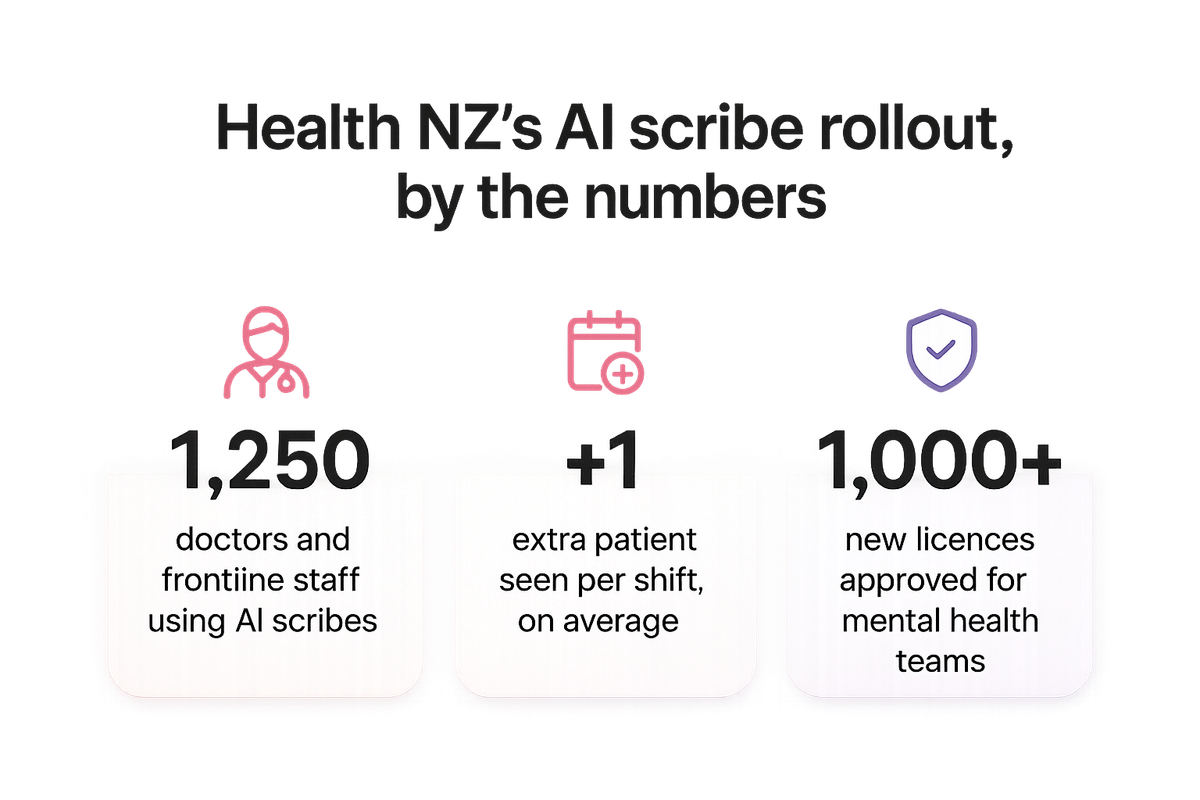
- 1,250 doctors and frontline staff now use AI scribes across all EDs — 250 more than originally planned (Beehive.govt.nz).
- Doctors are seeing, on average, one extra patient per shift as a result.
- Health NZ is now approving 1,000-plus additional licences to extend scribes into emergency mental health teams.
That's not a proof-of-concept. That's a national health system deciding ambient AI documentation is safe enough, and useful enough, to run at full scale.
Does it actually work? What the Otago research found
A University of Otago-led survey, published in the Journal of Primary Health Care on 26 March 2026, asked primary care staff what they actually experienced using AI scribes in consultations. The findings back up the ED results: less multitasking, lower cognitive load, more attention on the patient in front of them.
But the same researchers flagged unresolved gaps that matter for anyone outside the endorsed public pathway:
- No formal regulatory approval process exists yet for clinical AI scribes in New Zealand.
- External validity and safety testing of these tools remains limited.
- Māori data sovereignty and te reo Māori recognition are still open questions, not settled practice.
In other words: the productivity case is proven. The governance case is still being built underneath it.
The compliance perimeter is catching up — fast
This is where speed and oversight have started to collide. Three things have landed in quick succession:
- Information Privacy Principle 3A took effect on 1 May 2026 under the Privacy Amendment Act 2025, with the Health Information Privacy Code 2020 amended in March 2026 to match. Health NZ's own AI governance group, NAIAEAG, has warned that feeding identifiable patient data into a generic generative AI tool will almost certainly breach privacy unless specifically authorised.
- Vendor endorsement is now a real gate, not a formality. Heidi AI Scribes holds Enterprise-level endorsement. IntelliTek is conditionally endorsed, pending privacy, security and contractual sign-off. Other ambient scribe tools remain under review. If a tool hasn't cleared this pathway, using it with patient data inside the public system is a live risk.
- A security flaw surfaced in an already-endorsed tool. A Newsroom investigation on 20 March 2026 found a basic prompt-based vulnerability in a scribe tool that had already passed endorsement — a finding that's pushed ISO 27001 and ISO 42001 certification from a nice-to-have toward an expected baseline for any clinical AI vendor.
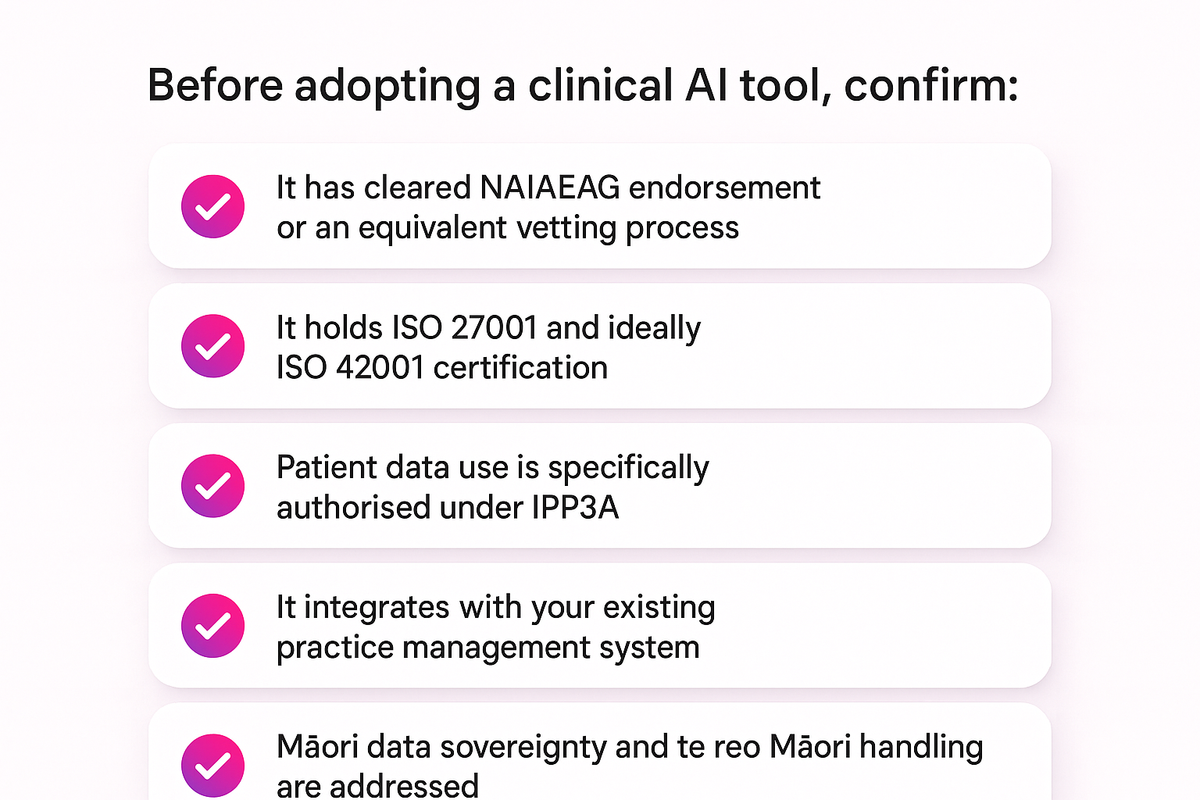
For a private clinic evaluating tools today, this means the question isn't "is AI allowed?" It's "has this specific tool, configured this specific way, actually cleared the bar?"
Why Health NZ chose vendors over building its own
Health NZ had already built an in-house scribe, Tuhi, for around $150,000 in 2024. It shelved it. Instead, it partnered with established vendors, citing scale and clinician-tested reliability as the deciding factors.
That's a telling signal from the country's largest health provider: even with the budget and the mandate to build from scratch, the safer and faster path was integrating a proven foundation into existing clinical workflows — properly governed, properly configured — rather than starting from zero. Generic tools bolted on without that configuration work carry the risk; purpose-built, correctly integrated ones don't.
What this means for private clinics and specialist providers
A BNZ survey found two-thirds of private healthcare providers have used or considered AI, with administrative and scribe tools leading adoption while clinical tools like imaging analysis remain in earlier pilot stages. The same survey names the barriers still holding wider uptake back: compliance uncertainty, affordability, and integration difficulty with existing practice management and patient record systems.
Those three barriers are really one problem wearing different hats. A tool that isn't properly vetted for privacy compliance, isn't priced with a clear return in mind, and doesn't plug cleanly into the systems a clinic already runs, is a tool that sits half-used — or worse, creates exposure nobody noticed until an audit or a breach.
Key takeaways
- Health NZ has proven AI scribes work at national scale: 1,250 ED staff, one extra patient per shift, and 1,000-plus new licences flowing into mental health teams.
- Otago research confirms real time and cognitive-load benefits in primary care, but flags that no formal regulatory approval process yet exists.
- IPP3A, in force from 1 May 2026, means identifiable patient data in a generic AI tool is likely a privacy breach unless specifically authorised.
- NAIAEAG's vendor endorsement pathway — with Heidi endorsed and others conditional or under review — is the practical gate any clinical AI tool must clear.
- Two-thirds of private providers have used or considered AI, but compliance, cost and integration remain the honest barriers to wider adoption.
Our take
The lesson from Health NZ's own path — shelving a home-built tool for a properly configured, clinician-tested vendor solution — applies just as directly to private clinics. The safest and most cost-effective move usually isn't building from scratch or grabbing a generic chatbot; it's getting a tool that's been shaped around your workflow, your patient data obligations, and your existing systems from the start. Providers who treat IPP3A compliance and NAIAEAG-style vetting as an afterthought are the ones most likely to find themselves explaining a breach rather than reading about someone else's.
FAQ
What is IPP3A and when did it take effect in New Zealand? Information Privacy Principle 3A came into force on 1 May 2026 under the Privacy Amendment Act 2025, with the Health Information Privacy Code 2020 amended in March 2026 to align. It tightens rules around using patient data in tools like generative AI.
Is it legal for a private clinic to use a generic AI chatbot for clinical notes? Health NZ's AI governance group, NAIAEAG, has warned that feeding identifiable patient data into a generic generative AI tool will almost certainly breach privacy obligations unless specifically authorised. Clinics should use tools that have cleared a formal vetting or endorsement process.
Which AI scribe tools are currently endorsed for use in New Zealand's health system? Heidi AI Scribes holds Enterprise-level endorsement from Health NZ. IntelliTek is conditionally endorsed pending privacy, security and contractual sign-off, and other ambient scribe tools remain under review.
Do AI scribes actually save clinicians time in New Zealand? Yes. Health NZ's nationwide ED rollout saw doctors see, on average, one extra patient per shift, and a University of Otago-led survey published in the Journal of Primary Health Care found primary care staff reported reduced multitasking and cognitive load.
What's holding back wider AI adoption among private healthcare providers in NZ? A BNZ survey found compliance uncertainty, affordability, and integration with existing systems are the main barriers, even though two-thirds of private providers have already used or considered AI tools, mostly for administrative and scribe functions.