AI Medical Scribe Software NZ: A Buyer's Guide
23 July 2026 · 8 min read

If you're choosing AI medical scribe software for a New Zealand clinic, the tools with the most established credibility are Heidi, iMedX, T-Pro and IntelliTek — the four ambient scribes currently endorsed by Health New Zealand's National Artificial Intelligence and Algorithm Expert Advisory Group (NAIAEAG) after privacy, security and contractual review. That endorsement is a useful signal even for private practice, but it isn't the whole decision: consent process, disclosed accuracy limits and where patient data is stored matter just as much, because the clinician — not the software — remains accountable for every entry in the record.
What an AI medical scribe actually does
An AI scribe listens to (or transcribes) a consultation and drafts clinical notes in something close to real time, usually formatted to match a standard structure like SOAP. The pitch is straightforward: less typing during the appointment, less after-hours admin, more attention on the patient.
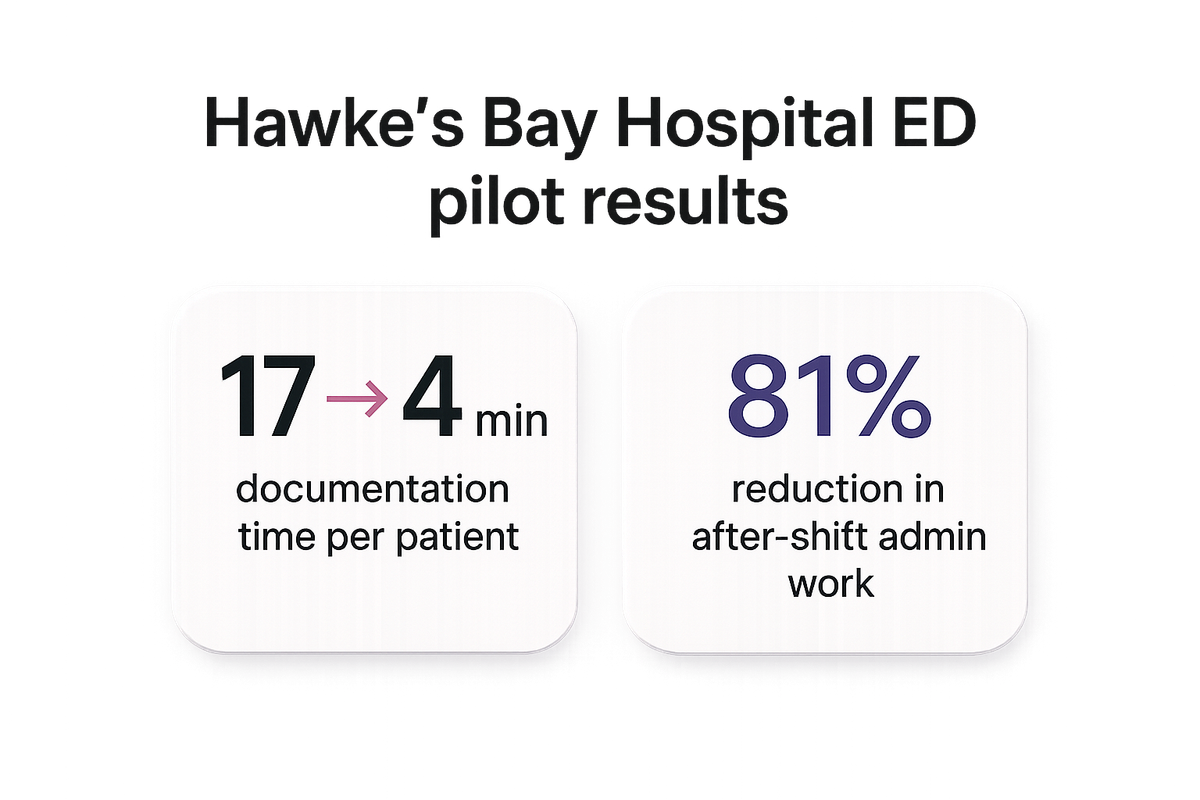
That pitch has held up in at least one public trial. In a Hawke's Bay Hospital emergency department pilot, Heidi reportedly cut average documentation time from around 17 minutes to just over four minutes per patient, let clinicians see an extra patient per shift, and reduced after-shift admin work by up to 81%. Health New Zealand followed that pilot with a rollout of 1,000 clinician licences plus 100 for mental health crisis teams — but expansion beyond emergency departments is deliberately gated, contingent on clinical governance and local readiness being reviewed and approved first, not just clinician demand.
Which AI scribes are endorsed in New Zealand's public system — and does that matter for a private clinic?
NAIAEAG's endorsement of Heidi, iMedX, T-Pro and IntelliTek followed a formal privacy, security and contractual review specific to the public system. A private clinic isn't bound by that endorsement, but it's a reasonable starting shortlist — and a useful benchmark for the kind of due diligence a private practice should run on any vendor that isn't on that list. If you're evaluating a scribe that hasn't been through Health NZ's process, ask the vendor for the equivalent: an independent security review, a clear data-processing agreement, and documented handling of clinical error.
If you use an AI scribe, who is accountable for what lands in the patient record?
Still you. The Medical Council of New Zealand has published guidance stating explicitly that AI tools "do not replace professional judgement" — doctors remain responsible for all clinical decisions and actions, including being satisfied a tool is safe and suitable, obtaining informed consent in specific situations, and checking that adequate privacy and data security safeguards are in place.
That's not a formality. A University of Otago survey of 197 primary care providers found real gaps in current practice: 41% of providers using AI scribes weren't seeking explicit patient consent, and some clinicians reported missed critical negative findings or a hallucination rate they described as "quite high and often quite subtle." An AI scribe assists a clinician; it does not replace the clinician's review. Every draft note needs a human check against what was actually said and clinically relevant before it becomes part of the record — no scribe purchase removes that step.
Privacy, consent and data storage: what to check before you sign
Patient health information handled by any AI scribe falls under the Health Information Privacy Code 2020 and the Privacy Act 2020, with a new obligation — IPP 3A — coming into force from 1 May 2026. Data sovereignty is a live issue too: some New Zealand patient data was reported stored offshore in Sydney as of late 2025.
Before signing with any vendor, ask:
- Has the tool been through a formal privacy/security review (NAIAEAG's process, or an equivalent for private-sector vendors)?
- Does the vendor disclose known error or hallucination patterns, rather than just marketing accuracy?
- Does the workflow force clinician sign-off before a draft note enters the official record?
- Is there a documented way to obtain informed patient consent for AI use, built into the workflow rather than left to individual habit?
- Where exactly is the data hosted, and does that align with the Health Information Privacy Code 2020 and the incoming IPP 3A obligation?
- Does it integrate cleanly with your existing practice management system, or does it need workarounds that create their own risk?
Off-the-shelf vs custom-built: how NZ clinics are choosing
Most clinics will do fine with an endorsed, off-the-shelf tool — it's faster to deploy and someone else has already done the security review. But not every clinic makes that call. Private clinic Tend chose to build its own in-house scribe, integrated with its Indici practice management system, specifically to retain clinical governance and control compliance with the Privacy Act and Medical Council expectations rather than inherit a vendor's defaults.
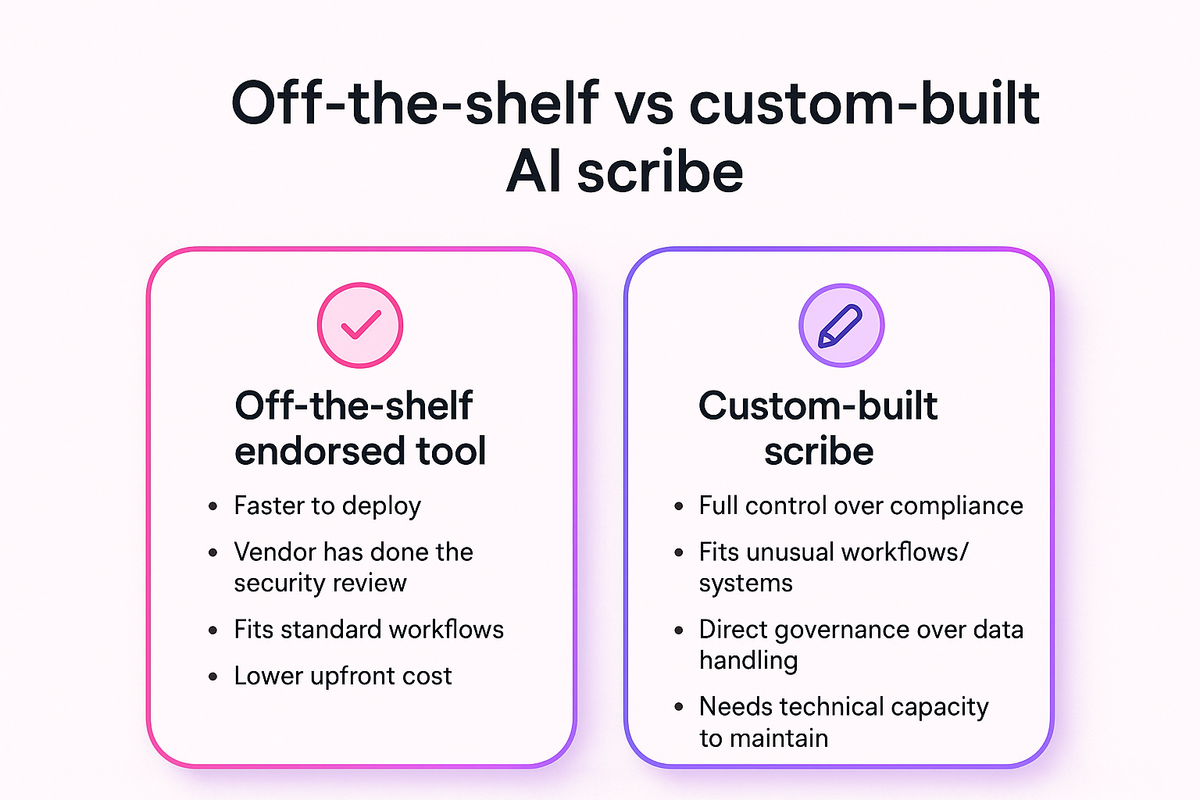
That build-your-own path isn't for everyone — it needs real technical capacity and ongoing maintenance. It tends to suit clinics with unusual workflows, strict data-governance requirements, or existing systems an off-the-shelf scribe won't integrate with cleanly. For clinics in that position, the relevant question usually isn't "which scribe has the best demo" but "who can build a documentation tool around our compliance requirements, not the other way round." That's closer to work done by custom AI developers than by scribe vendors — Supahuman, for instance, doesn't sell a scribe product, but its AI Workspace platform runs on AWS Australia infrastructure with architecture informed by ISO27001 and NZISM practices, and includes compliance checks against standards like ISO27001, PII handling and SOC2 — the kind of foundation a clinic wanting a governance-controlled, purpose-built documentation tool would need to specify, whether they build it themselves or with a partner.
Key takeaways
- NAIAEAG currently endorses four ambient scribes for NZ's public system — Heidi, iMedX, T-Pro and IntelliTek — following privacy, security and contractual review; private clinics can use this as a due-diligence benchmark even if not bound by it.
- The Medical Council of New Zealand is explicit: AI tools do not replace professional judgement, and clinicians remain responsible for every clinical decision that goes into the record.
- A University of Otago survey found 41% of surveyed providers weren't obtaining explicit patient consent for AI scribe use, and clinicians reported subtle hallucinations and missed findings — real gaps, not theoretical risk.
- Data storage and consent processes deserve as much scrutiny as speed gains; check where data is hosted against the Health Information Privacy Code 2020, the Privacy Act 2020 and the incoming IPP 3A obligation from 1 May 2026.
- Off-the-shelf endorsed tools suit most clinics; custom-built scribes (as Tend chose) suit clinics with strict governance needs or systems an off-the-shelf tool won't integrate with.
Our take
The demo will always look impressive — ambient transcription is genuinely good technology now. The harder, less glamorous question is whether a clinic has built the human checkpoints around it: documented consent, a forced review step before notes enter the record, and clarity on where the data actually sits. A NZ clinic that picks an endorsed tool but skips those checks hasn't really de-risked anything; a clinic that builds its own tool with proper governance, as Tend did, has done more real compliance work than one that just bought the best-reviewed product off the shelf. Buy for the workflow discipline, not just the transcript quality.
FAQ
Which AI scribes are endorsed for use in New Zealand's public health system? Health New Zealand's NAIAEAG currently endorses four ambient AI scribes — Heidi, iMedX, T-Pro and IntelliTek — following privacy, security and contractual review. Private clinics aren't required to use these, but the endorsement is a useful reference point for their own vendor due diligence.
If my clinic uses an AI scribe, am I still responsible for what's in the patient record? Yes. Medical Council of New Zealand guidance states that AI tools do not replace professional judgement and that doctors remain responsible for all clinical decisions, including checking that the tool is safe and suitable and that consent and privacy safeguards are in place. AI drafts assist; the clinician's review and validation is what makes a note fit for the record.
Do I need explicit patient consent to use an AI scribe in a consultation? Medical Council guidance says clinicians must obtain informed consent in specific situations. A University of Otago survey found 41% of surveyed providers weren't doing this — a documented consent process should be part of any AI scribe workflow, not an afterthought.
Where is my clinic's patient data actually stored if I use an AI scribe? This varies by vendor and should be confirmed before signing. Patient health information falls under the Health Information Privacy Code 2020 and the Privacy Act 2020, with a new obligation (IPP 3A) starting 1 May 2026. Some NZ patient data was reported stored offshore in Sydney as of late 2025, so ask vendors directly rather than assuming local hosting.
Should my clinic buy an off-the-shelf AI scribe or build our own? Most clinics are better served by an endorsed, off-the-shelf tool — it's faster to deploy and already reviewed. Clinics with strict governance requirements or systems that don't integrate cleanly, like Tend, may find a custom-built scribe gives them more control over compliance and data handling.
Can a custom AI documentation tool replace an AI scribe entirely? Not directly — building a scribe from scratch is a significant undertaking. But clinics with unusual workflows or governance needs sometimes work with custom AI developers (rather than off-the-shelf scribe vendors) to build documentation tools specified around their own compliance and infrastructure requirements, as Tend did with its in-house, Indici-integrated scribe.