AI Personalisation Software for NZ Retail: A Buyer's Guide
16 July 2026 · 8 min read
Most small-to-medium NZ retailers can personalise customer experience using off-the-shelf AI tools that plug into their existing e-commerce platform, no data science hire required. These tools handle recommendations, personalised emails and on-site product surfacing out of the box. The trade-off is that they run on generic, aggregated models rather than data trained specifically on your customers — which matters more as your catalogue and customer base grow.
What "AI personalisation" actually means for a retailer without a data team
Strip away the marketing language and AI personalisation software does a handful of concrete things: it recommends products based on browsing or purchase history, tailors email and on-site content to individual shoppers, and adjusts pricing or promotions dynamically for different segments. None of this requires you to build a model from scratch.
Most tools in this category are built as apps or plug-ins for common e-commerce platforms. That's the whole point — they're designed so a retailer without in-house technical staff can install, connect a data feed, and start seeing recommendations within days rather than months.
The catch is that "plug and play" doesn't mean "tuned to you." A generic recommendation engine trained on aggregated data across thousands of unrelated stores may perform well on paper but miss the quirks of a smaller NZ customer base — regional buying patterns, a niche catalogue, or seasonal promotions that don't map neatly onto a global model.
Off-the-shelf tools vs custom-built AI: which fits your shop?
There are really two paths, and the right one depends on how closely your customers' behaviour matches the assumptions built into a generic tool.
Off-the-shelf tools are faster and cheaper to start. You connect a plug-in to your platform, feed it a product and customer data export, and it starts generating recommendations. The model behind it, though, is trained on broad, aggregated patterns — not your specific shoppers — so results may need manual tuning, and keeping product catalogues and promotions in sync often means ongoing exporting and importing of data between systems.
Custom-built solutions are trained on your own sales and behavioural data. That generally means a closer fit to how your actual customers shop, but it requires more upfront investment, technical scoping, and continued input from your team as the model is built and refined. This is a genuinely different commitment, not a bigger version of the same thing — you're paying for fit, not just for features.
Neither option is automatically "better." A retailer with a fairly standard catalogue and low promotional complexity may get most of the value from an off-the-shelf tool at a fraction of the cost. A retailer with distinctive products, complex bundling, or customer behaviour that doesn't map to generic templates may find a custom approach pays off faster than expected — but only if the scoping is done properly.
How much technical work is really involved?
Even "no-code" personalisation tools carry some technical overhead. Before assuming a tool will just work, check:
- Whether it integrates natively with your e-commerce platform, or requires manual data exports and imports to stay current
- Whether it connects cleanly to your point-of-sale or inventory system — not all tools do, and mismatched stock data undermines the whole point of personalisation
- Who is responsible for ongoing maintenance, troubleshooting and retuning as your catalogue changes
- Whether the vendor offers local NZ support and onboarding, or you're relying on offshore documentation and time-zone-mismatched support tickets
The honest answer is: less technical work than building your own model, but rarely zero. Budget time for setup, data cleanup and a settling-in period before you judge results.
Privacy Act 2020 obligations you can't skip
Any tool that collects, stores or uses customer data to personalise shopping experiences puts you squarely in Privacy Act 2020 territory. NZ retailers are responsible for how personal information is collected, used and retained — even when a third-party tool is doing the processing on your behalf.
Before signing up to any personalisation platform, check:
- Where customer data is stored and processed, and whether that's disclosed clearly
- Whether the vendor's data retention practices align with what the Office of the Privacy Commissioner expects of NZ businesses
- Whether customers are told, in plain terms, that their data is being used for personalisation
- Whether you can delete or export customer data if you switch tools later
This isn't a box-ticking exercise you hand off to the vendor. The obligation sits with your business, so the compliance check needs to happen before the contract is signed, not after.
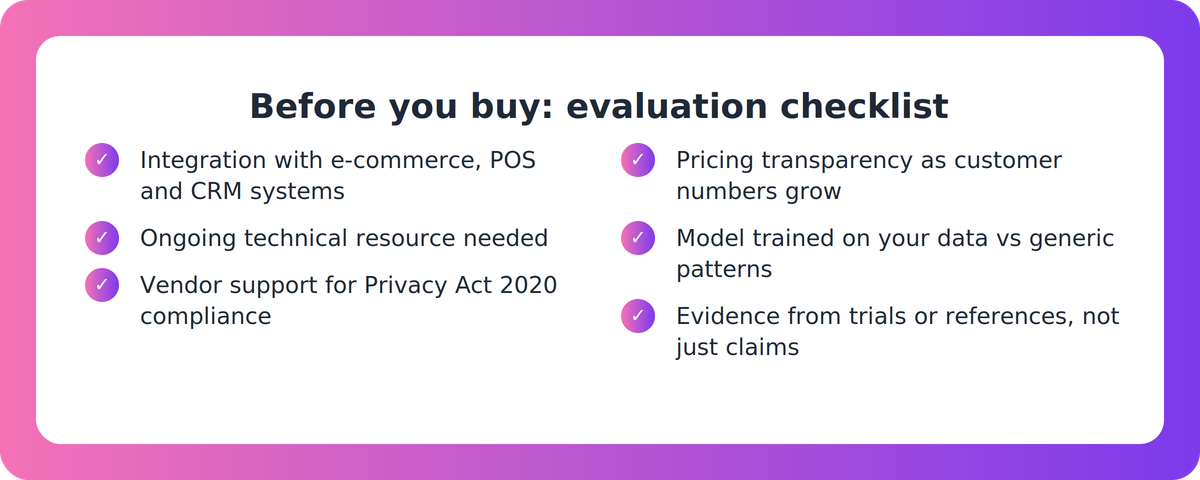
Checklist: what to weigh before you buy
- Integration with your existing e-commerce, POS and CRM systems
- Technical resource needed to set up and maintain it over time
- Clear vendor support for Privacy Act 2020 compliance
- Pricing transparency and how costs scale with customer numbers or transaction volume
- Whether the model learns from your own data or relies on generic patterns
- Local NZ support and onboarding availability
- Real evidence — trials, references, case studies — not just vendor claims
Pricing deserves particular attention. Some tools charge per contact or subscriber, others by usage tier, others take a revenue share. A price that looks reasonable at your current customer count can scale unpredictably as your list grows, so model the cost at double or triple your current volume before committing.
Key takeaways
- Off-the-shelf AI personalisation tools are the realistic starting point for most NZ retailers without a data science team, but they run on generic models that may not reflect your specific customers.
- Custom-built solutions trained on your own data can improve relevance, but need more upfront investment, scoping and ongoing input.
- Integration with your POS, inventory and CRM systems should be confirmed before you buy — not all tools connect cleanly.
- Any tool using customer data for personalisation must be assessed against your Privacy Act 2020 obligations; responsibility sits with your business, not the vendor.
- Treat vendor accuracy and ROI claims as marketing until you've seen evidence specific to a business like yours.
Our take
For most smaller NZ retailers, starting with an off-the-shelf tool and treating the first few months as a genuine trial — not a purchase decision — is the sensible path. Watch closely for where the generic model gets your customers wrong, because that gap is exactly where a more tailored, custom-built approach starts to earn its higher price tag. The mistake we see retailers make isn't choosing the wrong category — it's committing to either option on vendor promises alone, without testing fit against their own catalogue and customer behaviour first.
FAQ
What AI personalisation tools can a small-to-medium NZ retailer use without hiring a data science team? Most SME retailers start with off-the-shelf personalisation apps or plug-ins built for common e-commerce platforms. These are designed to be installed and configured without in-house technical staff, though some manual data setup and ongoing tuning is usually still needed.
How much technical work is needed to connect AI personalisation tools to an existing NZ e-commerce platform? It varies by tool. Some integrate directly with your platform; others require exporting and importing product and customer data manually to keep catalogues and promotions aligned. Compatibility with your point-of-sale and inventory systems should be confirmed before you commit.
What NZ privacy obligations apply when using customer data to personalise online shopping experiences? Retailers must handle customer data in line with the Privacy Act 2020 and guidance from the Office of the Privacy Commissioner, covering how data is collected, used and retained. This responsibility applies even when a third-party AI tool is doing the processing.
Is an off-the-shelf personalisation tool enough, or does a retailer need a custom-built AI solution? Off-the-shelf tools are usually enough for retailers with fairly standard catalogues and customer behaviour. Retailers whose products, promotions or customer patterns don't fit generic templates may see better results from a custom-built solution trained on their own sales and behavioural data — at the cost of more upfront investment and scoping.
How should a retailer compare pricing across personalisation tools? Model costs at your current customer volume and at two to three times that volume, since pricing structures — per-contact, usage-tier or revenue-share — can scale very differently as your list grows. Compare that against any custom-build quote, which is usually structured around fixed milestones rather than ongoing per-customer fees.
If you're weighing a generic tool against something built around your own catalogue and customer data, it's worth scoping both properly before you decide — a short conversation about your actual data and workflows will tell you more than any vendor's feature list.