Board Reporting for PTEs in NZ: Fix the Question, Not the Deadline
3 September 2026 · 7 min read

A late board pack isn't a scheduling failure — it's a diagnostic result. It tells you the systems generating your enrolment, financial and quality data can't answer, in real time, the question governance now has to ask continuously under NZQA's new framework, not periodically as it used to.
Why this lands on your desk, not HR's
You own the systems, the calendar and the people that turn raw enrolment, financial and quality data into something a board or NZQA can act on. When the pack is late, everyone else gets to ask why. You have to know.
Three things have changed the stakes on that question in the last year:
- NZQA has replaced the periodic evaluation model with an annual, continuous self-review rhythm — so "we'll fix it before the next audit" is no longer an option.
- TEC's risk model for Private Training Establishments (PTEs) treats poor-quality Single Data Return (SDR) reporting as a funding-risk signal in its own right, not just an administrative miss.
- PTEs must file financial reports within five months of balance date or breach funding conditions — a hard date that collides badly with any manual, spreadsheet-built reporting process.
None of these are new pressures created by an unreasonable board. They're regulatory design changes you're now operating inside.
The compliance rhythm just changed underneath you
From 2026, NZQA's integrated Quality Assurance Framework (iQAF) replaces the Evaluative Quality Assurance Framework for PTEs and ITPs. New external evaluation and review (EER) and consistency review processes stopped starting from 1 January. In their place, providers submit an annual self-review summary report and meet NZQA to discuss an improvement plan.
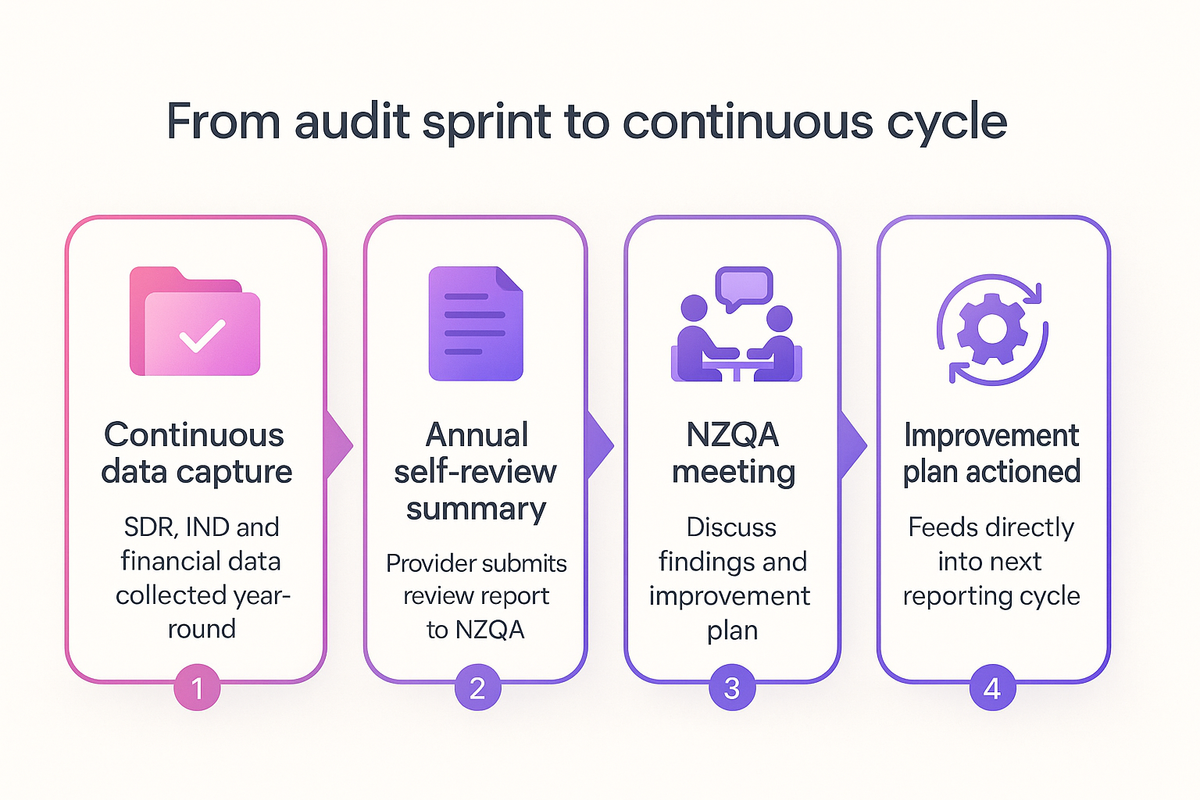
Reporting on your Education Code of Practice self-review has also been folded into that same annual TEO self-review submission, collapsing two compliance streams into one cycle you now have to design your internal reporting calendar around.
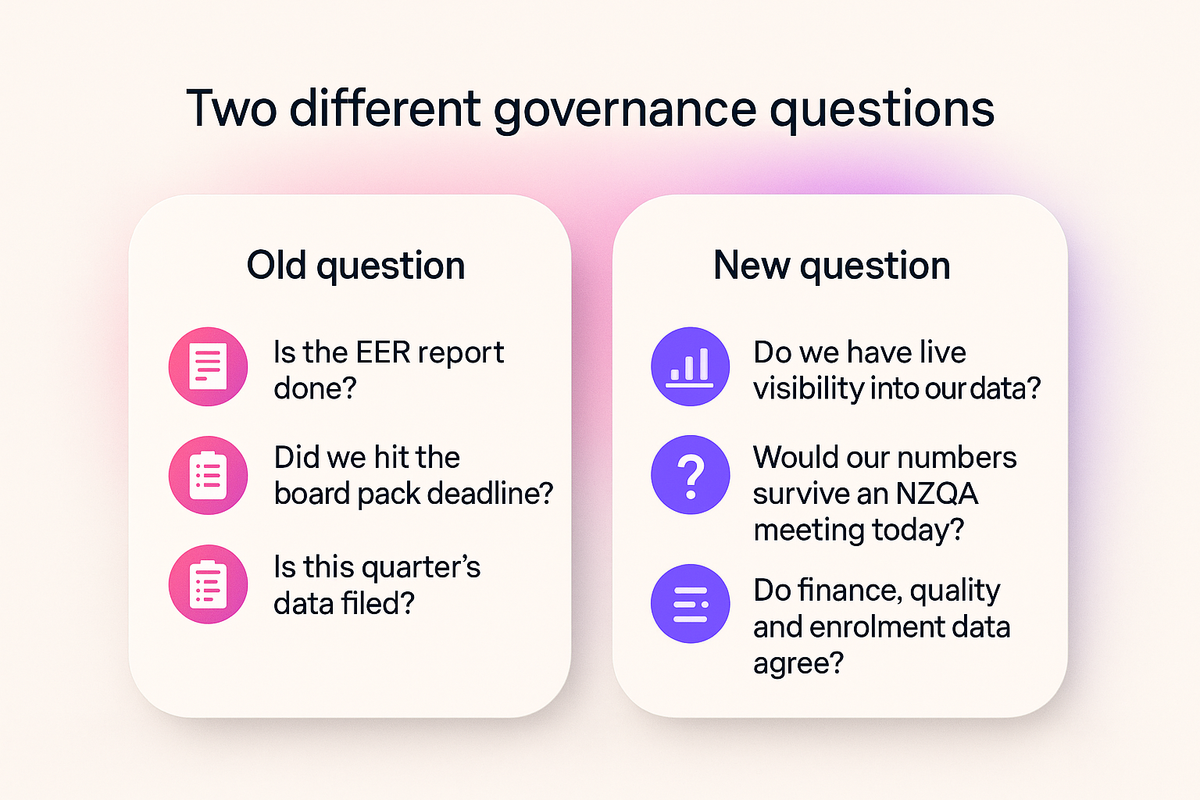
This is the structural shift that makes the old board question obsolete. "Did we finish the EER report on time?" assumed you had years between formal checkpoints to get your house in order. "Do we have accurate, live visibility into our data?" assumes you don't — because now you don't.
A thin board pack is now a funding-risk signal, not just an internal embarrassment
Tertiary education organisations submit SDR and Indicative Enrolment Collection (IND) data to TEC throughout the year to receive funding for delivery on the NZ Qualifications and Credentials Framework, plus a Workforce Questionnaire alongside the December SDR. That's a lot of touchpoints where data quality is visible to a funder, not just your own board.
TEC's own risk model for PTEs explicitly names low-quality SDR or fund reporting as a factor that elevates funding risk. And TEC has reciprocal arrangements allowing it to share PTE financial-viability concerns with NZQA on a confidential basis. Put those two facts together and a late or thin board pack stops being a governance-committee headache. It becomes a data-integrity signal that two regulators can see and act on independently of each other.
The five-month clock doesn't care how you built the spreadsheet
PTEs must supply financial reports within five months of balance date. Missing it is a breach of funding conditions, with your ongoing funding at risk as a direct consequence. That's not a target you negotiate with your finance team in a busy quarter — it's fixed, and you're personally accountable for hitting it.
If your reporting process depends on someone manually reconciling enrolment, financial and quality data across systems that don't talk to each other, that deadline is a fixed date sitting on top of a variable-length process. Every quarter you get lucky is a quarter you haven't actually fixed anything.
The data itself is changing, not just the calendar
A new suite of rules — the Private Training Establishment Rules 2026, the Qualification and Micro-credential Listing and Operational Rules 2026, and the Quality Assurance of Tertiary Education Providers Rules 2026 — took effect between 19 January and 1 February 2026. They align provider obligations with the iQAF, add new credit-reporting requirements, and remove the fixed maximum review periods that used to apply to qualifications and micro-credentials.
For a COO, this matters more than the compliance-calendar shift. It means the schema you're reporting from — what fields matter, what counts as current, what "under review" even means for a qualification — is itself moving. A reporting process built to answer last year's question won't automatically answer this year's, even if you hit every deadline.
The wider sector context reinforces why this isn't optional groundwork. Te Pūkenga was disestablished from 1 January 2026, with its programmes and functions transferring to ten regional polytechnics and new Industry Skills Boards, and officials have publicly warned the restructured polytechnic sector remains financially "at risk." Every PTE is operating inside the same NZQA/TEC rules ecosystem as that upheaval, whether or not the restructure touches you directly. Regulatory attention on financial viability isn't going to soften.
Ask a different question
The fix isn't a faster reporting sprint before board day. It's changing what the board pack is actually built to answer.
Key takeaways
- NZQA's iQAF, live from 2026, replaces periodic EER with an annual self-review summary report and NZQA meeting — your reporting rhythm is now continuous, not cyclical.
- TEC's risk model for PTEs names low-quality SDR reporting as a funding-risk factor, and TEC can share viability concerns with NZQA confidentially — data quality is now visible across agencies.
- PTEs must file financial reports within five months of balance date; missing it breaches funding conditions and puts ongoing funding at risk.
- New 2026 NZQA rules (PTE Rules 2026, Qualification and Micro-credential Listing and Operational Rules 2026, Quality Assurance of Tertiary Education Providers Rules 2026) change reporting requirements themselves, not just deadlines.
- A late or thin board pack is a symptom of disconnected systems and manual reconciliation — treat it as a data-architecture problem, not a staffing one.
Our take
Most operations leaders in this sector still measure reporting success by whether the pack arrived on time. That's the wrong scoreboard now. The right one is whether the numbers in that pack would survive an unannounced NZQA meeting or a TEC data query the same week — because under the iQAF and the SDR-linked risk model, that's effectively what's being asked of you all year, not just at balance date.
Fixing this at the level of "can we get it done faster" just produces a faster wrong answer. The organisations that stop firefighting board week are the ones that treat continuous data accuracy as the actual compliance product, and the board pack as one of several things that data feeds — alongside SDR submissions, the annual self-review, and whatever NZQA or TEC asks for next.
FAQ
What is the iQAF and when does it start affecting my PTE? The integrated Quality Assurance Framework (iQAF) replaces NZQA's Evaluative Quality Assurance Framework for PTEs and ITPs. New EER and consistency review processes stopped starting from 1 January, and providers now submit an annual self-review summary report and meet NZQA to discuss an improvement plan, folding Education Code of Practice self-review reporting into the same cycle.
How does TEC's risk model connect board reporting to our funding? TEC's risk model for PTEs names low-quality SDR or fund reporting as a factor that elevates an organisation's funding risk. TEC also has arrangements to share PTE financial-viability concerns with NZQA confidentially, so reporting quality functions as a signal both agencies can act on.
What's the actual deadline for PTE financial reporting, and what happens if we miss it? PTEs must supply financial reports within five months of balance date. Missing this is a breach of funding conditions and can put ongoing TEC funding at risk — it isn't a soft internal target.
Do the 2026 NZQA rule changes affect what we report, or just when? Both. The Private Training Establishment Rules 2026, the Qualification and Micro-credential Listing and Operational Rules 2026, and the Quality Assurance of Tertiary Education Providers Rules 2026 took effect between 19 January and 1 February 2026. They add new credit-reporting requirements and remove fixed maximum review periods for qualifications and micro-credentials, changing the underlying data structure providers report against.
A question worth sitting with before your next board cycle: if NZQA rang tomorrow and asked for your current enrolment, financial and quality numbers, could you produce them without opening five spreadsheets and calling three people first? If not, that's the process to fix — not the deadline.