Compliance Evidence Traceability: NZQA's New Bar for PTEs
17 September 2026 · 8 min read

Compliance Evidence Traceability: NZQA's New Bar for PTEs
NZQA no longer just wants to know a task was completed. It wants to know who completed it, when, and whether that record can be produced on request — not reconstructed after the fact from someone's memory and a folder of old emails. That shift, buried inside the move from external evaluation and review (EER) audits to annual self-review, changes what "being compliant" actually means for the person who signs off on it.
Why this lands on your desk
Up to now, audit-readiness has been a project with a start date. You knew roughly when your EER window was coming, and you built toward it. That model is ending. NZQA stopped starting new EER processes and consistency reviews from 1 January 2026 — reviews already underway will be completed, but the audit-cadence era is over.
In its place: an annual organisational self-review report, required under the Quality Assurance of Tertiary Education Providers Rules 2026, which came into force on 19 January 2026 and replaced the Quality Assurance (including EER) Rules 2022. Every calendar year you now have to identify improvement areas, confirm compliance, and respond to themes on NZQA's published annual schedule. From July 2026, that obligation extends to all non-university tertiary education providers, including Industry Skills Boards delivering work-based training — so the circle of organisations carrying this reporting load is widening, not narrowing.
On top of that, every provider must have — or build by 1 January 2027 if they don't already — a quality management system covering all aspects of their education and training operation, and be able to produce it to NZQA on request. Not a folder you assemble before an audit. A live system NZQA can ask to see at any point.
Add scheduled and unannounced risk-based monitoring visits to that mix, and you're carrying a standing obligation to prove things are current, not a periodic one to prove they were current once.
From EER cycle to continuous self-review
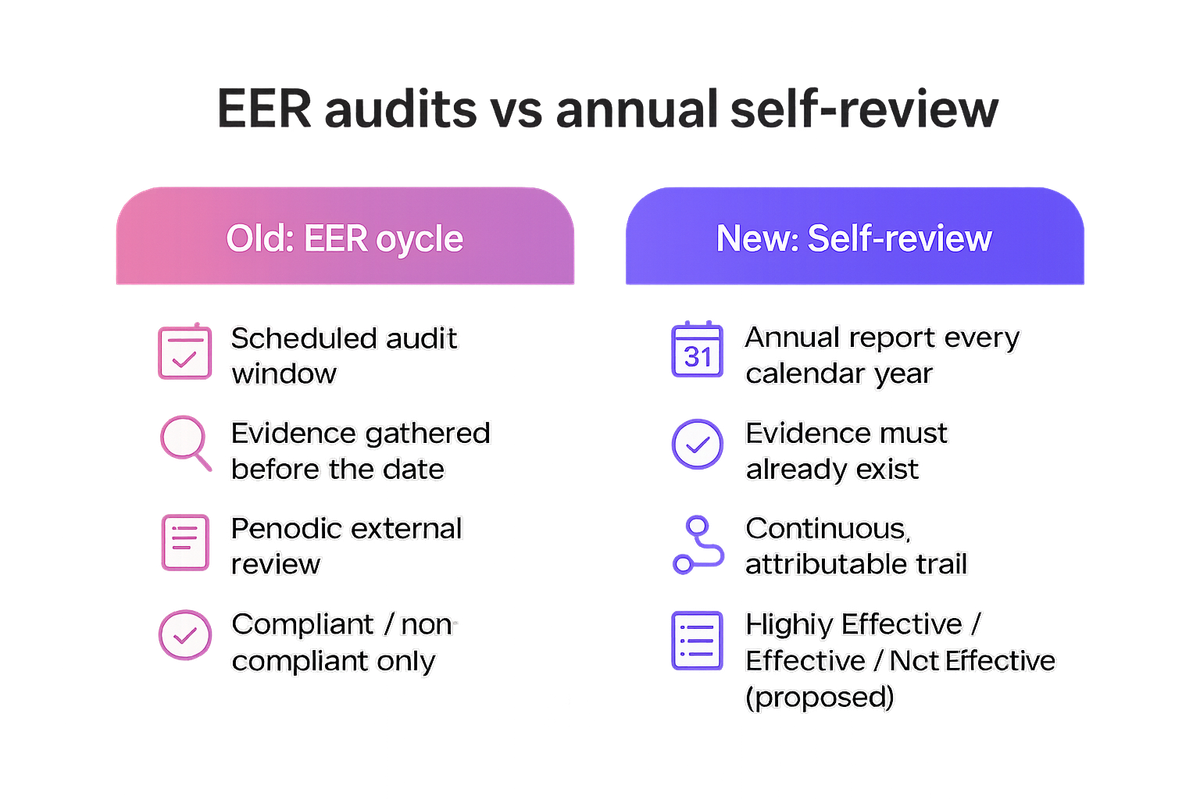
The practical difference is where the burden of proof sits in time. Under EER, you had a window to gather evidence and present your best case. Under self-review, the evidence has to already exist, dated and attributable, whenever NZQA or an inspector asks for it.
That's a harder standard than it sounds. It's one thing to know a policy review happened somewhere in the last twelve months. It's another to show, on the spot, who reviewed it, what changed, and when it was signed off — especially when your evidence lives across shared drives, inboxes and half a dozen spreadsheets that nobody but you can fully navigate.
If you're the only person who can find the trail, you're also the single point of failure the moment you're on leave, at a conference, or simply buried under three other things when the risk-based visit happens to land.
The quality management system is now a live system of record
The requirement to "have, maintain and produce" a quality management system is doing more work than it looks like on paper. It's NZQA telling providers that a set of documented policies isn't sufficient evidence of quality — you need a system that shows how those policies are actually being applied, by whom, and how recently.

The Private Training Establishment Rules 2026 sharpen this further for enrolment records specifically: they must be kept for at least two years after completion, and be easily recoverable and printable from the PTE's electronic data storage system. That's not a suggestion to keep good records — it's a specific, checkable obligation about retrieval, not just retention.
The same rules reinforce that ownership of records can't be delegated away. New sub-contracting provisions require that even where a sub-contractor delivers the training, your organisation retains all enrolments and must maintain all student enrolment and academic information. If a sub-contractor's evidence trail goes cold, that's still your compliance gap.
Stale documents are their own compliance risk
Here's the part that makes this genuinely difficult right now: the ground you're documenting against is itself moving. The 19 January 2026 rules rewrite touched the Private Training Establishment Rules, the Quality Assurance of Tertiary Education Providers Rules, and the Qualification and Micro-credential Listing and Operational Rules all at once. Workforce Development Councils were replaced by Industry Skills Boards from January 2026. Te Pūkenga's disestablishment is underway, with regional polytechnics and NZIST operating as a transitional arrangement.
Which means a policy, TAS document, or standards reference drafted even a year ago may cite a body or rule set that no longer exists in that form. Traceability isn't just about proving a task happened — it's about proving your documentation was updated to reflect the current regulatory landscape, and knowing exactly who updated it and when it went stale before that.
What "who did this, when" actually buys you
A clear, timestamped ownership trail does three things that a simple "yes, it's done" checkbox doesn't:
- It survives staff turnover. When the person who actioned a task leaves, the record of what they did and why doesn't leave with them.
- It gives you an early warning system. If nobody has touched a policy review in eight months, that's visible before an inspector notices it, not after.
- It holds up under an unannounced visit. You're not reconstructing a narrative on the spot — you're pointing at a record that already exists.
Preparing for a tougher effectiveness rating
NZQA is consulting (closing 7 September 2026) on replacing the simple compliant/non-compliant call with three descriptors — Highly Effective, Effective, Not Effective — assessed across four weighted criteria, one of which is your quality management system. That's a meaningful change in what "good enough" looks like. A system that merely exists won't be enough to land in the top tier; the assessment is explicitly about how well it functions, which almost certainly means how well it can demonstrate ownership, currency and follow-through.
Key takeaways
- NZQA has stopped starting new EER processes from 1 January 2026; annual self-review reporting is the new baseline, extending to all non-university providers from July 2026.
- Every provider needs a quality management system that covers the whole operation and can be produced to NZQA on request — build one before 1 January 2027 if you don't have one.
- Enrolment records must be recoverable and printable for at least two years post-completion under the Private Training Establishment Rules 2026; sub-contracted delivery doesn't transfer that responsibility.
- Policies and TAS documents can go out of date within months given the January 2026 rules rewrite and the Industry Skills Board and Te Pūkenga restructuring — currency needs its own tracking, separate from task completion.
- A proposed three-tier effectiveness rating (closing for consultation 7 September 2026) raises the bar from "compliant" to "demonstrably well-run," with quality management systems as one of four weighted criteria.
Our take
The sector conversation about this shift has mostly focused on the paperwork — new rules, new reporting cadence, new terminology to learn. The bigger change is quieter: NZQA has moved from trusting a snapshot to expecting a trail. That reframes your job from "prepare well for the next audit" to "never be more than a few clicks away from proof of who did what, and when." Providers that treat this as a one-off documentation refresh will find themselves back in the same scramble next year, because the rules underneath them will have moved again. The ones who get ahead of it are the ones who stop treating evidence as something assembled for an event, and start treating it as something that's simply always current.
FAQ
What changed on 19 January 2026 that affects how I show compliance? The Quality Assurance of Tertiary Education Providers Rules 2026 came into force, replacing the Quality Assurance (including EER) Rules 2022, alongside updated Private Training Establishment Rules 2026 and Qualification and Micro-credential Listing and Operational Rules. Together they shift the compliance model from periodic EER audits to annual self-review reporting.
Do I need a quality management system if I already have policies and procedures? Yes — NZQA's requirement is for a system covering all aspects of your education and training operation that you can produce on request, not a static set of policy documents. If you don't have one, the rules give you until 1 January 2027 to build it.
How does the move to annual self-review change my audit prep cycle? Instead of preparing for a scheduled EER window, you now submit a self-review report every calendar year confirming compliance and addressing NZQA's published annual themes — and from July 2026 this applies to all non-university providers, including Industry Skills Boards running work-based training.
What does the proposed three-tier effectiveness rating mean for my evidence? Under consultation until 7 September 2026, NZQA is proposing to replace the compliant/non-compliant judgement with Highly Effective, Effective and Not Effective ratings across four weighted criteria, including quality management systems — meaning evidence quality, not just evidence existence, will matter more.