Custom AI Development NZ: A Buyer's Guide for PTEs
28 July 2026 · 7 min read

If you're a New Zealand PTE weighing up a custom AI development partner, here's the honest answer: there's no single certificate to check. New Zealand has no AI-specific law or vendor accreditation scheme, so the real test is whether a partner understands your NZQA-related workflows, handles learner data the way the Privacy Act and the Office of the Privacy Commissioner (OPC) expect, and builds systems that keep a qualified human reviewing every compliance-relevant output.
That's a harder thing to shop for than a badge on a website. It means doing some of the evaluation yourself. This guide walks through what actually governs AI use for training providers here, and the questions worth asking before you sign anything.
Is there an official NZ certification or regulator for AI vendors?
Not in the way buyers often expect. MBIE released its national AI strategy, *Investing with Confidence*, in July 2025 — a principles-based, adoption-focused roadmap, not a compliance scheme. It sits alongside existing regimes rather than replacing them, and it doesn't hand out vendor certificates.
The rules that actually apply come from a few places:
- The Privacy Act, interpreted for AI by OPC guidance issued in September 2023. It explains how the 13 Information Privacy Principles apply across an AI system's lifecycle and recommends a Privacy Impact Assessment at the outset of any project touching personal information — which learner records always do. It isn't legally binding in itself, but it's treated as best practice across the sector.
- NZQA guidance, which is assessment-focused rather than vendor-focused. Generative AI isn't permitted for NCEA external assessments, and tertiary providers are expected to run coherent assessment and moderation systems. Separately, PTE registration is governed by the Private Training Establishment Rules 2026 and the Education and Training Act 2020 — neither of which mandates AI vendor certification.
- ISO/IEC 42001, an international AI management system standard with active New Zealand input via a Standards New Zealand mirror committee. It's currently under review for formal adoption as an AS/NZS standard, and it's the closest thing to a concrete, checkable framework a vendor can point to today.
Directories ranking Auckland AI firms — Clutch.co, AVIXA Xchange, and similar — are commercial listings. Useful for finding names, not a substitute for due diligence.
What to look for in a custom AI development partner
With no formal accreditation to lean on, the evaluation falls back on plain, practical questions. Ask any shortlisted partner to answer these specifically, not in generalities:
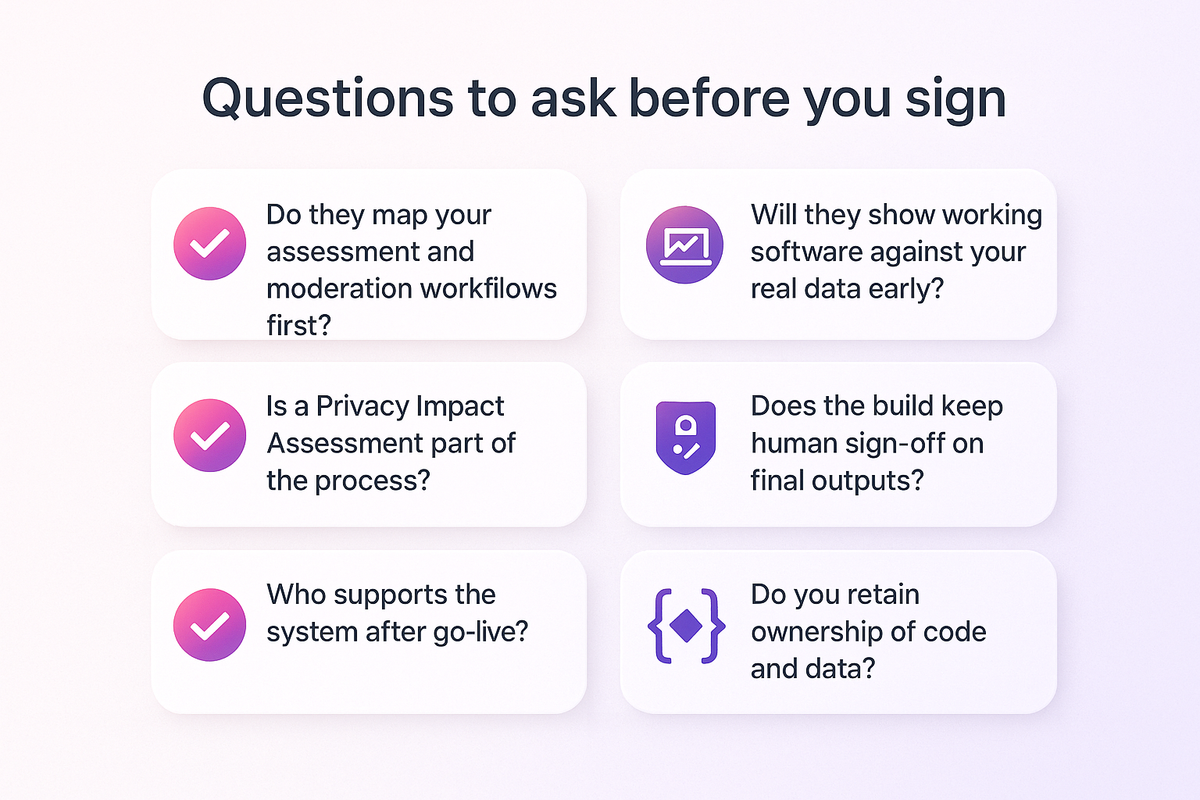
- Do they understand your actual workflows — assessment authoring, moderation, standards mapping — before proposing anything, rather than pitching a generic AI feature?
- Will they show working software early, built against your real data, instead of disappearing into months of discovery documents?
- Do they run a documented privacy risk process, ideally a Privacy Impact Assessment consistent with OPC guidance?
- Does the build preserve human review and sign-off on assessment or compliance-relevant outputs, rather than treating AI as a stand-in for staff judgement?
- What's their support model after go-live — do they keep operating and improving the system, or hand it over and move on?
- Where is data hosted, and what security standards apply?
- Do you keep ownership of your code, data and configurations?
- Is their evidence a named, checkable case study — or just marketing claims?
Generic AI tools vs a custom-built solution for your workflows
The difference isn't sophistication — it's fit. A generic AI chat tool can draft a paragraph or summarise a document. It has no knowledge of your enrolment system, your assessment bank, or where a unit standard sits in the shift toward skill standards on the NZQA directory.
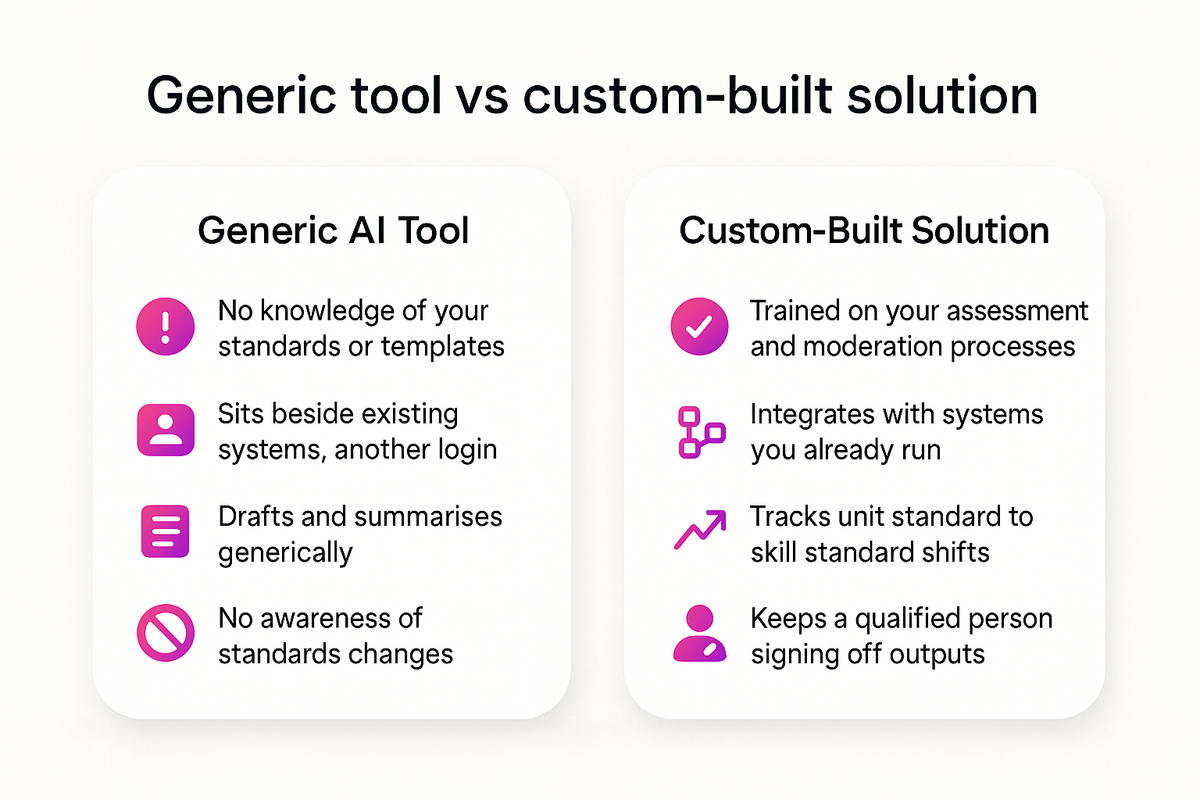
A custom-built solution is trained and integrated against your actual processes: it knows your standards, your templates, your moderation cycle, and it plugs into the systems you already run rather than sitting beside them as another login. That's the trade a training provider is really weighing — convenience now, versus a system that actually understands the work.
Keeping human oversight in assessment and compliance work
The OPC has been explicit that organisations remain accountable for decisions made using AI tools, and expects meaningful human review wherever a decision affects an individual. That expectation doesn't soften for training providers — arguably it matters more, given assessment decisions affect a learner's qualification outcome.
Any custom build touching assessment or compliance work should show, not just claim, that a qualified person reviews and signs off before anything is finalised. In the documented Mast Academy case — a New Zealand PTE — course-creation time reportedly dropped from six weeks to minutes using a custom AI build, but educators still reviewed and refined the AI-drafted materials rather than the system replacing their sign-off. That's the pattern worth looking for: faster drafting, unchanged accountability.
Local support, ownership and evidence of results
A few practical checks round out the evaluation. Local, timezone-aligned support matters when something breaks mid-assessment-period. Clear ownership of your code and data matters so you're not locked into one vendor indefinitely. Recognised security controls at the hosting layer matter given the personal information involved.
Supahuman, for instance, runs its Private AI architecture on AWS in Australia with ISO 27001 and NZISM-aligned controls, and builds in human-approval gates where the stakes call for them. Its team works out of GridAKL in Auckland in one-to-two-week build cycles, proving capability against a client's real data each round rather than presenting a finished pitch after months of silence. None of that is a certification — it's simply one way of answering the questions above with evidence rather than assurance.
Key takeaways
- New Zealand has no standalone AI law or vendor certification scheme — evaluate on workflow fit and data practice, not a badge.
- The Privacy Act and OPC's 2023 AI guidance are the operative rules for learner data; a Privacy Impact Assessment at project outset is best practice, not optional.
- ISO/IEC 42001 is the most concrete applicable standard, with active NZ input via Standards New Zealand.
- NZQA's AI guidance governs assessment integrity, not vendors — GenAI is barred from NCEA external assessment, and coherent moderation systems are expected.
- The strongest signal a partner is right for training-provider work is a named, checkable case study showing human sign-off preserved, not just a directory ranking.
Our take
Custom AI development in New Zealand is still a young, largely unregulated category, and that's not automatically a red flag — it just means the burden of due diligence sits with the buyer, not a regulator. The providers worth shortlisting are the ones willing to be specific: about your NZQA workflows, about where your data lives, about who signs off on what an AI system produces. Anyone offering a one-size-fits-all platform and vague ROI promises hasn't done the work of understanding a training provider's actual compliance obligations — and that gap shows up fast once the system meets a real assessment cycle.
FAQ
Is there an NZ government certification for AI vendors we should ask for? No. MBIE's 2025 AI strategy is principles-based and adoption-focused, not a certification scheme. The closest applicable standard is ISO/IEC 42001, an international AI management system standard with New Zealand input via Standards New Zealand.
Who actually governs how a custom AI tool handles our learners' personal data? The Privacy Act, interpreted through OPC guidance issued in September 2023, which applies the 13 Information Privacy Principles across the AI lifecycle and recommends a Privacy Impact Assessment at project outset.
Can generative AI be used for NZQA assessment work? NZQA guidance does not permit generative AI for NCEA external assessments, and tertiary providers are expected to maintain coherent, human-reviewed assessment and moderation systems throughout.
What's the real difference between a generic AI tool and a custom-built one for a training provider? A generic tool drafts or summarises with no knowledge of your specific standards, templates or moderation process. A custom build is trained and integrated against your actual workflows — including tracking changes like the shift from unit standards to skill standards — while keeping a qualified person reviewing final outputs.
Should directory rankings of Auckland AI firms factor into our decision? Treat them as commercial listings, not regulatory endorsements. A named, checkable case study — showing real workflow fit and preserved human sign-off — is a more reliable signal than a ranking position.