The Real Reason NZ Insurers Back Claims Automation
22 September 2026 · 7 min read
New Zealand insurers aren't automating claims chiefly to save money — they're doing it because weather events are generating claims volumes manual teams can't absorb, rivals are already publishing results, and the Reserve Bank of New Zealand and Financial Markets Authority expect any AI decision to be explainable on demand. Tower, IAG and AA Insurance have all moved from pilots to production in the past year, and the numbers behind that shift explain why.
What's actually forcing the pace?
Ask most claims leaders why they're investing now, and cost reduction is rarely the first answer. Three pressures are converging at once:
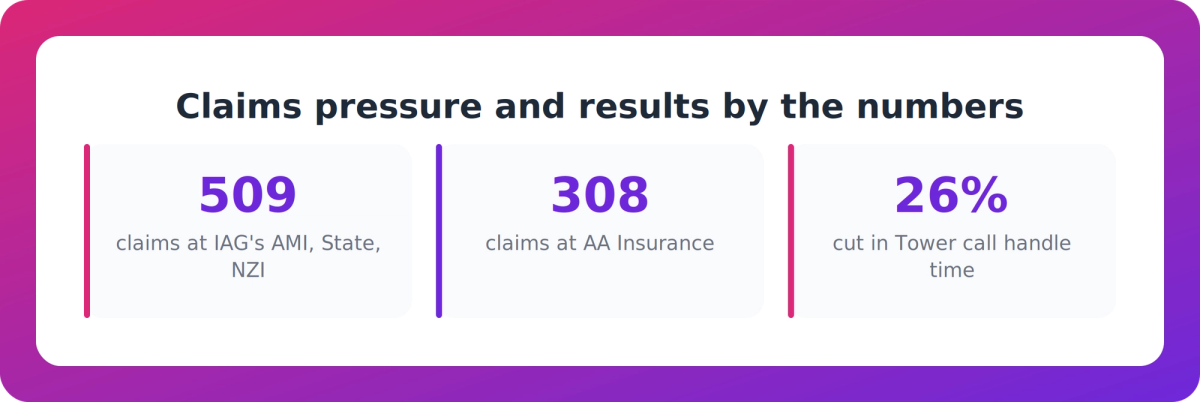
- Claims volumes are spiking faster than manual processes can cope with. A single Wellington flooding and landslip event generated 509 claims across IAG's AMI, State and NZI brands and 308 at AA Insurance in a short window, according to reporting on the event. Tower saw under 130 claims from the same event — a gap that shows how much variance exists in how insurers are set up to absorb a surge.
- Competitors are shipping visible results. Tower's contact-centre rebuild cut call handle time by 26% within five months and saved over a million customer minutes, per Insurance Business reporting on the AWS- and Deloitte-supported Amazon Connect deployment. That's not a pilot metric — it's a published operational outcome other insurers now have to explain if they can't match.
- Regulators are watching how AI decisions get made, not just how fast they land. The Reserve Bank of New Zealand and the Financial Markets Authority have both signalled an enable-but-oversee stance: AI in claims needs to remain contestable and explainable, not a black box that spits out a settlement figure nobody can walk back through.
Why weather is the real trigger, not the pitch deck
IAG New Zealand's decision to migrate its Guidewire ClaimCenter onto the Guidewire Cloud Platform was explicitly framed around the increasing frequency and severity of weather-related events, not around trimming headcount. That framing matters. When a flood or storm can generate hundreds of claims within days, the bottleneck isn't process design in the abstract — it's whether the platform can flex under a genuine spike without breaking service levels or letting claims sit in a backlog.
KPMG New Zealand's analysis of the sector puts this plainly: the real business case for AI in claims is triage. Automating the routine, below-threshold claims frees adjusters to focus on complex or high-value cases, and it reduces what KPMG calls claims leakage — the slow bleed of cost and customer goodwill that comes from claims sitting unresolved. Fraud detection improves as a byproduct, but it's not the headline reason insurers are moving.
What that looks like in practice
- Simple, well-documented claims get assessed and settled with minimal human handling.
- Complex or ambiguous claims escalate to an adjuster, with the AI's reasoning attached so a human can review it quickly.
- Frontline staff use AI-backed knowledge assistants during calls, rather than switching between systems mid-conversation.
- Fraud signals accumulate over time as the volume of processed claims grows.
The competitive scoreboard is now public
Until recently, claims automation in New Zealand was mostly discussed in strategy documents. That's changed. AA Insurance's internally built claims tool won a Financial Review AI Award for Ethics and Responsibility — a signal that responsible design, not just raw speed, is becoming a competitive differentiator. IAG has a multi-year data and AI arrangement with Google Cloud sitting alongside its Guidewire migration. Aon is rolling out an AI-driven claims platform across its network, including New Zealand, through 2026–2027. And industry infrastructure is starting to move too: tools like Grappler's end-to-end settlement system are connecting brokers, managing general agents, underwriting agencies and insurers across the claims chain, rather than each player automating in isolation.
That last point matters for smaller insurers and brokers watching from the sidelines. The competitive gap isn't just about who has the biggest AI budget — it's about who can plug into shared claims infrastructure fastest, without rebuilding everything from scratch.
Why explainability is now a design requirement, not an afterthought
The Reserve Bank of New Zealand and the Financial Markets Authority have made clear they're not trying to slow AI adoption in financial services — but they do expect insurers to be able to show their working. That means:
- Claims decisions need an audit trail a regulator or an ombudsman can follow.
- Customers need a genuine path to contest an automated outcome, not just a support ticket that goes nowhere.
- Models trained on claims data need periodic review, so drift or bias doesn't quietly creep into settlement patterns.
For insurers building or buying claims automation, this is the practical difference between a generic AI tool bolted onto an existing workflow and a system designed around the actual regulatory and operational constraints of the New Zealand market. A model that works well in a vacuum but can't produce an explanation on demand isn't fit for purpose here, no matter how fast it runs.
Key takeaways
- Weather-driven claims spikes — not cost-cutting alone — are the primary reason Tower, IAG and AA Insurance are rebuilding claims platforms now.
- Tower's Amazon Connect deployment cut call handle time by 26% within five months, saving over a million customer minutes.
- A single Wellington flooding event generated 509 claims at IAG's AMI, State and NZI brands and 308 at AA Insurance, showing how fast volume can outpace manual capacity.
- KPMG frames the core opportunity as triage: automate routine claims, escalate complex ones, and reduce claims leakage over time.
- The Reserve Bank of New Zealand and Financial Markets Authority expect claims AI to be explainable and contestable, making governance a design requirement rather than a compliance afterthought.
Our take
The insurers moving fastest here aren't the ones chasing the flashiest AI headline — they're the ones treating explainability as a feature, not a constraint bolted on after the fact. That's the harder engineering problem, and it's exactly where generic, off-the-shelf automation tends to fall short: it optimises for speed and can't produce the audit trail a regulator, an ombudsman or a frustrated customer will eventually ask for. Insurers and brokers who haven't started this work yet should assume the bar has already moved from "can we automate this claim" to "can we show our working when someone asks why."
FAQ
Why are New Zealand insurers investing in claims automation now, rather than five years ago? The immediate driver is volume: worsening weather events are generating claims spikes — such as the 509 claims IAG's AMI, State and NZI brands received from a single Wellington flooding event — that manual processes struggle to absorb quickly. Visible results from competitors, like Tower's 26% cut in call handle time, are adding competitive pressure on top of that.
What role do the Reserve Bank of New Zealand and Financial Markets Authority play in claims AI? Both regulators have signalled an approach that allows AI innovation but expects insurers to keep decision-making explainable and contestable. That means claims automation needs an audit trail and a genuine path for customers to challenge an automated outcome, not just speed.
Is claims automation mainly about cutting costs? Not primarily, based on how insurers themselves frame it. IAG's migration to the Guidewire Cloud Platform was explicitly linked to the increasing frequency and severity of weather events, and KPMG New Zealand frames the core value as reducing claims backlog and leakage through triage, with cost savings following as a result rather than the starting point.
How are insurers deciding which claims to automate? KPMG's triage model, echoed across the sector, focuses on automating routine, below-threshold claims while escalating complex or high-value cases to human adjusters. This keeps human judgement where it matters most while freeing capacity for volume spikes.
Is claims automation only relevant to the big insurers? No. Shared infrastructure is emerging that connects brokers, managing general agents, underwriting agencies and insurers across the claims chain — tools like Grappler's settlement system are one example — meaning smaller players can plug into automated claims processes without building everything themselves.