NZQA Audit Readiness After iQAF: A Compliance Manager's Guide
30 July 2026 · 8 min read

NZQA has stopped telling you when the audit is coming. From 1 January 2026 it isn't opening any new External Evaluation and Review or consistency review processes, and from July 2026 every non-university tertiary education organisation must submit an annual self-review summary report instead. The deadline didn't move. It dissolved into a standing obligation.
Why this hits your desk
You used to run a project. Now you're running an ongoing system, and the difference matters for how you staff, document, and sleep.
Under the old Evaluative Quality Assurance Framework, audit-readiness had a shape: a scheduled visit, a known window to pull evidence together, a four-category rating at the end of it. Under the integrated Quality Assurance Framework (iQAF), that shape is gone. From July 2026, self-review becomes a standing requirement for all non-university tertiary education organisations, including Industry Skills Boards delivering work-based training. You'll submit an annual self-review summary report and sit down with NZQA to discuss an improvement plan — every year, not every few years.
At the same moment, five or more NZQA rule sets changed simultaneously on 19 January 2026: Programme Approval, the Directory of Assessment and Skill Standards, Qualification and Micro-credentials, PTE Registration, and the entirely new Quality Assurance of Tertiary Education Providers Rules 2026. Terminology shifted too — Workforce Development Councils became Industry Skills Boards, Te Pūkenga became regional polytechnics — which means every policy, TAS and evidence document that references the old names needs tracing and updating. Nobody handed you a project plan for that. You're building one yourself, while ratios climb and budgets don't.
What iQAF actually replaces — and what it doesn't
It's worth being precise about what's actually changed, because the risk sits in the gaps between old and new.
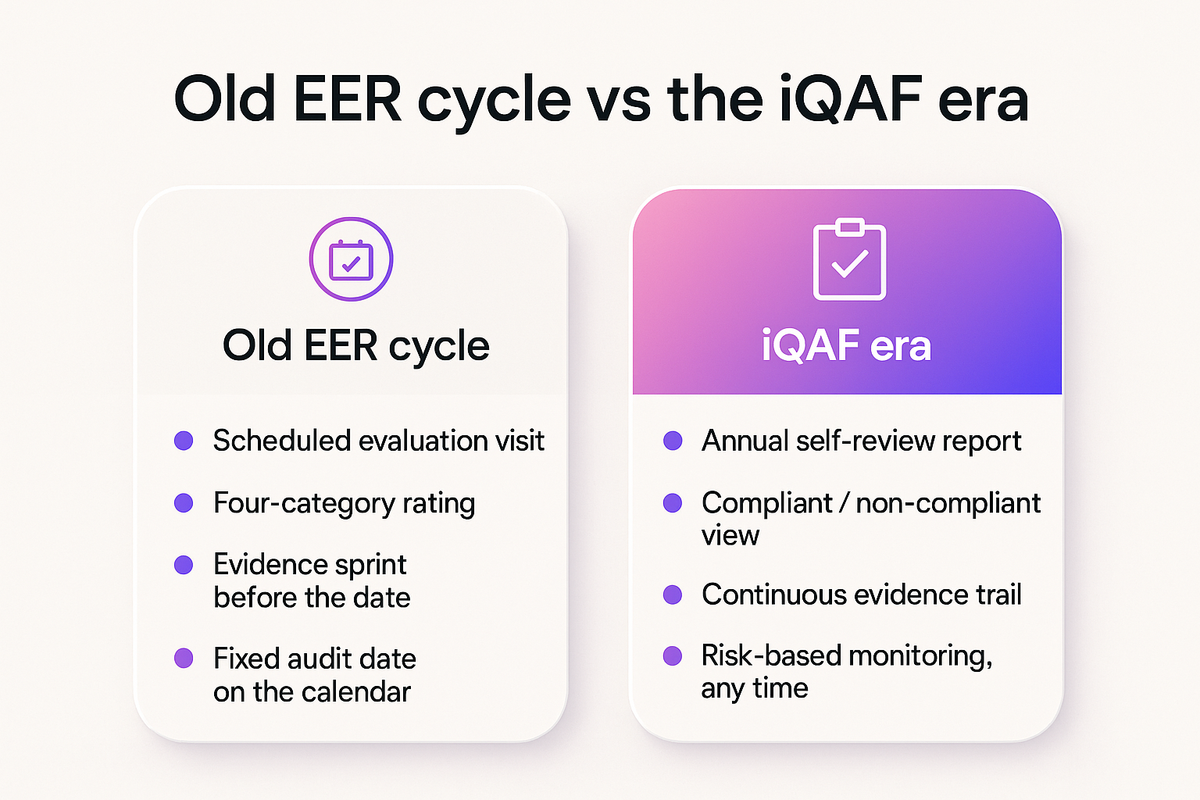
NZQA has described the intent behind iQAF as extending assessment-focused monitoring, moving away from categories tied to a scheduled evaluation, and guided by principles it calls impact-led, anticipatory and adaptable. The four-category EER rating is being replaced with a simpler compliant / non-compliant view.
But Immigration New Zealand will keep using existing EER category ratings for 12 months from early 2026 for visa purposes. That means, for the better part of a year, you may be operating under two live reference points at once: NZQA's new compliant/non-compliant status, and a legacy EER rating that still governs your international student visa standing. If you enrol offshore students, that's a distinction worth calendaring, even though the audit calendar itself no longer exists.
What hasn't changed: NZQA still holds compliance notices, conditions on registration, accreditation withdrawal and cancellation powers, and automatic lapse triggers. The absence of a fixed EER date doesn't mean reduced regulatory exposure. It means the monitoring is less predictable, and evidence gaps are less visible until something surfaces them.
Sub-contracting: the new evidentiary trail
One change deserves its own line item because it's specific, dated, and immediate.
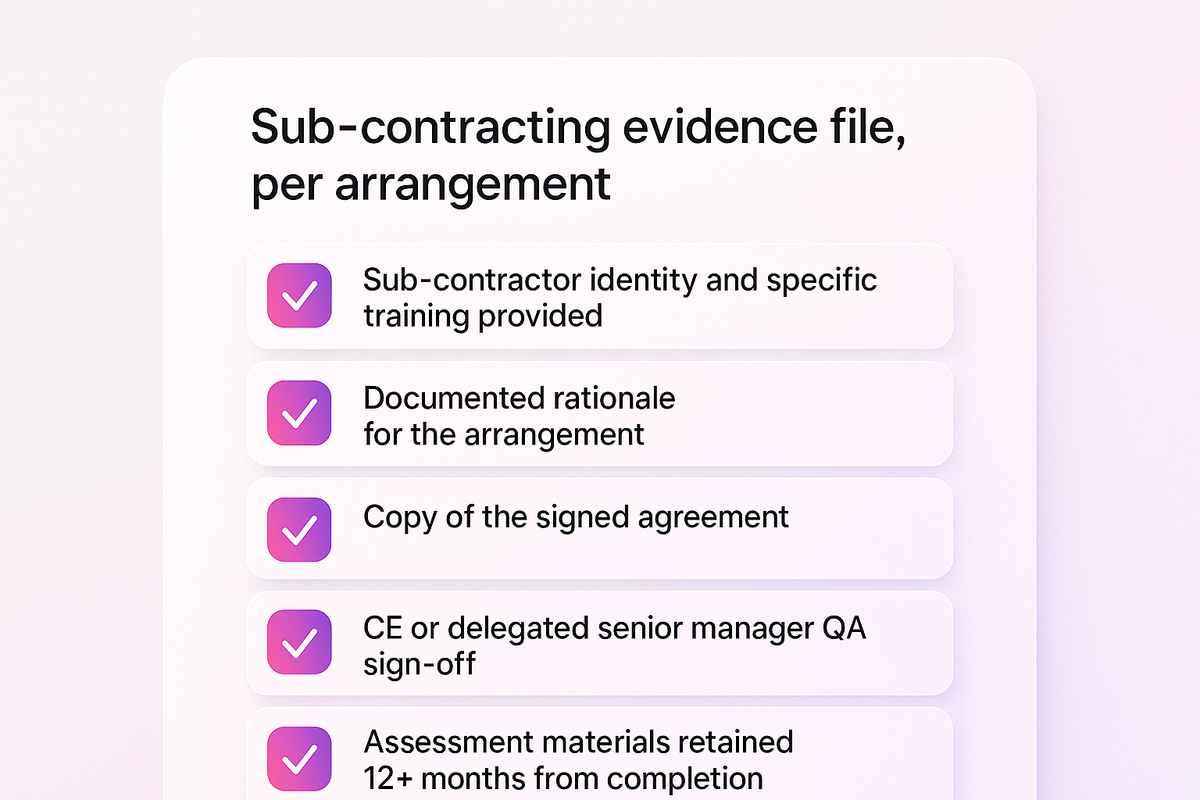
Sub-contracting requirements moved out of the Programme Approval Rules and into the new Quality Assurance of Tertiary Education Providers Rules 2026. If your PTE sub-contracts any training delivery, your Quality Management System now needs to hold, per arrangement:
- The sub-contractor's identity and the specific training they provide
- A documented rationale for the sub-contracting arrangement
- A copy of the signed agreement
- Evidence of internal quality assurance approval by the Chief Executive or a delegated senior manager
PTEs must also retain all student assessment materials — including anything generated by sub-contractors — for at least 12 months from completion. If your evidence for sub-contracted delivery currently lives across a mix of shared drives, old contracts, and someone's inbox, this is the rule set that will find that out for you first.
The staffing squeeze is real, and it lands on you
None of this arrives into a well-resourced quality team. Tertiary providers are operating at the highest student-to-staff ratios since 2016, with PTE ratios rising from 13.1 to 16.0, while funding has not kept pace with roughly 25% cumulative inflation over six years. That's the backdrop against which you're now expected to run continuous self-review instead of periodic audit prep.
The practical effect: fewer hours per compliance task, more tasks per year, and a regulator that expects evidence to be current at any moment rather than assembled for a known date. If you're still the single point of review for every policy and evidence document, that model was already fragile under the old system. Under iQAF, it's not sustainable.
What "continuously defensible" evidence actually looks like
A few practical shifts worth making this quarter, regardless of team size:
- Map every affected document against the January 2026 rule changes — Programme Approval, DASS, PTE Registration, Qualification and Micro-credentials, and the new Quality Assurance of Tertiary Education Providers Rules — and log terminology updates (Industry Skills Boards, regional polytechnics) as you go.
- Build a sub-contracting evidence file per arrangement, not a general folder, so each contract's rationale, sign-off and retention clock is traceable on its own.
- Assign named owners for each self-review domain, so no single person is the bottleneck for the annual report due from July 2026.
- Track the Immigration New Zealand transition window separately if you enrol international students, since legacy EER ratings persist there for 12 months from early 2026 even as NZQA's own framework has moved on.
Key takeaways
- NZQA stopped opening new EER and consistency reviews from 1 January 2026; annual self-review reporting becomes mandatory for non-university TEOs from July 2026.
- Five NZQA rule sets changed simultaneously on 19 January 2026, including terminology shifts (WDCs to Industry Skills Boards, Te Pūkenga to regional polytechnics) that touch every existing policy and TAS.
- Sub-contracting evidence requirements — identity, rationale, signed agreement, CE-level sign-off — moved into the new Quality Assurance of Tertiary Education Providers Rules 2026, with a 12-month assessment material retention rule for PTEs.
- Immigration New Zealand keeps using legacy EER category ratings for 12 months from early 2026, creating a transition period with two compliance reference points for providers with international students.
- NZQA's compliance notices, registration conditions, accreditation withdrawal and lapse powers remain fully in force — the end of the audit calendar is not a reduction in regulatory risk.
Our take
The sector conversation around iQAF has largely focused on relief — no more EER visits, less ceremony, less stress. We think that reading understates the shift. A scheduled audit is actually a forgiving structure: it gives you a known date to work backward from, and a known scope. Continuous, risk-based monitoring gives you neither. The real discipline now isn't preparing a file for a fixed date — it's making sure that on any random Tuesday, someone could ask for evidence against a current rule and you could produce it without a scramble. For a compliance function that's often a team of one operating under tighter staffing ratios than at any point since 2016, that's a genuine step up in what "audit-ready" means, not a lighter version of the old job.
FAQ
Does the end of External Evaluation and Review mean less scrutiny of my provider? No. NZQA has stopped starting new EER and consistency review processes from 1 January 2026, but it retains compliance notices, conditions on registration, and accreditation withdrawal and cancellation powers. Annual self-review reporting from July 2026 replaces the periodic audit with a standing obligation, not a lighter one.
What happens to our existing EER category rating? The four-category EER rating is being phased out in favour of a compliant/non-compliant view under iQAF. However, Immigration New Zealand will continue using existing EER category ratings for 12 months from early 2026 for visa purposes, so providers with international students should track both reference points during the transition.
Do we need to redo our sub-contracting agreements immediately? Sub-contracting requirements moved into the new Quality Assurance of Tertiary Education Providers Rules 2026, in force from 19 January 2026. Each arrangement now needs documented sub-contractor identity and training, a rationale, a signed agreement copy, and CE or delegated senior manager sign-off — worth auditing against your current contracts now rather than waiting for a review to surface a gap.
Who has to submit the new annual self-review report, and from when? From July 2026, all non-university tertiary education organisations — including Industry Skills Boards delivering work-based training — must undertake self-review, submit an annual self-review summary report to NZQA, and meet with NZQA to discuss an improvement plan.