Why Off-the-Shelf AI Is Stalling in NZ Boardrooms
9 July 2026 · 7 min read
Why Off-the-Shelf AI Is Stalling in NZ Boardrooms
New Zealand has hit near-universal AI adoption — 82% of businesses now use some form of AI — yet national productivity fell over the same period. The gap isn't about access to tools. It's about depth: most AI sits bolted onto existing workflows rather than built into how decisions actually get made, leaving boards exposed on both return on investment and governance.
The adoption number that doesn't add up
Deloitte Access Economics research commissioned by 2degrees found 82% of New Zealand businesses now use AI in some form. Over the same period, labour productivity fell 0.7% and multi-factor productivity dropped 0.9%.
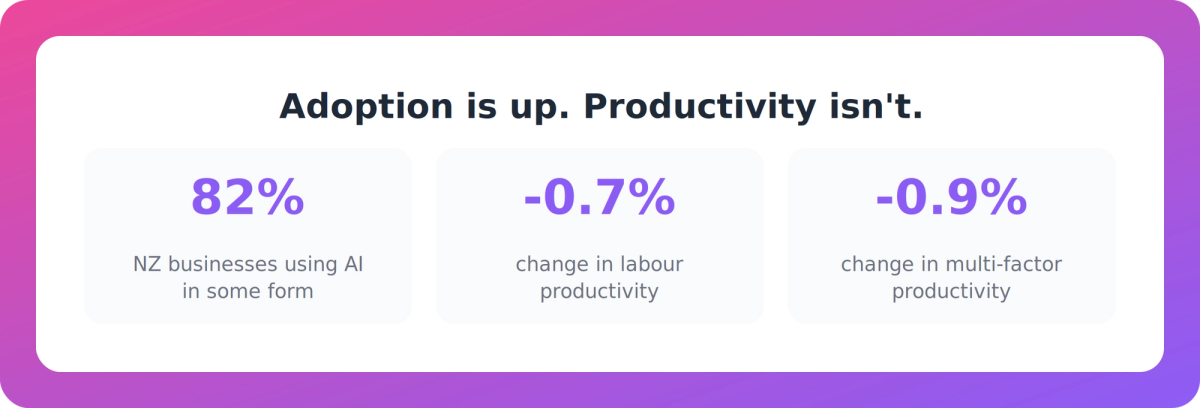
That's the puzzle every board should be asking about right now. If four out of five organisations are "using AI", why isn't the country producing more with less?
The answer isn't that AI doesn't work. It's that switching on a chatbot, a copilot licence or a generic assistant is not the same as redesigning a workflow around it. Adoption measures whether a tool got turned on. It says nothing about whether anyone changed how work actually happens.
Why bolted-on AI keeps stalling
Cairn.nz's analysis of the AI Forum's 2026 AI Blueprint for Aotearoa identifies three recurring patterns behind New Zealand's stalled AI returns:
- Activity without accountability — affecting around 4 in 10 organisations, where AI use has no clear owner or measurable outcome attached to it.
- Bolted-on, not built-in — another 4 in 10, where AI is added as a feature on top of an existing tool rather than embedded into the workflow it's meant to improve.
- A compliance gap — roughly 3 in 10, where AI use is outpacing organisations' understanding of how New Zealand law applies to it.
Each of these is a symptom of the same root cause: buying a generic AI feature is easy, but embedding AI into how a business actually operates — its data, its processes, its accountability lines — is a project, not a toggle switch.
The trust problem sitting inside the productivity problem
Embedding failures don't just cost efficiency. They erode trust, and trust is what boards ultimately answer for.
One NZ's AI Trust Report 2026 found 76% of New Zealanders used an AI tool in the past year. Of those users, 70% hit problems with it, and 62% said they'd stop using a product or service over concerns about how a company was using AI.
Meanwhile, governance is lagging usage badly. NSP and Qualtrics data cited by NZBusiness show only 12% of New Zealand employees use solely company-provided AI tools — the lowest share of any country surveyed. Separately, 49% of enterprise workers use unsanctioned AI tools, and 27% have shared sensitive employee data through them.
Put those together and you get a workforce quietly running its own shadow AI stack, often through consumer-grade tools the organisation never vetted, while the board assumes its AI policy is being followed.
Directors now carry personal exposure
This isn't just an operational risk anymore. It's a legal one.
Simpson Grierson's briefing on boardroom AI use notes that under the Companies Act, directors who rely on AI outputs without adequate verification and disclosure risk exposure similar to that flagged by courts overseas — where safe-harbour protections may not apply if AI played a prominent role in a decision.
IT Brief New Zealand reports boardrooms are demanding tougher returns on AI investment in 2026, with enterprise buyers increasingly sceptical of black-box pitches and generic "AI-powered" claims. What they want now is proof a solution is embedded into daily operations — not a demo that impresses in a workshop and then sits unused.
What embedded AI actually looks like
Five NZ's boardroom research found 65% of New Zealand organisations are running AI initiatives, but fewer than 40% have the platform-led data foundations needed to capture real returns from them. The same research flags a further risk: dependence on two or three offshore AI providers leaves boards with limited control over their own operational continuity.
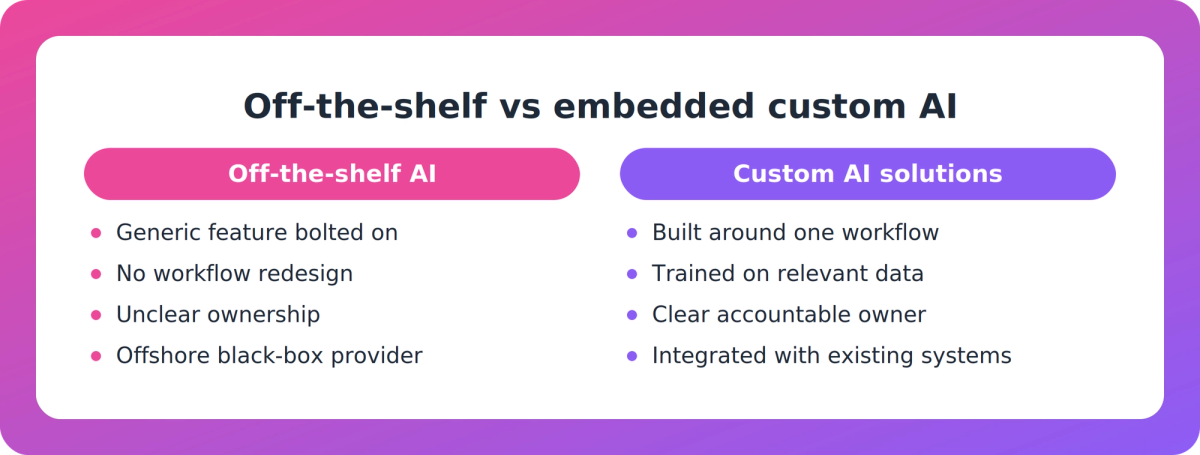
This is the practical distinction that matters for any New Zealand business weighing custom AI solutions against another off-the-shelf licence:
- Off-the-shelf tools are fast to switch on, generic by design, and rarely connect to the specific systems, data and workflows a business already runs on.
- Custom AI solutions are built around a specific workflow, trained on data relevant to the industry and business, integrated with existing systems, and owned with a clear line of accountability back to the people who deployed them.
The first gets you an adoption statistic. The second is what shows up in a productivity number — and in an audit trail a director can actually stand behind.
Key takeaways
- 82% of NZ businesses use AI in some form, but labour productivity fell 0.7% and multi-factor productivity fell 0.9% over the same period — adoption isn't delivering embedded value.
- Cairn.nz's read of the AI Forum's 2026 Blueprint finds roughly 4 in 10 organisations lack accountability for AI use, another 4 in 10 have bolted AI onto workflows rather than built it in, and 3 in 10 face a compliance gap against NZ law.
- 70% of New Zealanders who used an AI tool in the past year hit problems with it, and 62% would stop using a product or service over AI trust concerns (One NZ AI Trust Report 2026).
- Simpson Grierson warns directors risk exposure under the Companies Act if AI-influenced decisions aren't properly verified and disclosed.
- Only 12% of NZ employees use solely company-sanctioned AI tools — the lowest of any country surveyed by Qualtrics — while fewer than 40% of organisations running AI initiatives have the data foundations to capture real returns (Five NZ).
Our take
The 82%-adoption-versus-falling-productivity gap is the clearest evidence yet that "we use AI" and "AI works for us" are two different claims, and New Zealand boards have been conflating them. Bolting a generic assistant onto an existing process doesn't remove the bottleneck — it just adds a feature nobody redesigned the workflow around. The governance exposure now flagged by Simpson Grierson makes this more than an efficiency question: if a director can't explain how an AI output was verified, generic tools become a liability, not a shortcut. Boards that want a productivity number to move, not just an adoption statistic, will need AI that's built around their own data, systems and accountability lines — not another licence switched on and left to drift.
FAQ
Why has NZ productivity fallen despite 82% AI adoption? Deloitte Access Economics research commissioned by 2degrees found adoption reached 82% while labour productivity fell 0.7% and multi-factor productivity dropped 0.9% over the same period. Analysis from Cairn.nz attributes this to AI being bolted onto existing tools rather than embedded into workflows, with unclear accountability for outcomes.
What's the difference between off-the-shelf AI and custom AI solutions? Off-the-shelf tools are generic features added to existing software, fast to switch on but rarely connected to a business's specific data and workflows. Custom AI solutions are built around a specific process, trained on relevant industry data, integrated with existing systems, and owned with clear accountability — the kind of embedding Five NZ's research links to fewer than 40% of organisations currently achieving.
Are NZ directors personally at risk over AI decisions? Simpson Grierson's briefing notes that under the Companies Act, directors who rely on AI outputs without adequate verification and disclosure risk exposure similar to cases flagged overseas, where safe-harbour protections may not apply if AI played a prominent role in a decision.
How widespread is unsanctioned AI use inside NZ organisations? NSP and Qualtrics data cited by NZBusiness found only 12% of NZ employees use solely company-provided AI tools — the lowest share of any country surveyed — while 49% of enterprise workers use unsanctioned tools and 27% have shared sensitive employee data through them.
What should a board ask before approving another AI tool? Ask whether the tool is embedded into an actual workflow with an accountable owner, whether outputs can be verified and disclosed if challenged, and whether the data foundations exist to measure a real return — the gaps Cairn.nz and Five NZ both flag as the difference between AI activity and AI value.