Predictive Maintenance AI: NZ Manufacturing's Blind Spot
21 July 2026 · 7 min read

Predictive Maintenance AI: NZ Manufacturing's Blind Spot
New Zealand manufacturing just posted its strongest activity in three years, and government-backed digital adoption support is expanding to hundreds of small and medium manufacturers. Yet most local AI spending is still going into admin, reporting and customer service — not equipment monitoring — which makes predictive maintenance the most underused productivity lever on the factory floor right now.
Why is this the moment to look at equipment-level AI?
The BNZ–BusinessNZ Performance of Manufacturing Index hit 56.1 in December 2025, a three-year high that put New Zealand ahead of the US, China, Japan, the UK and Australia on this measure. Growth changes the arithmetic on downtime. When lines are running flat out, an unplanned stoppage costs more in lost output, not less — every idle hour has a fuller order book behind it.
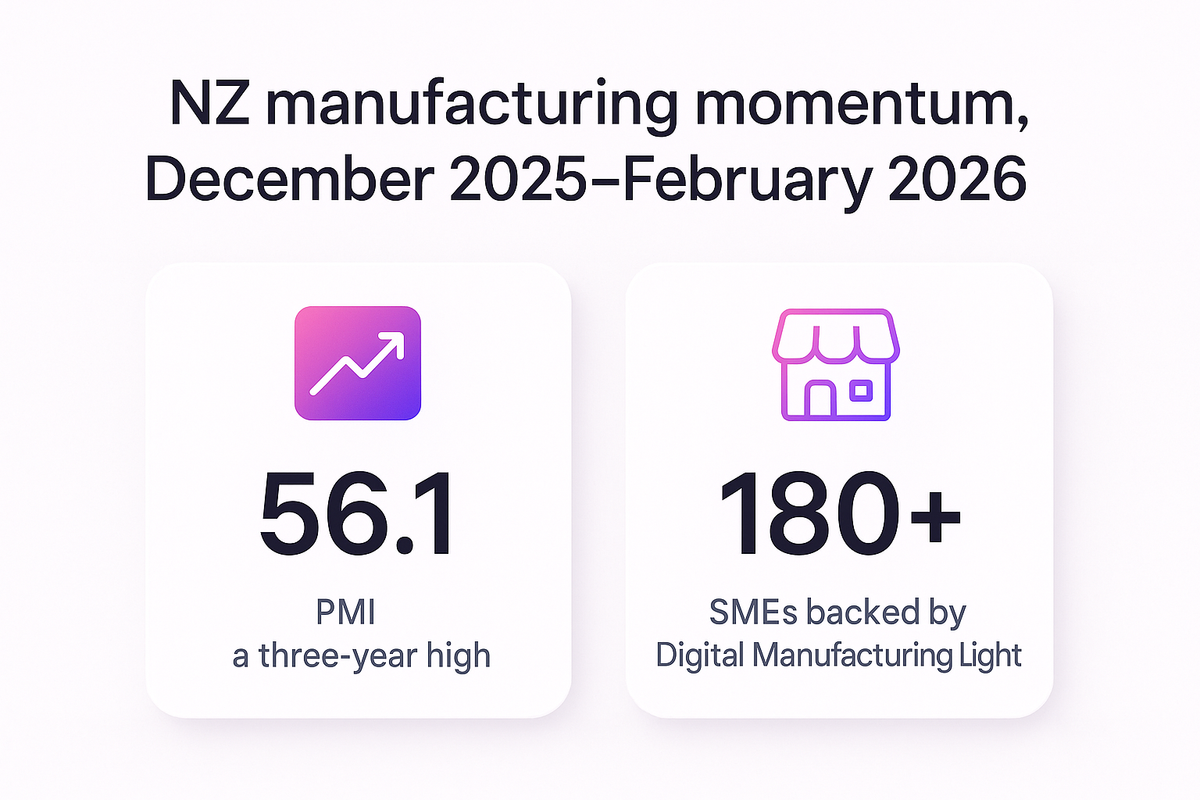
At the same time, the Ministry of Business, Innovation and Employment confirmed in February 2026 an expanded Digital Manufacturing Light programme, delivered with the University of Auckland, to support at least 180 small and medium manufacturers. The focus is Auckland, Waikato, Northland and the Bay of Plenty — regions that together account for roughly 55% of the country's manufacturers. The stated barriers the programme is built to address are the usual ones: cost, and a lack of in-house technical skill to evaluate or run new tools.
Where is NZ manufacturing actually putting its AI budget?
AI adoption across New Zealand businesses is already mainstream — cited at 82–91% in recent surveys. But that adoption is concentrated where it's easiest to justify and easiest to deploy:
- Administrative and reporting tasks
- Customer service and support
- Energy-use tracking and general automation
Sector commentary from SecurityBrief NZ shows manufacturers actively exploring IoT-driven real-time tracking and automation for energy use — capabilities that sit right next door to predictive maintenance, without many firms making the jump. That's the gap: the sensors and monitoring habits are often half-built already, aimed at cost or energy reporting rather than failure prediction.
Does predictive maintenance actually work for a NZ-sized manufacturer?
Fisher & Paykel offers the clearest domestic answer. Its automation spin-out Facteon runs production-line sensors that feed cloud-based monitoring of power, water and other operating metrics, flagging likely equipment failures before they happen. Downtime, as it's described internally, is treated as the enemy of the factory — not an occasional annoyance but a direct hit to throughput.
Fisher & Paykel is now extending the same real-time monitoring logic outward, building predictive maintenance into its own IoT-enabled appliances. That's a useful signal: a company that started with plant-floor monitoring is now applying the same approach to products in the field, which suggests the underlying method scales down as well as up.
Why should small firms think small, not enterprise-scale?
New Zealand's manufacturing base is structurally different from the large-plant economies that most predictive maintenance case studies come from. Around 97% of local businesses employ fewer than 20 people, and GDP per hour worked sits roughly 40% below small advanced economies like Denmark, Finland and Sweden. That gap is as much structural as technological — it reflects firm size and capital intensity, not just slower tool adoption.
That profile argues against copying large-enterprise Industry 4.0 programmes wholesale. It argues for:
- Single-line pilots rather than plant-wide rollouts
- Reusing existing sensor and reporting data instead of installing new hardware everywhere at once
- Cloud-based monitoring services that don't require a dedicated data science team
- Clear failure-mode targets — the two or three machines where an unplanned stop actually hurts output
A University of Auckland commentary on "strategic smallness" makes a related point for 2026: New Zealand's small-firm structure can be an advantage when it's paired with tools designed for that scale, rather than treated purely as a constraint to be engineered around.
What does a right-sized deployment actually involve?
A workable predictive maintenance project for a small or medium NZ manufacturer typically starts narrow and proves value before it expands. The building blocks are consistent across most credible implementations:
- Identify the one or two assets where downtime is most costly
- Check what sensor or usage data already exists before buying new hardware
- Set a clear, measurable failure signal (vibration, temperature, power draw) rather than trying to monitor everything
- Route alerts to whoever schedules maintenance, not just to a dashboard nobody checks
- Review after one quarter before deciding whether to extend to more lines
This is the same logic behind the broader economic case for AI in New Zealand. Analysis cited by ITBrief NZ, drawing on Accenture modelling, puts the potential contribution of generative AI to the NZ economy at $76–108 billion annually by 2038 — but that figure depends on businesses moving past pilot-stage use into applications with a direct line to output, not just administrative convenience.
Key takeaways
- NZ manufacturing activity hit a three-year high (PMI 56.1, December 2025), raising the cost of unplanned downtime just as growth makes capacity tighter.
- MBIE's expanded Digital Manufacturing Light programme will back at least 180 SMEs across regions covering roughly 55% of the country's manufacturers, specifically to lower cost and skill barriers.
- AI adoption in NZ business is mainstream (82–91%), but concentrated in admin and customer service — plant-floor equipment monitoring remains comparatively untapped.
- Fisher & Paykel's Facteon monitoring systems are a credible local proof that predictive maintenance works at NZ scale, and the same logic is now extending to IoT appliances.
- The 97%-small-firm structure of NZ manufacturing favours narrow, single-line predictive maintenance pilots over large enterprise transformation programmes.
Our take
The interesting part of this story isn't that predictive maintenance works — that's well established internationally. It's that New Zealand manufacturers have already built half the plumbing for it, in the form of energy-tracking and reporting automation, without connecting that data to failure prediction. Given how small and capability-constrained most NZ manufacturers are, the sensible move isn't a big Industry 4.0 programme; it's picking the one machine where a stoppage actually hurts, wiring up a monitoring service against it, and proving the case before going further. Funding support like Digital Manufacturing Light removes the cost excuse. What's missing is simply the decision to point existing AI momentum at the factory floor instead of the inbox.
FAQ
What is predictive maintenance AI, and how is it different from the AI most NZ manufacturers already use? Predictive maintenance uses sensor data — power draw, vibration, temperature and similar signals — fed into monitoring software to flag likely equipment failures before they happen. Most current NZ manufacturing AI use, by contrast, sits in admin, reporting and customer service rather than equipment monitoring.
Is predictive maintenance realistic for a small NZ manufacturer, not just large plants? Yes, if the deployment is scoped narrowly. Around 97% of NZ businesses employ fewer than 20 people, which favours single-line pilots using existing sensor and reporting data over large-scale transformation projects designed for bigger plants.
What government support exists for NZ manufacturers adopting digital tools like this? MBIE's expanded Digital Manufacturing Light programme, confirmed in February 2026 and delivered with the University of Auckland, will support at least 180 small and medium manufacturers across Auckland, Waikato, Northland and the Bay of Plenty — regions covering roughly 55% of the country's manufacturers.
Does Fisher & Paykel actually use predictive maintenance, or is this theoretical for NZ? Fisher & Paykel's automation spin-out Facteon runs cloud-based monitoring of production-line sensors to flag likely failures ahead of time, treating downtime as a direct cost to output. The company is now extending similar monitoring logic to predictive maintenance for its IoT-enabled appliances.
Why does the timing matter — why not wait to invest in equipment monitoring? NZ manufacturing activity hit a three-year high in December 2025 (PMI 56.1), which raises the cost of every unplanned stoppage. Growth periods are exactly when avoiding downtime pays off most, because idle capacity has a fuller order book behind it.