Predictive Maintenance AI: NZ Manufacturing's Next Move
9 August 2026 · 7 min read
Generic IoT dashboards tell manufacturers something broke. Purpose-built predictive maintenance AI, trained on a plant's own sensor history, tells them what's about to break and when. That gap — between raw data and an actionable answer — is why more New Zealand manufacturers are moving past off-the-shelf monitoring tools and commissioning custom models instead.
Why is unplanned downtime suddenly a board-level issue?
For years, unplanned downtime sat with the maintenance team. It doesn't anymore.
Skilled trades shortages mean fewer experienced technicians are available to catch problems by ear, feel or gut instinct — the tacit knowledge that used to plug the gap between sensor alerts and real diagnosis. When a senior fitter retires, that judgement often leaves with them.
At the same time, rising energy costs have squeezed manufacturing margins across the country. A line stoppage that used to be an inconvenience is now a measurable hit to the bottom line, and boards want to know why it happened and how it will be prevented next time.
Put those two pressures together and predictive maintenance stops being a nice-to-have. It becomes a way to protect output and margin when the workforce doing the protecting is thinner than it used to be.
What's wrong with generic condition-monitoring dashboards?
Most manufacturing sites already have some form of condition monitoring — vibration sensors, temperature probes, SCADA alerts feeding a dashboard somewhere. These tools are useful for one thing: telling you a threshold has been crossed.
That's reactive, not predictive. By the time a vibration alarm fires, the bearing is often already failing. The dashboard has done its job — it noticed — but it hasn't told anyone what to do next, how urgent it is, or how it fits the wider picture of that specific machine's history.
Generic tools are built to work across thousands of different sites and machine types, which means they're tuned for the average case, not your factory. They rarely learn from:
- the specific failure patterns of your equipment over its actual operating life
- how your maintenance interventions have changed wear patterns over time
- the interaction effects between machines on the same line
- seasonal or production-cycle variation unique to your plant
That's the ceiling generic monitoring hits. It flags anomalies. It doesn't forecast failure.
How does a custom AI model change the equation?
A purpose-built predictive maintenance model is trained on your plant's own sensor history — not a generic library of "typical" failure signatures pulled from unrelated sites. That distinction matters more than it sounds.
Because the model learns from your equipment's actual behaviour, it can start to answer sharper questions:
- Which specific asset is trending toward failure, and on what timeframe?
- What's the likely failure mode, based on how similar signal patterns played out last time?
- Should maintenance be scheduled this week, or can it safely wait until the next planned shutdown?
Getting there usually means integrating with what's already on the floor — the ERP system, the SCADA or historian data, work-order history — rather than bolting on another standalone dashboard nobody checks. The model earns its keep only if the answer shows up where operations staff and planners already work.
Build vs buy: what changes with a purpose-built model
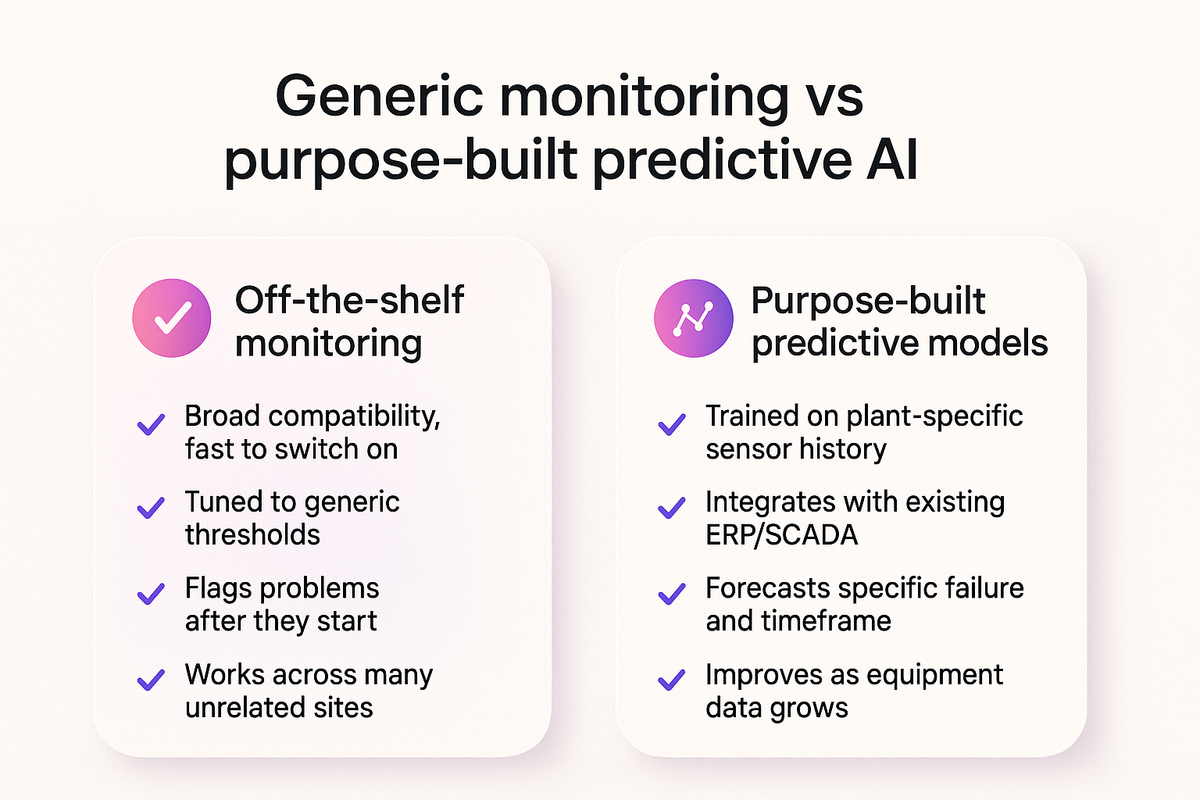
Manufacturers weighing this up are essentially choosing between two philosophies:
- Off-the-shelf monitoring: broad compatibility, fast to switch on, tuned to generic thresholds, flags that something is wrong after the fact.
- Purpose-built predictive models: trained on plant-specific data, integrated with existing systems, aimed at forecasting a specific failure and timeframe rather than a generic alarm.
Neither is inherently wrong. A small site with low downtime risk may never need more than threshold alerts. But for manufacturers where an unplanned stoppage costs real money and skilled cover is thin, the case for a model trained specifically on their own equipment gets stronger every year energy costs and trades shortages keep biting.
What does it take to get a predictive maintenance model working?
This is where a lot of good intentions stall. Building a model is the easy part; getting it to produce a trustworthy, usable answer on a live production line is the actual work.
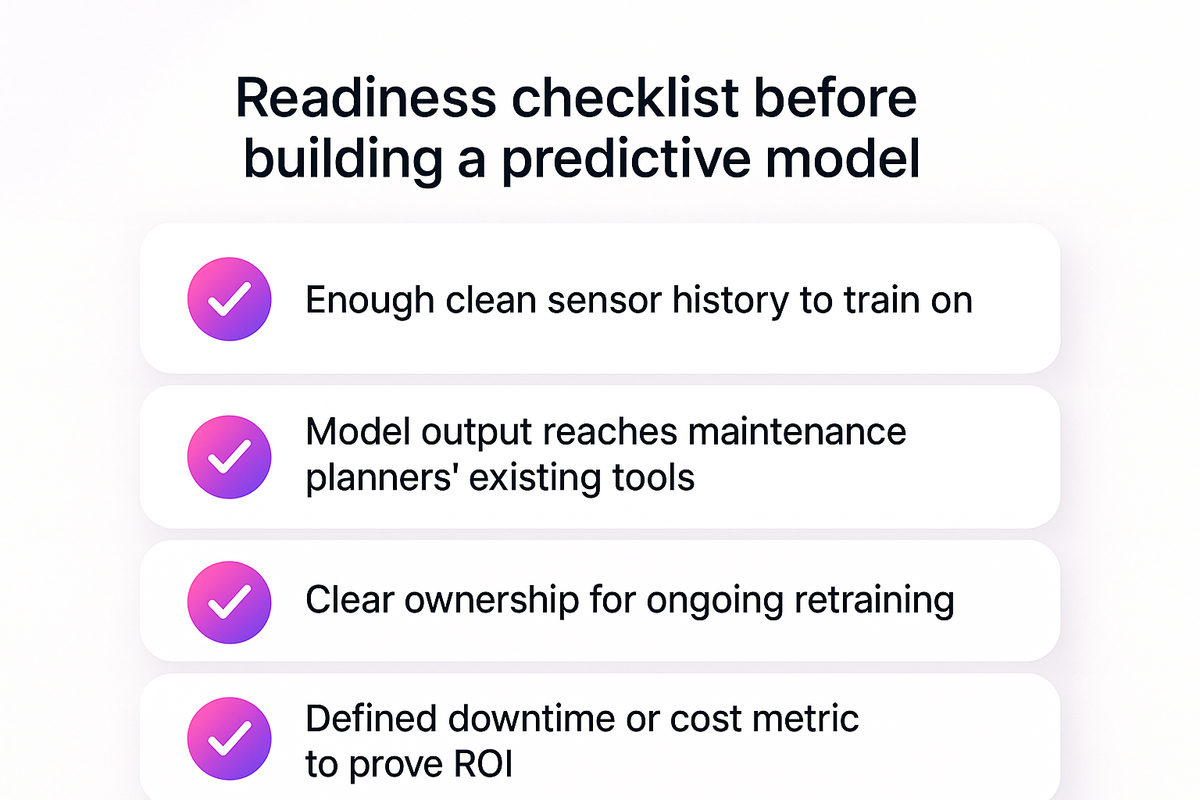
Before committing, operations leaders should be honest about:
- Data history: is there enough clean sensor history to train on, or does it need to be collected first?
- System integration: can the model's output reach the people who plan maintenance, inside the tools they already use?
- Ownership: who maintains and retrains the model as equipment ages or processes change?
- Success measures: what specific downtime, cost or output figure will prove the investment worked?
Manufacturers without in-house data science capability don't need to build this alone — but they do need a partner who will stay involved past go-live, because a predictive model that isn't retrained as conditions change quietly becomes as blunt as the dashboard it replaced.
There's also a workforce angle here that shouldn't be ignored. As Workforce Development Councils shape the trades pipeline for the coming years, the technicians entering the sector will increasingly be trained to work alongside these systems rather than instead of them — reading model outputs, validating predictions, and making the final call. Predictive AI isn't a replacement for trade skill; it's a way of stretching a shrinking pool of it further.
Key takeaways
- Off-the-shelf IoT dashboards are reactive: they flag that a threshold has been crossed, not what's likely to fail next or when.
- Custom predictive maintenance models trained on plant-specific sensor history can forecast a specific failure mode and timeframe, not just an anomaly.
- Skilled trades shortages and rising energy costs have pushed unplanned downtime from a maintenance-team problem to a board-level concern.
- Success depends on integration with existing ERP, SCADA and work-order systems, plus ongoing retraining as equipment and processes change.
- Predictive AI works best alongside trade skill, not instead of it — supporting technicians rather than replacing their judgement.
Our take
Predictive maintenance has been "coming" for manufacturing for over a decade, but most sites still run on generic thresholds because that's what was easy to buy. The shift now is less about the technology becoming smarter and more about the cost of not using it properly becoming impossible to ignore. We'd argue the real differentiator isn't the AI model itself — it's whether a provider sticks around to retrain it as your plant changes, because a static model trained once on last year's data is barely better than the dashboard it replaced. Manufacturers evaluating this should ask harder questions about ongoing ownership than about accuracy claims on day one.
FAQ
What's the difference between condition monitoring and predictive maintenance AI? Condition monitoring alerts you when a sensor reading crosses a fixed threshold — it's reactive. Predictive maintenance AI, trained on a plant's own historical sensor data, aims to forecast a specific failure mode and timeframe before it happens, giving maintenance teams a lead-time to act.
Why are NZ manufacturers prioritising this now? Skilled trades shortages have reduced the pool of experienced technicians who could previously catch early warning signs through experience, and rising energy costs have made unplanned downtime a more visible cost. Together, these pressures have pushed predictive maintenance from an operational nice-to-have to a board-level priority.
Does a custom AI model need to replace our existing SCADA or ERP systems? No. A well-built predictive maintenance model integrates with what's already running on the floor — SCADA data, historian records and ERP work orders — rather than replacing them. The goal is to feed a sharper prediction into the systems planners already use, not add another standalone dashboard.
How much sensor history is needed before a predictive model is useful? It varies by equipment and failure type, but the model needs enough historical data to have observed failure patterns, not just normal operation. Sites without sufficient history often need a short data-collection phase before a reliable model can be trained.
Will predictive maintenance AI reduce the need for skilled trades staff? Not in any straightforward sense. These models are designed to support technicians — flagging what to check and when — rather than replace the trade judgement needed to diagnose and fix the issue. As Workforce Development Councils shape trades training, the expectation is that technicians will increasingly work alongside these tools rather than be displaced by them.