Why Your Board Pack Never Matches Your PTE's Reality
11 August 2026 · 8 min read

Your board pack is a photograph. By the time it reaches the table, NZQA's quality-assurance settings have already shifted, your funding body is watching your cash position rather than your board's confidence in it, and the enrolment mix sitting under your headline number has moved again. A quarterly snapshot used to be adequate. Under continuous self-review, it's a liability.
Why this lands on your desk
You answer for three things at once: regulatory standing, financial viability, and competitive position. Historically those moved on different clocks — an External Evaluation and Review (EER) every few years, a financial return once a year, a market review whenever someone got around to it. From 1 January 2026, that separation collapses. NZQA's Integrated Quality Assurance Framework (iQAF) makes self-review continuous, the Tertiary Education Commission (TEC) ties funding confidence to your real-time margin, and the disestablishment of Te Pūkenga is redrawing the competitive map faster than most board cycles can track. If your internal reporting still runs on the old quarterly rhythm, you're making decisions — and answering to NZQA and TEC — on a version of the business that no longer exists.
From periodic audit to continuous proof
NZQA has stopped initiating new EER processes. In their place, providers now produce an annual self-review summary report and sit down with NZQA for an improvement-plan discussion. That sounds like a lighter touch. It isn't. A periodic EER was a project you could resource for — pull the files, brief the team, present the evidence, move on. Continuous self-review means the evidence has to be current whenever NZQA asks, not just current when you knew they were coming.
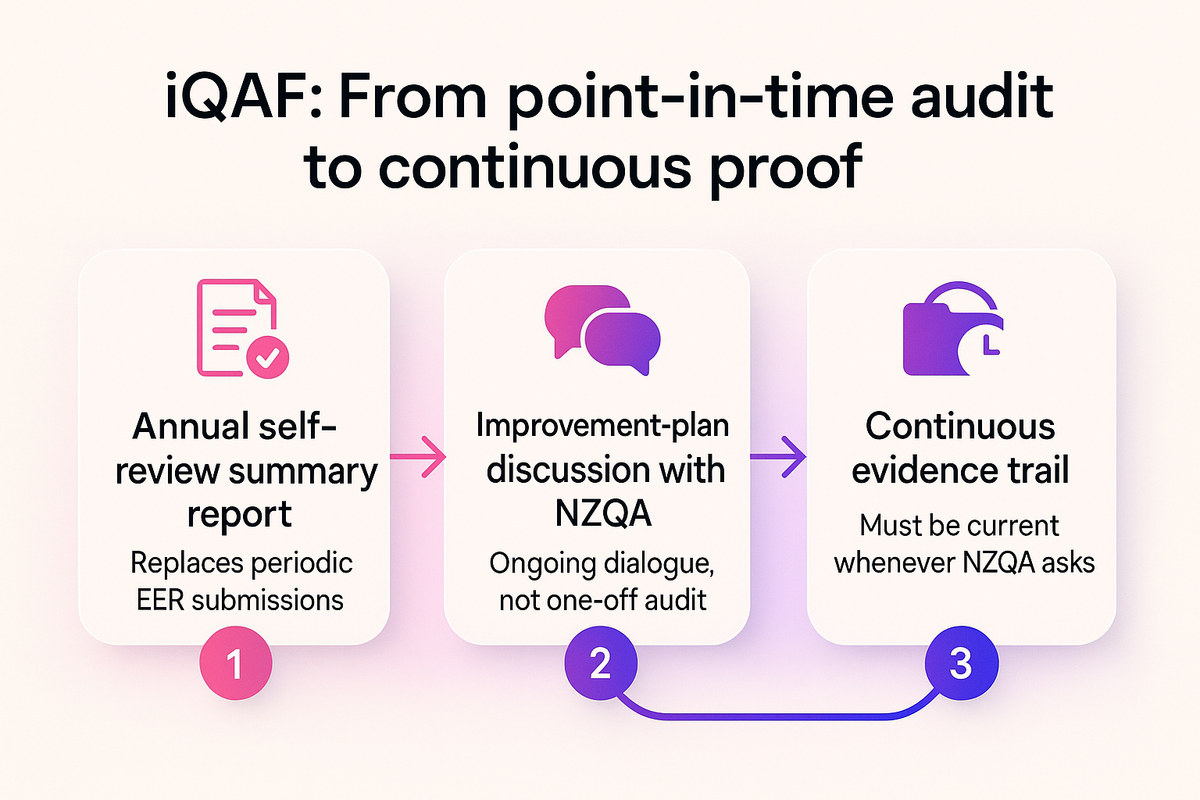
The practical shift for you as CEO: you can no longer treat quality assurance evidence as something assembled for an event. It needs to be a by-product of how the business runs day to day. If your compliance evidence still depends on one or two people manually compiling it before a deadline, that's now a standing exposure rather than an occasional scramble.
The PTE Rules 2026 reinforce the same logic on the financial side. They replaced the Private Training Establishment Registration Rules 2025, dropped the annual registration fee, moved non-funded PTEs from annual to biennial financial returns, and — notably — swapped the prescribed GAAP reporting requirement for a general obligation to maintain adequate internal financial controls. NZQA has stepped back from dictating the format. It now expects you to prove your own controls are good enough, on your own terms, at any point in time.
Solvency is now a live question, not a board-meeting one
TEC treats financial viability as something a TEC-funded PTE must demonstrate independent of its owners. Short-term shareholder support is fine. Relying on it indefinitely is not considered sustainable, and TEC has information-sharing arrangements with NZQA if viability concerns surface. That means a soft patch in your cash position isn't just a conversation for your next board meeting — it can become a regulatory conversation before you've had the chance to explain the plan to fix it.
If your margin and cost-per-student figures are a month or two behind actual trading, you're not just managing with a lag. You're exposed to two regulators forming a view of your business before you do.
The enrolment averages are lying to you
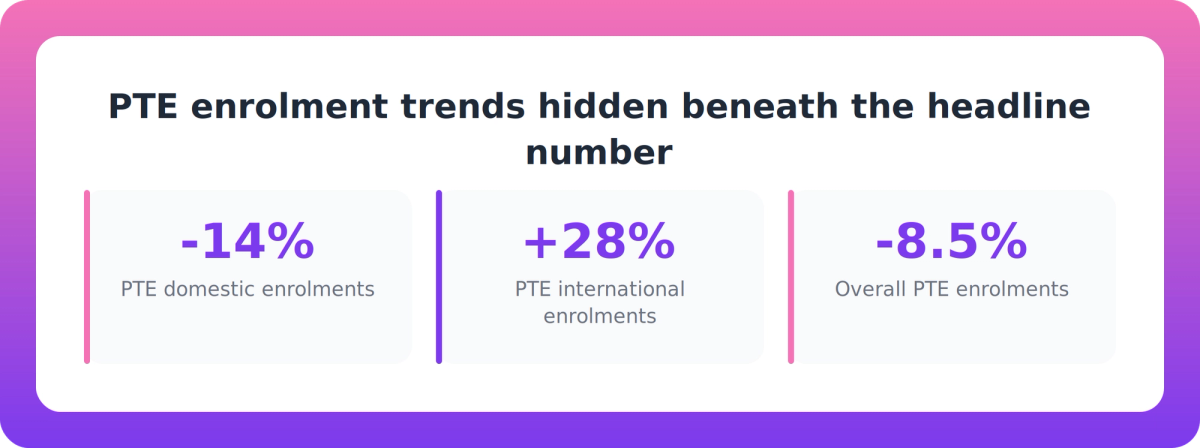
Nationally, domestic enrolments fell 3.5% in 2025 while international enrolments rose 15%. Inside the PTE sector specifically, the split is sharper: domestic enrolments down 14%, international enrolments up 28% — yet overall PTE enrolments still fell 8.5%. A board pack that reports one net enrolment number is hiding the fact that you might be losing your domestic pipeline while an international recovery only partly offsets it, or vice versa.
It gets more specific again. Government-funded PTEs saw enrolments climb 33% (January–August 2025), while universities have pulled ahead in the international market, lifting their share of international enrolments to 41%, up from 21% in 2016. The PTE sector's own international enrolments have sat roughly flat since 2019 — around 14,300 against 13,700 — even as the broader market recovers. Not every provider is riding the same wave. If your reporting can't disaggregate by funding status, domestic versus international, and programme, you genuinely don't know which parts of your pipeline are the ones actually moving.
Layer the public provider restructure on top. The disestablishment of Te Pūkenga into ten regionally governed polytechnics and eight Industry Skills Boards from 1 January 2026 followed at least 154 role cuts and one campus closure across the institute-of-technology sector as it prepared for the change. That's genuine disruption in the public provider base — students, staff and employer relationships in flux. It's an opening for a well-run PTE. But it only stays open for providers whose leadership can see the shift and act inside the window, not after a quarter has already closed around it.
What "current" actually means for your reporting
There's no NZ-specific benchmark yet for PTE staffing efficiency, key-person compliance risk, or back-office productivity. That's not comforting — it means you can't check whether your reporting gaps are typical or a genuine competitive weakness. In the absence of an external yardstick, the honest test is a simple one: if NZQA asked for your current self-review evidence tomorrow, or TEC asked for this month's cash position, could you produce it without a week of manual reconciliation? If the answer involves someone's personal spreadsheet or someone's memory of where things stand, that's your actual reporting risk — not the topline number in your last board pack.
Key takeaways
- iQAF replaces periodic EER with an annual self-review summary report and an improvement-plan discussion — compliance evidence now needs to be current at any moment, not assembled for an event.
- The PTE Rules 2026 trade prescribed GAAP reporting for a general duty to maintain adequate internal financial controls, shifting the burden of proof onto your own systems.
- TEC expects TEC-funded PTEs to show financial viability independent of shareholder support, and shares viability concerns with NZQA — a lagging cash view is now a dual-regulator risk.
- PTE-wide enrolment numbers hide sharply different domestic (-14%) and international (+28%) trends beneath an overall 8.5% decline — aggregated reporting can mask exactly where your pipeline is growing or shrinking.
- Te Pūkenga's disestablishment and the ITP restructure have opened real competitive space, but only for providers who can read and act on their own performance data faster than the sector moves.
Our take
The regulatory settings changing in 2026 don't punish PTEs for having imperfect systems. They punish PTEs whose reporting can't keep pace with a business that's genuinely moving — and right now, most of the sector is moving on divergent tracks at once. We think the sharpest read of iQAF and the PTE Rules 2026 is that NZQA and TEC have quietly outsourced the ongoing proof of good management back to providers themselves. That's a bet on your internal visibility, not a bet on paperwork. CEOs who treat this as a systems and data problem — not just a compliance filing problem — will be the ones who can tell, in real time, whether their domestic pipeline is actually the one in trouble, or whether a restructuring polytechnic down the road just became their best recruitment opportunity this year.
FAQ
Does the move to iQAF mean less compliance work overall? Not necessarily less — different. NZQA has stopped starting new EER processes and replaced them with an annual self-review summary report plus an improvement-plan discussion. The workload shifts from a periodic project to an ongoing discipline of keeping evidence current.
What changed for PTE financial reporting under the PTE Rules 2026? Non-funded PTEs moved from annual to biennial financial returns, the annual registration fee was removed, and the prescribed GAAP reporting requirement was replaced with a general obligation to maintain adequate internal financial controls — putting more responsibility on your own financial governance rather than a fixed external format.
How does TEC's view of financial viability affect a PTE that funds itself independently? The viability expectation applies specifically to TEC-funded PTEs, which must show they can stand on their own rather than relying indefinitely on shareholder support. TEC and NZQA share information where viability concerns arise, so a funded provider's cash position can become a cross-regulator issue, not just an internal one.
Is the Te Pūkenga disestablishment actually good news for PTEs? It's an opening, not a guarantee. Role cuts and restructuring across institutes of technology and polytechnics ahead of the shift to ten regionally governed polytechnics and eight Industry Skills Boards have created genuine disruption in the public provider base — but capturing that opportunity depends on how quickly a PTE's leadership can see and respond to the shift, not on the disruption itself.