Why Your PTE's Growth Plan Is Only as Good as Its Data
2 August 2026 · 8 min read

Your board doesn't want your confidence anymore — it wants your evidence. NZQA's shift from periodic audits to continuous self-review means every PTE CEO now owns an ongoing quality-assurance function, and that function is only as strong as the enrolment, financial and quality data feeding it. Gut feel won't survive contact with the new regime.
Why this hits your desk
From 1 January 2026, NZQA replaced External Evaluation and Review (EER) with an integrated Quality Assurance Framework (iQAF). Providers now produce annual self-review summary reports and sit improvement-plan meetings with NZQA, rather than waiting years between full evaluations. Templates are still being rolled out, but the shift in obligation is already real: you, not a scheduled auditor, are now the one certifying that your provider's performance and compliance picture is accurate — every year, not every four or five.
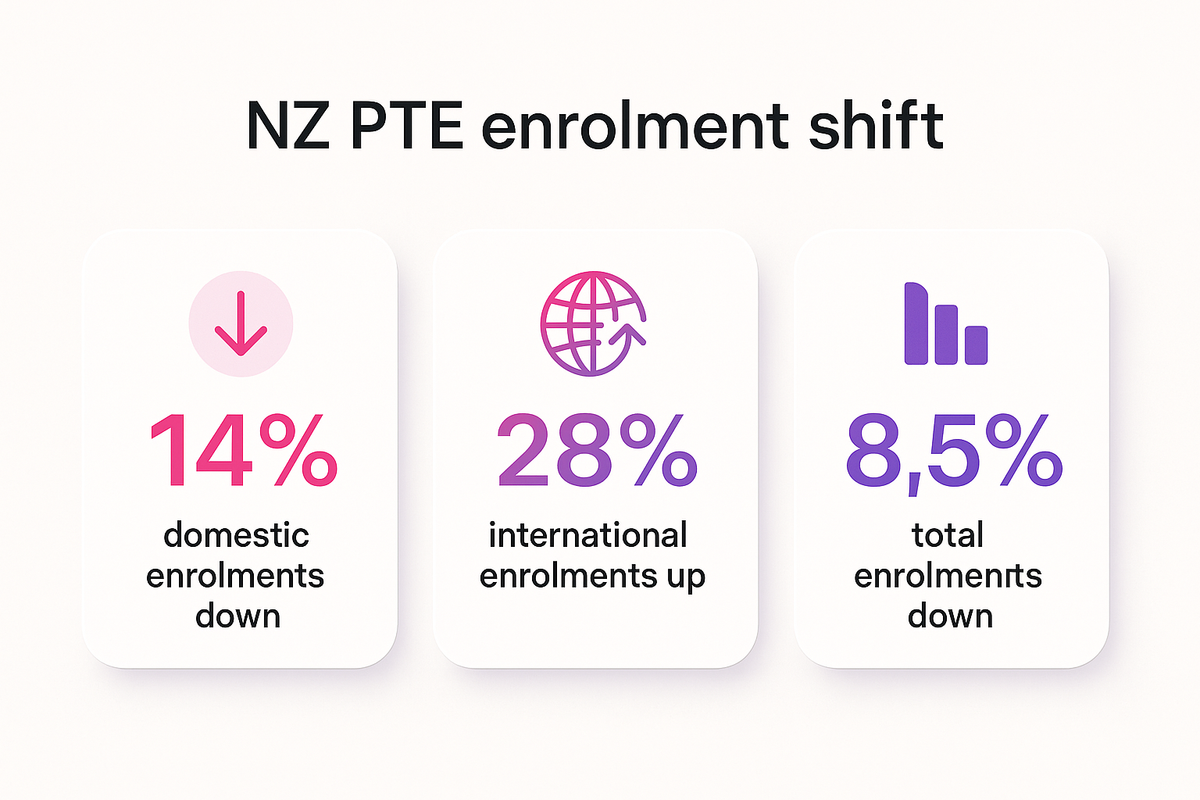
At the same time, your pipeline is more volatile than it's been in years. Domestic PTE enrolments have fallen 14%, while international enrolments have jumped 28%, part of a sector-wide reshuffle happening as Te Pūkenga is disestablished, regional institutes and industry skills boards take shape, and new entrants change who you're competing against for both cohorts. Your board will expect a data-backed read on where you sit in that market — not an anecdote.
And if the person who understands your compliance evidence, your enrolment trends and your margin drivers is one compliance manager working from a personal spreadsheet, that's not a resourcing quirk. Under provider-led self-review, it's a governance risk with your name attached to the sign-off.
From an audit event to a running commentary
The old EER model rewarded providers who could get audit-ready once every few years. The iQAF rewards providers who are always audit-ready, because self-review summary reports and improvement-plan conversations happen on a running annual cycle. That changes what "good" data looks like. It's no longer a folder assembled in the weeks before a site visit — it needs to be current enough that you could produce a defensible position on quality, enrolment and financial performance on short notice, at any point in the year.
There's a complicating wrinkle worth flagging to anyone in your finance or compliance team who thinks the old evidence trail is retired: Immigration New Zealand has confirmed it will keep using current EER category ratings for visa conditions through 2026. So for at least this transition year, you're running two evidence trails in parallel — legacy EER categories for visa purposes, and the new iQAF self-review reporting for NZQA. That's not a reason to panic, but it is a reason to make sure your systems can hold both threads without anyone having to reconstruct history from memory.
Two other rule changes land squarely on your desk. The annual financial return has moved to a biennial requirement for most PTEs, unless NZQA directs otherwise — useful breathing room, but only if your financial reporting is reliable enough that skipping a year doesn't mean losing the thread. And providers without a compliant quality management system by 1 January 2026 have a grace period to 1 January 2027 to build one. That's a real deadline, not a soft suggestion, and it's a data and systems project as much as a compliance one.
Your enrolment pipeline is now two businesses in one
Domestic and international enrolments don't behave the same way, and treating them as one blended number is how forecasting goes wrong. Education Counts data shows domestic PTE enrolments down 14% (roughly 8,905 students) while international enrolments rose 28% (around 2,675 students), for a net overall decline of 8.5%. That's not a rounding error — it's a structural change in where your revenue and your delivery risk sit.
The government's Going for Growth plan is betting heavily on the international side, targeting growth from 83,400 international students in 2024 to 105,000 by 2027 and 119,000 by 2034. 2025 results — 92,580 students, up 11% on the prior year — are already tracking ahead of that schedule. But the growth is geographically lopsided: Auckland holds around 55% of enrolments, which means the national headline can mask a very different reality depending on where your PTE actually operates.
For you, that means cost-per-student and margin forecasts need to be built cohort by cohort, not blended. International students carry different acquisition costs, different compliance obligations, and different cash-flow timing than domestic learners. A single average obscures exactly the detail your board needs to sanity-check a growth plan.
The market is being redrawn while you're mid-plan
October 2025's legislative reform disestablished Te Pūkenga, created the transitional NZIST alongside regional stand-alone and federated institutes, and replaced Workforce Development Councils with Industry Skills Boards from 1 January 2026. Established industry training players are also becoming PTEs in their own right — BCITO's move to a fast-tracked PTE transition is one visible example. Your competitive set is shifting under you at the same time your regulatory obligations are tightening.
A growth plan written six months ago may already assume a market structure that no longer exists. Boards will reasonably ask how you know your current positioning still holds — and "we haven't heard otherwise" isn't an answer that survives scrutiny.
The single-view test: how would you actually know?
Here's a useful exercise for your next leadership meeting: ask how long it would take to produce, from memory or from existing reports, an accurate current picture of enrolment mix, cost per student by cohort, and compliance evidence status. If the honest answer involves waiting on one person, stitching together three spreadsheets, or guessing at the last time a number was updated, that's your real risk — not the audit itself.
Published 2025 EER reports across the sector already show how wide the gap between providers can be, ranging from findings that a provider is "not yet confident" in its own performance through to reviews that praise strong leadership navigating real disruption. The difference between those outcomes usually isn't effort. It's whether the organisation's evidence lived in systems the whole leadership team could see, or in one person's head.
Where AI fits — and where it doesn't
The OECD's analysis of AI in vocational education makes a point worth sitting with: providers and countries with stronger underlying data infrastructure are the ones actually able to move beyond small, isolated AI pilots. That's the right order of operations. AI applied on top of scattered, unreliable data mostly just automates the confusion faster.
If you're weighing where to spend your technology budget this year, the unglamorous answer is usually the right one: get your enrolment, financial and quality data into a single, trustworthy source before you chase anything more ambitious. Everything else — forecasting, automation, faster self-review reporting — gets easier once that foundation exists, and close to impossible without it.
Key takeaways
- NZQA's iQAF, live from 1 January 2026, replaces periodic EER audits with annual self-review summary reports and improvement-plan meetings — your data needs to be current year-round, not audit-ready periodically.
- Legacy EER category ratings still govern visa conditions through 2026, so PTEs need parallel evidence trails for the old and new frameworks simultaneously.
- Domestic PTE enrolments are down 14% and international enrolments up 28% (total down 8.5%), meaning cost-per-student and margin need cohort-level forecasting, not blended averages.
- Sector restructuring — Te Pūkenga's disestablishment, the transitional NZIST, regional institutes, Industry Skills Boards, and new PTE entrants — means competitive positioning needs re-checking, not assuming it still holds.
- Key-person risk in compliance reporting is now a governance issue: if your evidence lives with one person rather than in shared systems, that's the exposure your board should be asking about.
Our take
The providers that will do well under iQAF aren't necessarily the ones with the best compliance manager — they're the ones where good data isn't dependent on any single person being in the building. That's a leadership and systems choice, not a compliance one, and it sits squarely with the CEO. Boards are going to start asking for a live view of performance rather than a quarterly summary, and providers that can answer that request quickly will have more room to move — on growth, on partnerships, on pricing — than those still assembling the picture from scratch each time someone asks.
FAQ
What is the iQAF and when did it take effect? The integrated Quality Assurance Framework (iQAF) is NZQA's replacement for External Evaluation and Review, live from 1 January 2026. It moves providers to annual self-review summary reports and improvement-plan meetings with NZQA, with reporting templates being released over the following months.
Do legacy EER category ratings still matter after the move to iQAF? Yes, at least for now. Immigration New Zealand has confirmed it will keep using current EER category ratings for visa conditions through 2026, so PTEs need to maintain evidence for both the old EER categories and the new iQAF self-review process during the transition.
What are the financial return and quality management system deadlines I need to know? The annual financial return requirement has moved to biennial for most PTEs unless NZQA directs otherwise. Separately, providers without a compliant quality management system by 1 January 2026 have until 1 January 2027 to put one in place.
How does the wider sector reform affect a PTE's competitive position? October 2025 legislation disestablished Te Pūkenga, created the transitional NZIST with regional stand-alone and federated institutes, and replaced Workforce Development Councils with Industry Skills Boards from 1 January 2026. Established training organisations, such as BCITO, are also moving into PTE status, which changes who PTEs compete and partner with across both domestic and international markets.