Life After Te Pūkenga: A PTE Growth Strategy for NZ
15 September 2026 · 7 min read

The government didn't dismantle Te Pūkenga to be tidy. It did it to force enrolments back toward providers who can run a tight ship — and it built a deadline into the law to make sure that happens. If your growth plan for the next two years doesn't name 1 January 2028, you don't have a growth plan. You have a hope.
Why this lands on your desk this quarter
You're being asked to commit growth capital — marketing spend, tutor hires, facility investment — against a fixed-term opportunity, not an open-ended market shift. Get the timing wrong and you're either under-resourced when Industry Skills Board (ISB) enrolments start moving, or you've over-invested chasing demand that other providers absorb first.
At the same time, the compliance ground has moved under you. NZQA's Quality Assurance of Tertiary Education Providers Rules 2026, in force from 19 January 2026, replace External Evaluation and Review with an annual self-review report every provider must submit. That's not a paperwork tweak. It converts regulatory risk from something you prepare for periodically into something you own year-round — while a documented quality management system is now an explicit condition of PTE registration. If that system lives in one compliance manager's head and a shared drive, you've got a growth constraint and an audit risk sitting in the same seat.
The dated opportunity: what's actually up for grabs
Ten regionally governed polytechnics are being re-established from the wreckage of the old centralised model, now renamed the New Zealand Institute of Skills and Technology (NZIST) and operating as a transitional entity. Four — NorthTec, WITT, Whitireia/WelTec and Tai Poutini — remain inside NZIST pending viability decisions due in the first half of 2026, with several becoming standalone institutions from 1 January 2027.
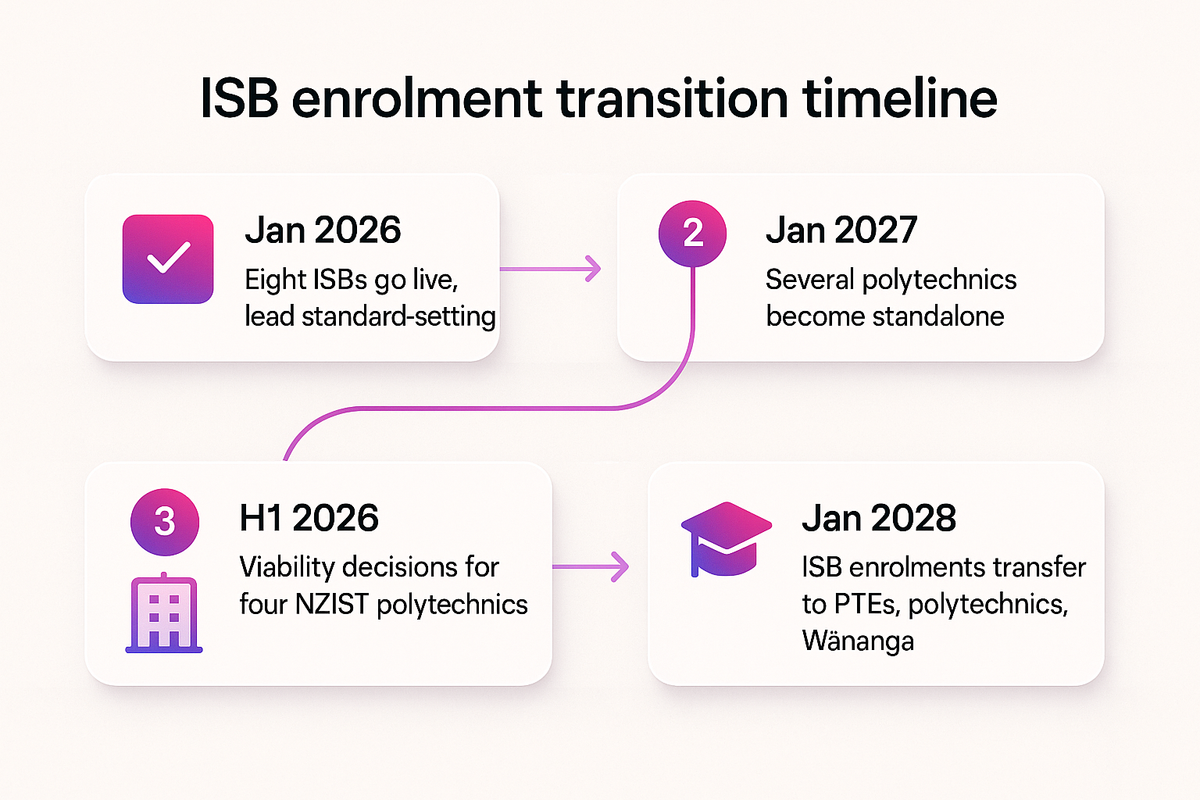
Alongside that, eight Industry Skills Boards became operational from 1 January 2026 to lead standard-setting and temporarily manage work-based training. Their programmes and enrolments must transfer to polytechnics, PTEs or Wānanga by 1 January 2028 — and ISBs are barred from enrolling new learners where an equivalent PTE or polytechnic programme already exists. That's a direct, legislated market-share opening in work-based learning, with a hard stop.
The scale of what preceded this matters for context. BERL's reporting puts cumulative losses under the old model above $300 million, with clawbacks of $107.7 million tied to low enrolments. Government didn't create this opening by accident — it's a deliberate correction, and it expects providers to compete for the enrolments it's freeing up.
Where the growth is already showing up
Early 2026 sector reporting shows recovery concentrating unevenly by field: nursing enrolments up 15% at Ara, engineering up 10% at WinTec. That's a signal, not a guarantee — it tells you where domestic demand is already moving, and where a PTE with the right programme mix and delivery capacity can position ahead of the ISB handover rather than after it.
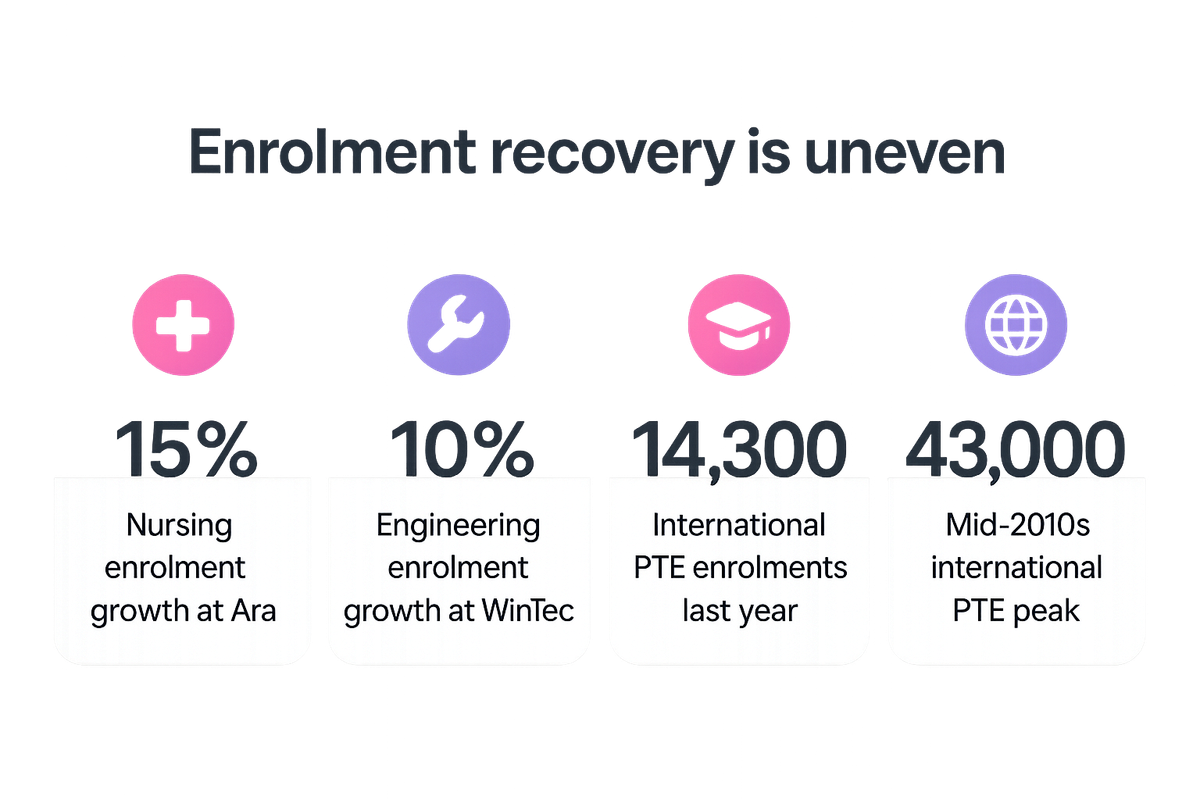
International enrolment tells a more cautious story. PTE international numbers are recovering — around 14,300 last year versus 13,700 in 2019 — but still sit well below the sector's mid-2010s peak of roughly 43,000. That gap reflects a deliberate, quality-focused policy reset tied to the government's Going for Growth ambition to double international education export revenue by 2034. Read it as encouragement with conditions: the door is open, but not on the old volume terms.
Against this, roughly 250,000 learners sit in the VET system annually, split between polytechnics, PTEs and Wānanga delivery and on-the-job training. That's the addressable base you're competing for, at a time when tertiary teaching capacity and curriculum currency in technical fields are both flagged as constraints across the sector.
Key-person risk just became a registration risk
Here's the part that should reorder your priority list. Financial return obligations are moving from annual to biennial by default, unless NZQA directs otherwise for your organisation specifically — genuinely less routine paperwork. But the annual self-review report and the quality management system requirement pull in the opposite direction: continuous, evidenced, provider-owned compliance replaces a periodic audit event.
That's the trade you're actually managing. Less compliance frequency, more compliance depth, every year, whether or not NZQA is knocking. If your quality evidence is scattered across one manager's inbox, a folder of old policy documents and institutional memory, you don't have a quality management system — you have a single point of failure wearing a QMS label. Boards should be asking whether that person going on leave, or leaving the organisation, would leave a gap NZQA could find before you do.
Key takeaways
- ISB enrolments must transfer to polytechnics, PTEs or Wānanga by 1 January 2028 — a fixed, legislated window, not an open-ended trend.
- NZQA's Quality Assurance of Tertiary Education Providers Rules 2026 replace periodic External Evaluation and Review with an annual, provider-owned self-review report.
- A documented quality management system is now an explicit PTE registration requirement — compliance knowledge concentrated in one person is now a registration-level exposure.
- Financial returns moving to biennial by default is a genuine easing; annual self-review and QMS evidence are the offsetting, heavier obligation.
- Domestic recovery is field-specific (nursing, engineering), and international PTE numbers, while recovering, remain well below their mid-2010s peak — plan capacity accordingly rather than assuming uniform demand.
Our take
The providers who win the ISB handover won't necessarily be the ones with the flashiest marketing. They'll be the ones whose compliance evidence is already continuous, current and pulled from real operational data rather than assembled in a scramble each time NZQA asks. Treat the annual self-review requirement as a genuine strategic input — a forcing function to know your own performance year-round — rather than a box you tick once a year. The growth opportunity and the compliance overhaul are the same decision. Providers who separate them in their planning will be slower to move than they think.
FAQ
When exactly do Industry Skills Board enrolments have to move to PTEs, polytechnics or Wānanga? By 1 January 2028, under the government's phased redesign of the vocational education and training system. Eight Industry Skills Boards became operational from 1 January 2026 to lead standard-setting and temporarily manage work-based training, but they cannot enrol new learners where an equivalent PTE or polytechnic programme already exists, and all their programmes must transfer by the 2028 deadline.
What actually changes under NZQA's Quality Assurance of Tertiary Education Providers Rules 2026? The rules, in force from 19 January 2026, abolish External Evaluation and Review and require every provider to submit an annual self-review report confirming compliance, identifying improvement areas and addressing themes NZQA sets. Compliance shifts from a discrete audit event to a continuous obligation you carry year-round.
Does PTE registration now require a formal quality management system? Yes — PTE registration explicitly requires evidence of a quality management system as a registration condition, raising the stakes on any provider still running compliance through informal, single-person processes.
Is the international PTE market actually recovering, or is that overstated? It's recovering but modestly. International PTE enrolments sat around 14,300 last year versus 13,700 in 2019 — above pre-pandemic levels but still well short of the sector's mid-2010s peak of roughly 43,000, consistent with a deliberate, quality-focused policy reset rather than a return to historic volumes.
Where would your quality evidence be if NZQA asked for it tomorrow — in a system you could show them in an afternoon, or in one person's head?