Why NZ PTE Systems Integration Is an Operations Problem
3 August 2026 · 8 min read

The compliance failure that lands a Private Training Establishment in front of NZQA or TEC is rarely one bad decision. It's the ninth time this year someone has retyped the same enrolment record into a different system, and the one figure that quietly stopped matching the other four. That's not a training gap. It's an operations design gap, and it sits on your desk.
Why this lands on your desk, not just compliance's
Compliance managers own the rulebook. You own whether the organisation can actually meet it, repeatedly, without heroics. Right now that's a harder job than it should be. Two PTE rule updates have landed within about six months — the Private Training Establishment Registration Rules 2025 from 1 July 2025, then further PTE and Industry Skills Board fee rules alongside the Student Fee Protection Rules 2025 from 19 January 2026. Each cycle means re-checking enrolment records, fee protection processes and conflict-of-interest registers against a moved goalpost, while enrolments, delivery and finance keep running underneath you.
At the same time, the Single Data Return and Indicative Enrolment Collection run on fixed windows that don't move for anyone. The December 2025 SDR round opened 1 January 2026 and closed at 5pm on 31 January 2026. There is no grace period to go clean up messy source data once that window opens — the accuracy has to already be built into how enrolment data gets captured all year.
The rulebook rewritten twice in six months
It's worth naming what actually changed, because it's easy to treat rule updates as a compliance-team problem when they're really an operations-team workload. The 2025 registration rules reset requirements around registration and ongoing PTE obligations. The rules following from January 2026 layer in Industry Skills Board–related fee settings and a distinct set of Student Fee Protection Rules. Templates, evidence trails and fee-protection workflows have had to be updated twice inside a year — and each update touches the same underlying data: who's enrolled, what they've paid, and what's been promised to them.
If that data sits in a spreadsheet the enrolments team maintains, a student management system the academic team trusts, and a finance tool no one else opens, every rule change becomes three separate updates instead of one. That's the multiplier operations leaders feel and regulators never see directly.
Record-keeping that lives in five places
NZQA's record-keeping duties are specific and auditable, not vague guidance. Enrolment records need to show evidence that students met entry requirements, plus fee invoices and receipts. Assessment materials — including anything produced by sub-contractors — need to be retained for at least 12 months after course completion. None of that is unreasonable on its own. It becomes unreliable when the evidence for one enrolled student is split across a student management system, an email thread, a shared drive folder, and a sub-contractor's own records that only surface when someone remembers to chase them.
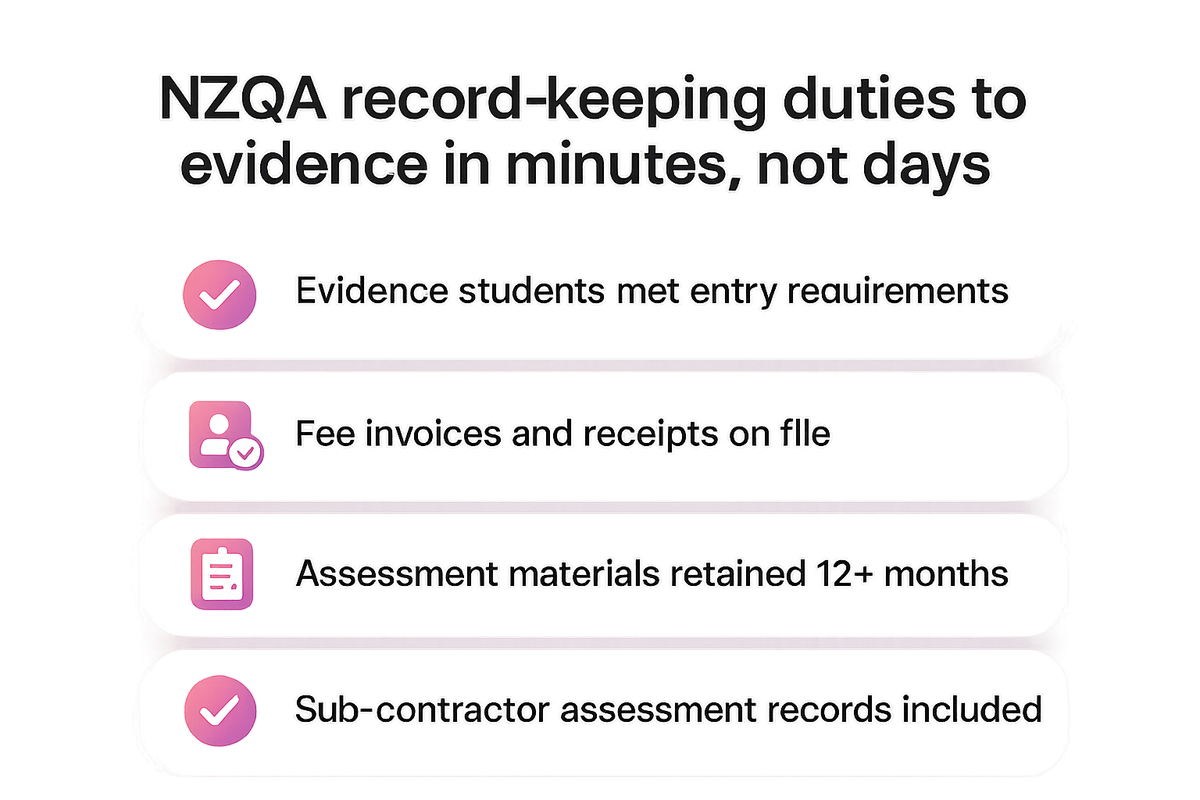
A useful audit question: for any random student, could you produce the full evidence trail — entry requirement evidence, fee documentation, assessment materials — in under ten minutes, without asking three different people? If not, that's your actual compliance exposure, independent of anything NZQA has flagged yet.
Three data returns, one fixed window
SDR and IND cover every enrolment in the student management system regardless of funding source, and every provider receiving the Student Achievement Component, or with students on loans or allowances, has to submit both. Layered on top is the annual Workforce Questionnaire — a separate statistical return on staff numbers for the full calendar year, submitted alongside the December SDR. That means HR and payroll data has to line up with academic and finance data, on the same clock, in the same window.
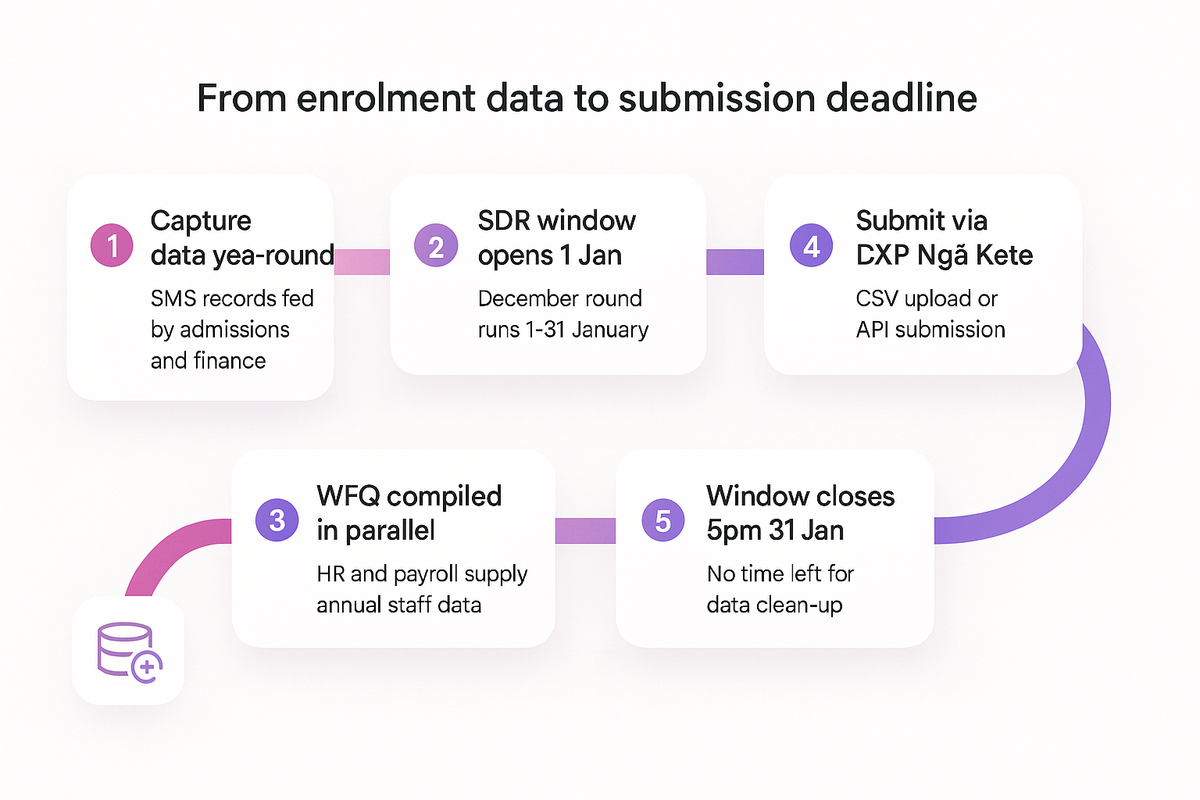
This is where duplicate data entry stops being an internal inefficiency and becomes visible to TEC. If your staffing numbers in the Workforce Questionnaire don't reconcile cleanly with what the SDR implies about delivery, that's a flag raised by your own reporting, not an auditor's.
The reporting pipe just changed shape
Since August 2025, SDR and IND data moves through the DXP Ngā Kete platform, which accepts either CSV upload or system-to-system API submission. Providers with proper integration between their student management system and DXP Ngā Kete can automate the submission step. Providers still exporting, manually reformatting and hand-checking CSV files are exposed to the same lengthy reporting cycle they've always had — just now inside a narrower, less forgiving window.
A sector reorganising around you
Legislation passed in October 2025 disestablished Te Pūkenga in favour of a transitional New Zealand Institute of Skills and Technology, effective from 1 January 2026, with Industry Skills Boards replacing Workforce Development Councils from the same date. Day-to-day PTE compliance obligations haven't gone away — they've continued through the restructure. But some of the bodies you coordinate with have changed names, remits or contact points, and that uncertainty gets absorbed by whichever team is already stretched thinnest. For most PTEs, that's operations.
There's a longer-term upside worth tracking rather than reacting to: NZQA is working with Workforce Development Councils and Industry Skills Boards to progressively replace unit standards with skill standards, and to move toward single national programmes instead of multiple provider-developed versions. That's explicitly aimed at reducing compliance costs and improving consistency. It won't simplify your next reporting cycle, but it may simplify the ones after that.
Key takeaways
- Two PTE rule cycles landed within roughly six months (1 July 2025 and 19 January 2026), meaning operations teams have re-validated enrolment, fee-protection and record-keeping processes twice in under a year.
- NZQA's record-keeping duties — entry requirement evidence, fee invoices/receipts, and 12 months' retention of assessment materials including sub-contractor work — are hard to prove reliably when data is spread across disconnected systems.
- SDR, IND and the annual Workforce Questionnaire run on fixed, unforgiving windows (the December 2025 SDR round: 1–31 January 2026), so source data accuracy has to be built in year-round, not fixed at deadline time.
- DXP Ngā Kete, live from August 2025, supports API submission as an alternative to manual CSV handling — the gap between automated and manual providers is now a genuine reporting-speed difference, not a hypothetical one.
- Sector restructure (NZIST from 1 January 2026, Industry Skills Boards replacing Workforce Development Councils) adds coordination uncertainty operations leaders have to absorb without new headcount.
Our take
Treat this as a standing operations design problem, not a series of one-off compliance scrambles. The PTEs that handle rule changes and reporting deadlines calmly aren't the ones with the most compliant intentions — they're the ones whose enrolment, finance and academic data already agrees with itself before anyone opens a reporting window. That's an operating model decision, made months before the deadline, not a scramble made during it. If your team is still re-keying the same student record into three systems, the next rule change — and there will be one — is a preview of the next fire drill, not a one-off.
FAQ
What are the current PTE record-keeping obligations under NZQA rules? NZQA requires enrolment records to show evidence students met entry requirements, along with fee invoices and receipts, and requires all student assessment materials — including those produced by sub-contractors — to be retained for at least 12 months after course completion.
How often are PTE registration rules changing right now? PTEs have absorbed two rule cycles inside roughly six months: the Private Training Establishment Registration Rules 2025 from 1 July 2025, and further PTE/Industry Skills Board fee rules alongside the Student Fee Protection Rules 2025 from 19 January 2026.
What's the deadline pressure with SDR, IND and the Workforce Questionnaire? SDR and IND windows are fixed and short — the December 2025 SDR round ran from 1 to 31 January 2026 at 5pm. The Workforce Questionnaire, an annual staffing return, is submitted alongside the December SDR, meaning HR, payroll and academic data all have to reconcile inside the same narrow window.
Does DXP Ngā Kete change how PTEs submit SDR and IND data? Yes. Since August 2025, SDR and IND data moves through DXP Ngā Kete, which accepts either CSV upload or API submission — providers with system-to-system integration can automate submission, while those still exporting and manually formatting files remain exposed to a longer manual reporting cycle.
What does the vocational education restructure mean for PTE operations? From 1 January 2026, a transitional New Zealand Institute of Skills and Technology replaced Te Pūkenga, and Industry Skills Boards replaced Workforce Development Councils. Core PTE compliance obligations continue, but some of the bodies PTEs coordinate with have changed, adding short-term process uncertainty for operations teams.