Self-Assessment Report Software for NZ PTEs: Buyer's Guide
10 August 2026 · 8 min read

NZQA doesn't certify or require any specific 'self-assessment report software' — it only requires that a PTE's self-assessment process be comprehensive, authentic, transparent and robust. From 1 January 2026, though, the reporting mechanism itself changes: External Evaluation and Review (EER) is being replaced by the integrated Quality Assurance Framework (iQAF), so any tool you buy needs to be built for the incoming annual self-review summary report, not the outgoing EER model.
What NZQA actually requires — and how it's changing
NZQA's own guidance is clear that self-assessment is a process, not a template. A PTE can use whatever method suits its context, as long as it can show the process is genuine and stands up to scrutiny. That's why there has never been an 'NZQA-approved' report format to build software against.
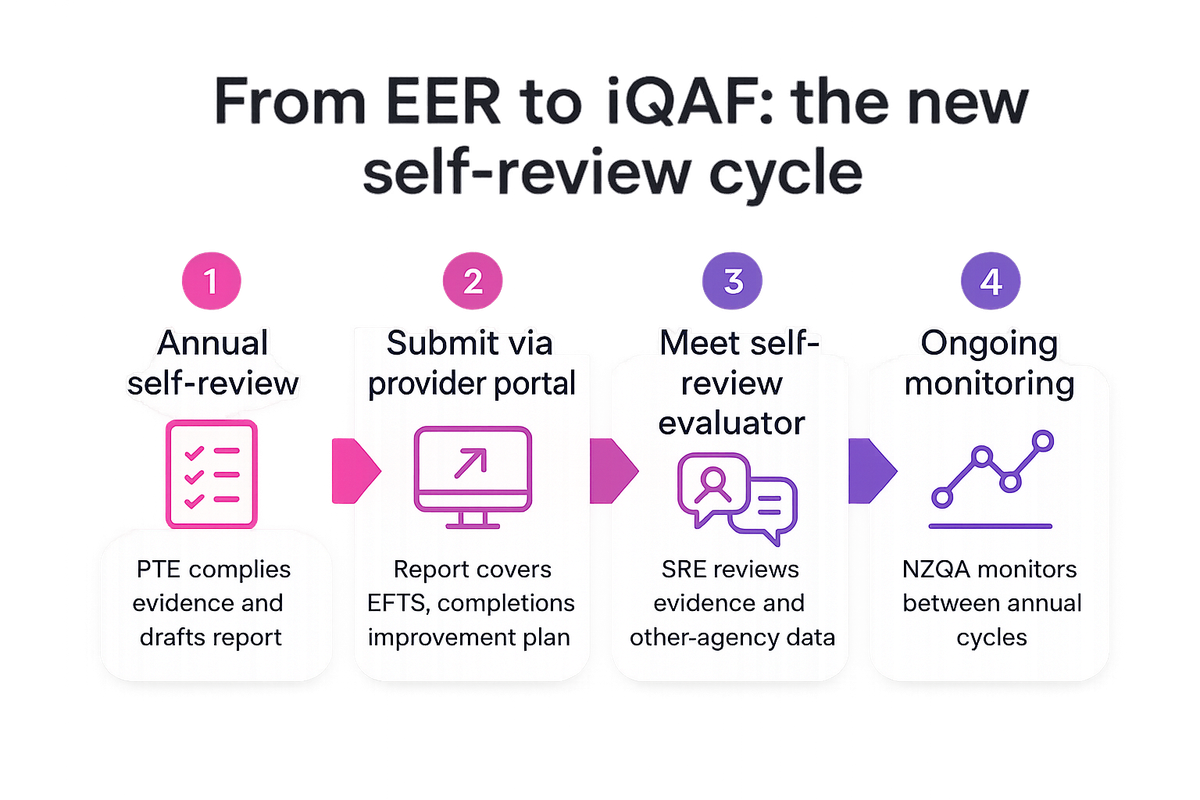
What is changing is the machinery around that process:
- EER is closing down. NZQA is not opening new EER processes from 1 January 2026, and the Private Training Establishment Rules 2026 remove EER terminology in favour of self-review and monitoring, effective 19 January 2026.
- The iQAF introduces an annual self-review summary report, submitted through NZQA's provider portal, followed by a meeting with a self-review evaluator (SRE).
- The report itself has four sections, including current and previous-year EFTS and completion data plus an improvement plan — so it's as much a data-reporting exercise as a narrative one.
- SREs also cross-reference data held by other agencies, including TEC, the Ministry of Education and Immigration New Zealand, during the annual discussion. That means evidence organisation matters more than polished prose.
- Providers delivering kaupapa Māori programmes or teaching mātauranga Māori can instead engage through Te Hono o Te Kahurangi — a distinct pathway any evaluation or reporting tool should be able to accommodate.
- Existing EER category ratings (1–4) aren't disappearing overnight. Immigration New Zealand, for instance, will keep using current EER categories for visa conditions for 12 months from early 2026 — a reminder that the regulatory picture is mid-transition, and any vendor you evaluate needs a credible iQAF roadmap, not just an EER-era product.
Can software actually write your self-assessment report?
No tool can write a compliant self-assessment report on its own, and any vendor implying otherwise should raise a flag. NZQA's self-review evaluator is assessing whether your organisation's judgement about its own performance is authentic and evidenced — not whether the prose reads well.
What software can genuinely do is:
- Draft narrative sections from source data, for a qualified staff member to review, edit and validate before submission.
- Organise evidence — enrolment, EFTS, completion and assessment records — so it's traceable back to source rather than typed from memory.
- Keep version history and change logs, so when an SRE asks 'what changed since last year and why', you have an answer.
- Flag relevant regulatory updates so your evidence and templates don't quietly go stale between reporting cycles.
The accountable person — a manager, quality lead or the PTE's CEO — still owns the judgement in the report. AI or workflow software assists that person; it doesn't replace their sign-off, and it shouldn't be marketed as if it does.
What to look for when evaluating options
Given NZQA doesn't prescribe a method, judge software on process fit and evidence discipline, not on any claim to auto-generate a compliant report:
- iQAF-current, not EER-legacy. Is the vendor's language and workflow built around the self-review summary report, EFTS/completion data and the improvement plan — or still describing EER-era submissions?
- Evidence trail over word count. Does it track version history, source data and change logs, or does it just produce narrative text with no traceability?
- Human sign-off stays central. Does the workflow require a named, qualified person to review and approve before anything is submitted?
- Separates the two self-review obligations. Does it distinguish TEO self-review (academic performance, EFTS, improvement plan, submitted to NZQA) from Code of Practice self-review (pastoral care, published on your website, attested annually by the CEO, Principal or Chair)?
- Tracks regulatory change. Can it surface relevant NZQA updates so your templates and evidence stay current between cycles?
- Connects to data you already hold. Does it pull from your existing enrolment, EFTS and assessment records, or does it need everything re-entered by hand?
- Transparent, proportionate pricing with demonstrable experience working with New Zealand PTEs specifically — not a generic AI writing tool relabelled for compliance.
TEO self-review vs Code of Practice self-review: one tool or two?
These are genuinely separate obligations, and it's worth checking whether a tool covers both or only one.
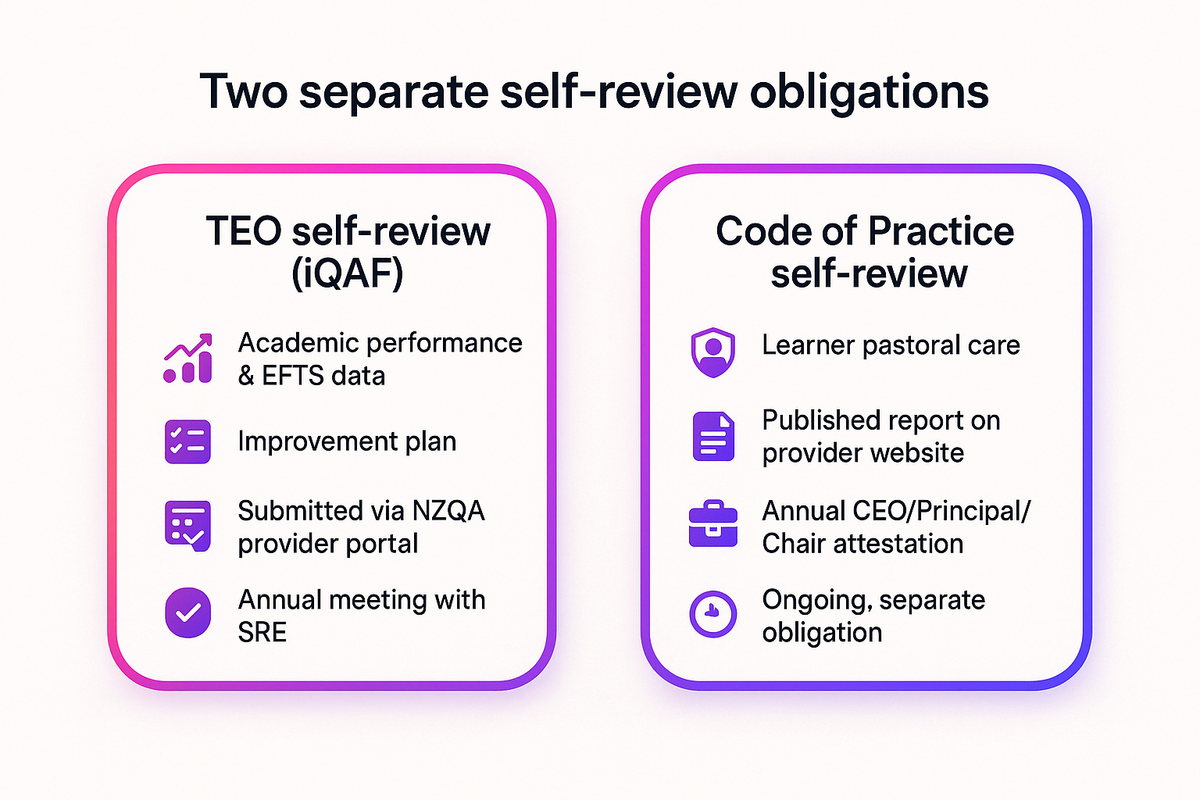
TEO self-review under the iQAF is the annual, academic-performance-focused cycle: EFTS and completion data, an improvement plan, submitted via the NZQA provider portal, followed by a meeting with an SRE.
Code of Practice self-review is about the pastoral care of learners. It's ongoing, requires a self-review report published in an accessible place on your website, and needs an annual attestation signed by the CEO, Principal or Chair. It runs on its own cycle, independent of the TEO self-review calendar.
A single piece of software can reasonably support both by organising evidence for each — but treat any claim that one workflow produces both final reports with some scepticism; the outputs, audiences and sign-off requirements differ.
Where AI tools fit — and where they don't
Supahuman's AI Workspace, built for New Zealand PTEs, is a reasonable example of the adjacent-support category rather than a purpose-built self-review report generator. Its Resource Library keeps version history, change logs and compliance tracking — the kind of evidence trail a PTE would draw on when compiling material for a self-review summary report. It also monitors regulatory changes from NZQA, which helps keep documentation current as the iQAF rules bed in.
It drafts formatted outputs like validation reports and assessor guides, with workflows that keep educators reviewing and finalising the content rather than treating AI output as a finished compliance document. One documented New Zealand PTE, Mast Academy, reports course-creation work that used to take around six weeks was reduced to minutes using the platform — a useful indicator of admin-time savings on the kind of documentation work that feeds into self-review, even though it's not a claim about self-assessment reports specifically.
Worth being direct about the gap: neither Supahuman's nor VETos' published material describes a feature literally called 'self-assessment report software'. The honest framing is that these tools support the evidence and drafting work around self-review — they don't replace the provider's own self-assessment judgement, and they shouldn't be bought expecting a one-click compliant report.
Key takeaways
- NZQA doesn't prescribe a self-assessment format — it requires the process be comprehensive, authentic, transparent and robust, so buy for evidence discipline, not a fixed template.
- From 1 January 2026, EER is being replaced by the iQAF; PTEs will submit an annual self-review summary report via NZQA's provider portal and meet with a self-review evaluator.
- Software should manage evidence, version history and regulatory-change tracking — not just generate narrative text with no traceability back to source data.
- TEO self-review (academic, EFTS-based) and Code of Practice self-review (pastoral care, CEO-attested) are separate obligations; check whether a tool actually distinguishes them.
- A qualified, accountable person must still validate and sign off any AI-assisted draft — no tool removes that requirement.
Our take
Buying 'self-assessment report software' as if it were a single, certifiable product misreads how NZQA's system works — there's no fixed format to build against, and the ground is shifting under everyone's feet as the iQAF rolls out. The more useful question for a PTE is whether a tool tightens your evidence trail and keeps pace with the rule changes, while leaving the actual self-assessment judgement where it belongs — with a qualified person in your organisation. Treat any vendor promising a fully automated compliant report with caution; treat one that's honest about being an evidence-and-drafting assistant, with a credible iQAF roadmap, as the more trustworthy category of buy.
FAQ
Does NZQA require PTEs to use specific self-assessment report software? No. NZQA requires the self-assessment process to be comprehensive, authentic, transparent and robust, but it doesn't mandate a format or a specific tool. Software is a support option, not a compliance requirement.
What's replacing External Evaluation and Review (EER)? From 1 January 2026, NZQA is not opening new EER processes; EER is being replaced by the integrated Quality Assurance Framework (iQAF). The Private Training Establishment Rules 2026 formally remove EER terminology in favour of self-review and monitoring, effective 19 January 2026.
What does the new annual self-review summary report actually contain? Under the iQAF, PTEs submit an annual self-review summary report through NZQA's provider portal and meet with a self-review evaluator. The report has four sections, including current and previous-year EFTS and completion data and an improvement plan.
Is Code of Practice self-review the same as TEO self-review? No. Code of Practice self-review covers the pastoral care of learners, requires a published report on the provider's website and an annual attestation by the CEO, Principal or Chair. TEO self-review under the iQAF is a separate, academic-performance-focused cycle involving EFTS data and an improvement plan submitted to NZQA.
Can AI actually write our self-assessment report for us? AI tools can help draft sections from your own data and organise evidence, but a qualified, accountable person in your PTE must still review, validate and sign off the final report. No current tool removes that human accountability, and none should be bought on the promise that it does.