Trainer Turnover in NZ PTEs: A Quality Risk, Not an HR One
28 July 2026 · 7 min read

Trainer turnover doesn't just leave a gap on the timetable. It empties a filing cabinet nobody knew existed — the unwritten moderation calls, the "why we mark it this way" judgement, the mid-course tweaks that made assessment defensible. NZQA's own External Evaluation and Review reports are starting to say this out loud, and it's worth reading them the way a Head of Training should: as evidence about you, not just about staffing.
Why this lands on your desk
You own trainer capability, currency and workload. You're judged on completion and engagement. You're accountable when validation and moderation results come back patchy. Turnover sits underneath all three.
When an experienced trainer leaves mid-cycle, the learners in front of them feel it first — through inconsistent feedback, a substitute who marks differently, or a course that quietly drifts off-plan. The moderation risk shows up later, often at the worst possible moment: during an EER, when a reviewer asks how you know assessor judgements are "reliable and accurate across all learners, regardless of who does the assessing or when" — the exact standard set out in Rule 10.3 of the national external moderation principles. That standard gets structurally harder to meet when your trainer team is in constant flux.
What NZQA's evaluations already show
The pattern across published EER reports is consistent, and it doesn't flatter organisations that treat trainer support as a nice-to-have.
One evaluation credited a provider's "good staff morale and low staff turnover" and a supportive "family environment" as a genuine strength worth naming. Another found the opposite: trainers who "did not always understand the relationship between assessment and moderation" — precisely the kind of capability gap that widens fastest when the people who understood it best have already left, and nobody captured what they knew.
A 2024 evaluation went further, crediting structured trainer development days with "the valuing of staff, investment in developing staff, and a commitment to fostering consistency of expected quality practices" — and linked that investment directly to "positive... audits, as well as successful external moderation." That's not a soft HR outcome. That's a lead indicator NZQA is prepared to name in a formal report.
More recently, NZQA's 2025 review of TR Driver Training Limited recommended the provider "consider analysing individual trainer rates of success and any achievement differences between branches" — reviewers are now explicitly testing whether you can see trainer-level performance at all, not just aggregate outcomes.
The version-control problem: what walks out the door
An earlier EER found something a lot of Heads of Training will recognise uncomfortably well: post-course trainer evaluations that "mostly involve ticking boxes and have few comments, making them not very useful," and debriefing discussions that led to real delivery changes but "are not recorded."
That's not a paperwork complaint. It's an institutional memory failure. Under the Private Training Establishment Rules 2026, PTEs must keep permanent academic records, evidential records for cross-credit and recognition of prior learning, attendance records for the duration of enrolment, and assessment materials for a minimum of 12 months. None of that is hard to manage while the trainer who built the assessment is still on staff. All of it becomes fragile the week they're not.
The reform shockwave hitting your trainer pool
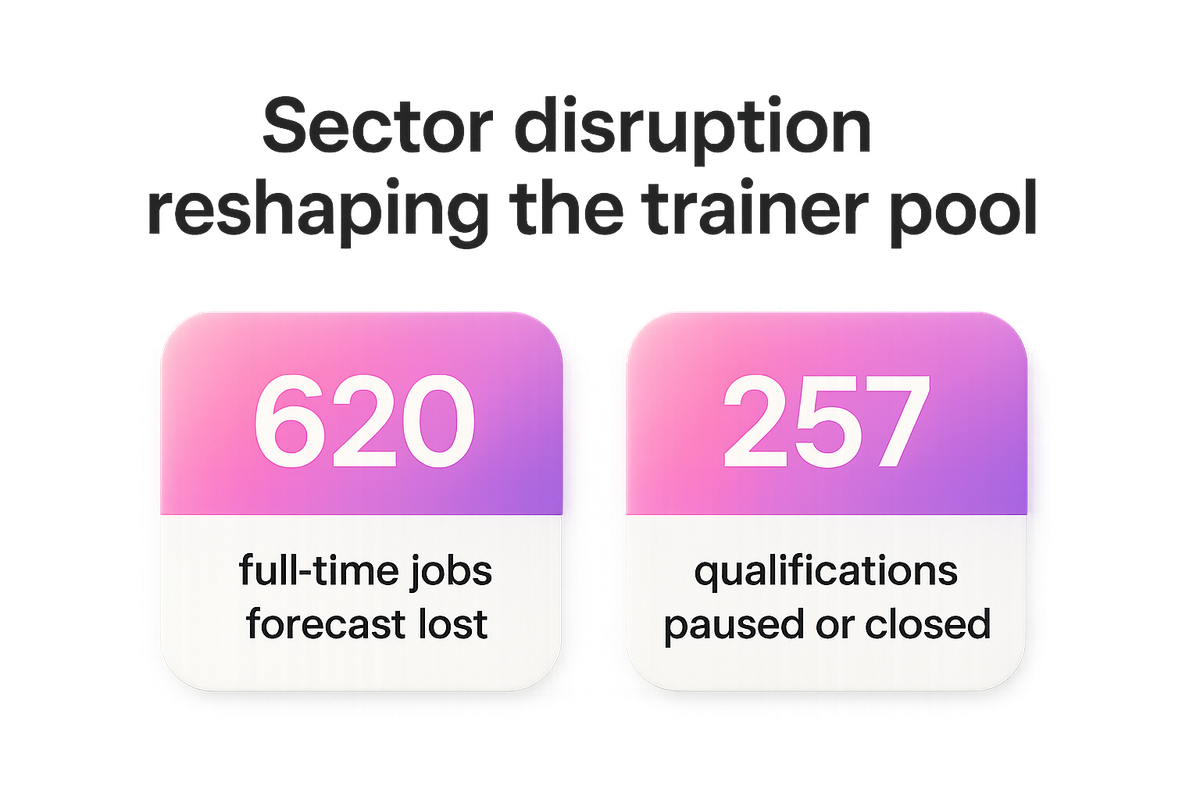
This is landing at an unusually disruptive moment for the sector. The Education and Training (Vocational Education and Training System) legislation passed in October 2025 disestablished Te Pūkenga, creating ten regional polytechnics and new Industry Skills Boards from 1 January 2026. Reporting alongside that reform points to around 620 full-time jobs forecast lost and 257 qualifications paused or closed at the end of 2025.
Whatever you think of the reform itself, the practical effect for a Head of Training is the same: experienced vocational trainers are being displaced into, or out of, the same labour market PTEs recruit from. Immigration New Zealand already tracks Vocational Education Teacher as its own occupational category on the skill-shortage checker — a signal, at government level, that trainer supply was tight before this reshuffle even started. Worth checking the live tool rather than assuming current status, but the direction of travel is clear.
Building retention into your quality system, not just your HR plan
A few things you can act on this quarter, without waiting for a bigger fix:
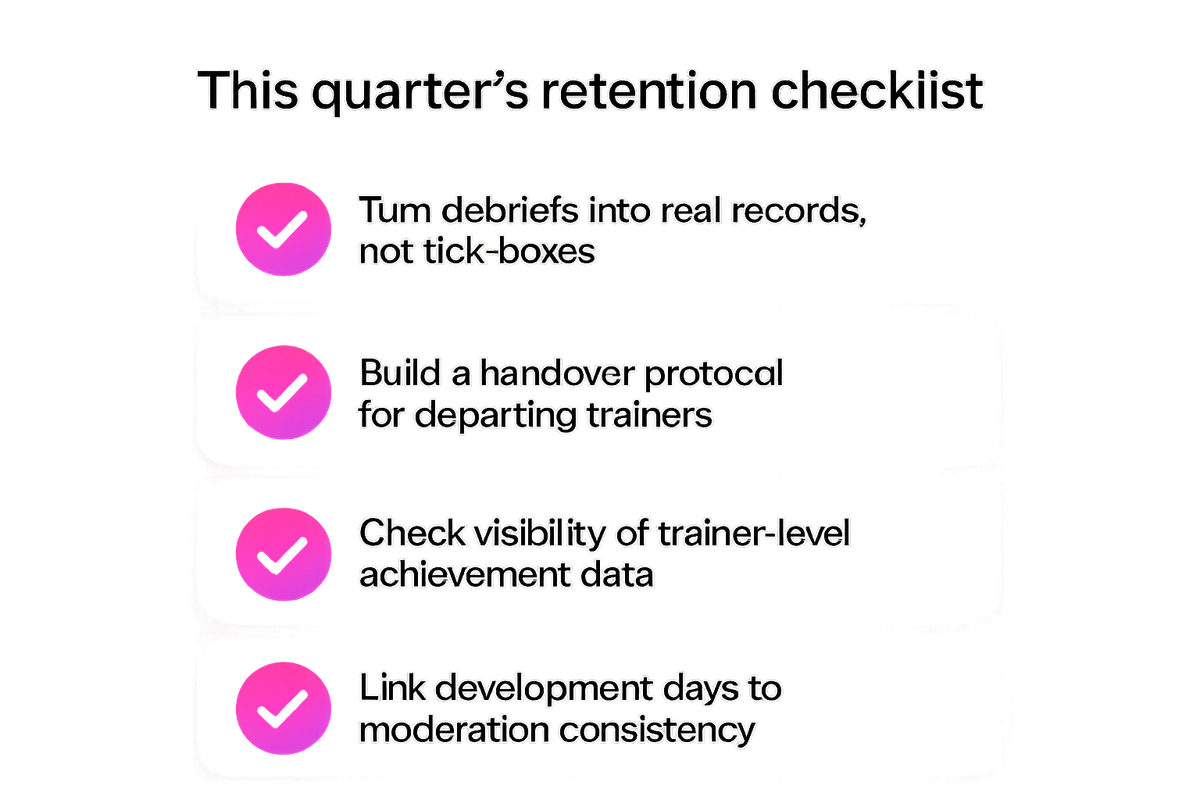
- Turn post-course debriefs into a real record, not a tick-box form — capture the specific delivery decisions and why, not just satisfaction scores.
- Build a lightweight handover protocol for any trainer leaving or reducing hours: what moderation judgement calls did they make that aren't written down anywhere?
- Ask, as NZQA's TR Driver Training review suggests, whether you can see trainer-level and branch-level achievement patterns today — not after the next EER asks you to produce them.
- Treat trainer development days as a moderation-consistency investment, not a training-budget line, and be ready to point to the connection if asked.
Key takeaways
- NZQA's EER reports directly link low staff turnover and strong staff support to better moderation and audit outcomes — and link trainer capability gaps to weaker ones.
- Post-course debriefs that aren't properly recorded create an institutional memory gap that gets exposed the moment an experienced trainer leaves.
- The Private Training Establishment Rules 2026 set concrete record-keeping minimums that turnover makes harder to meet cleanly.
- Sector reform — Te Pūkenga's disestablishment, new Industry Skills Boards, reported job and qualification losses — is actively reshaping the trainer labour market PTEs draw from.
- Rule 10.3's requirement for consistent assessor judgement "regardless of who does the assessing" is a standard turnover makes structurally harder to hold.
Our take
Treat trainer retention as a quality-assurance discipline, not an HR metric buried in a staff survey. The EER evidence is blunt about it: providers that can show visible investment in trainer development and low turnover get named favourably; providers with patchy trainer understanding of moderation get named as a risk. Somewhere between those two outcomes sits a decision you make every time a trainer resigns — whether their judgement leaves with them, or whether you've built the habit of capturing it on the way out. That habit is cheaper to build now than to explain in your next EER.
FAQ
Does NZQA actually assess trainer turnover directly? Not as a standalone metric. But published External Evaluation and Review reports repeatedly connect staff morale, turnover and development investment to moderation and audit outcomes, meaning turnover shows up indirectly through the quality evidence reviewers examine.
What records do we need to keep when a trainer leaves? Under the Private Training Establishment Rules 2026, PTEs must retain permanent academic records, evidential records for cross-credit and recognition of prior learning, attendance records for the duration of enrolment, and assessment materials for at least 12 months — obligations that don't pause when the trainer who created them does.
How does the Te Pūkenga disestablishment affect trainer supply for PTEs? The October 2025 legislation disestablishing Te Pūkenga created ten regional polytechnics and new Industry Skills Boards from January 2026, alongside reported job losses and qualification closures — disruption that is shifting where experienced vocational trainers sit across the whole system, including the pool PTEs recruit from.
What does Rule 10.3 actually require of us? The national external moderation principles require assessor judgements to be reliable and accurate across all learners, regardless of who does the assessing or when — a consistency standard that gets harder to sustain the more your trainer team changes.