Trainer Workload Timetabling for PTEs After EER Ends
6 August 2026 · 8 min read

From 19 January 2026, the roster you build each term stops being a logistics document and becomes quality-assurance evidence. NZQA's move to continuous, provider-led self-review means there's no external EER cycle waiting to catch a thin trainer bench before it shows up in a learner's assessment. The trade-off between coverage and consistency is now yours to own, in real time, with your own evidence trail.
Why this lands on your desk, not just the compliance team's
You own the training and assessment strategy. You also own the roster that puts it into practice — which trainer covers which site, which cohort gets the experienced tutor and which gets the one three weeks into the job. Those decisions have always shaped assessment consistency and trainer currency. What's changed is that nobody outside your organisation is going to periodically check whether the trade-offs held up.
Under the old model, an EER visit every few years gave you an external checkpoint — uncomfortable, but a backstop. Under continuous self-review, the checkpoint is whatever your own quality management system captures, continuously, across every site and shift. If your timetabling decisions are quietly stretching capability thin, that pattern is now sitting inside your own records rather than waiting to be flagged by someone else.
The safety net is gone: what changes on 19 January 2026
The Quality Assurance of Tertiary Education Providers Rules 2026 come into force on 19 January 2026, replacing EER and its category ratings with ongoing self-review and monitoring. Providers must maintain, keep up to date, and give effect to a quality management system across all aspects of delivery — not just produce one for an audit.
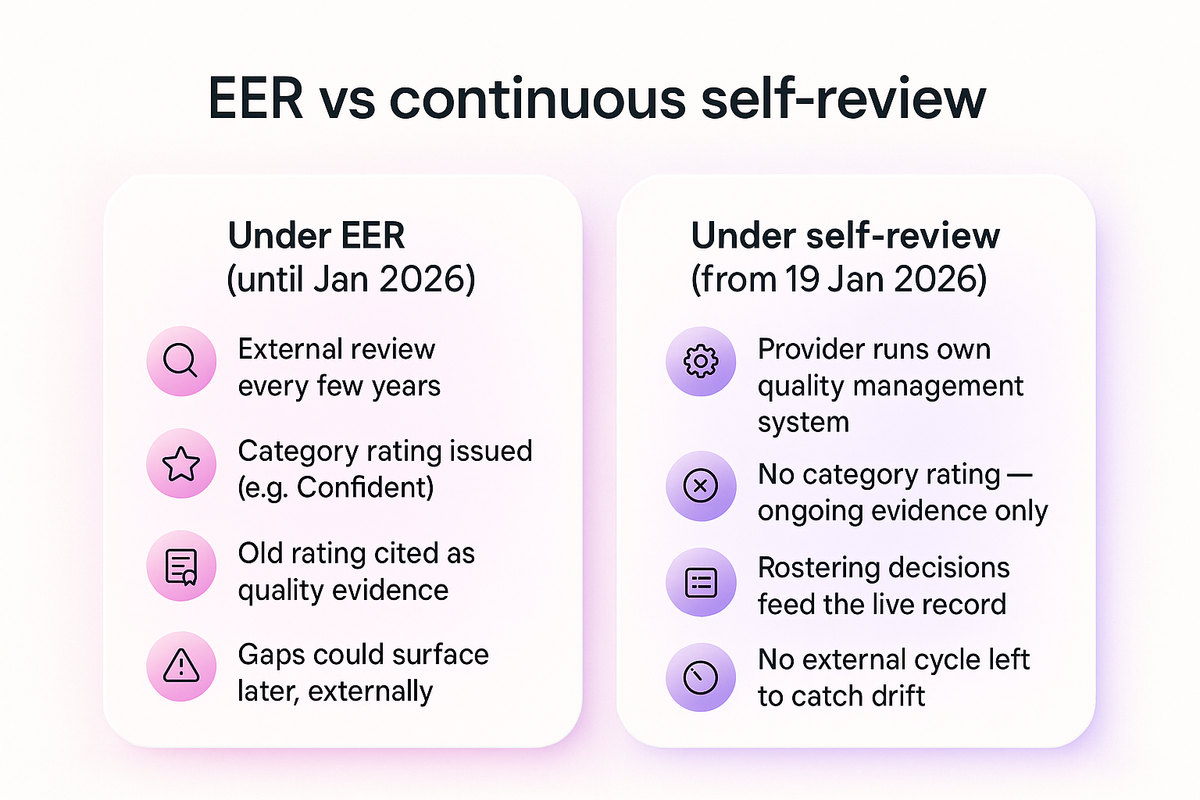
NZQA has also been explicit that any provider still citing an old EER category must state the year it was received and note that the EER system is no longer in operation. That's a small rule with a big implication: a historical "Confident" or "Excellent" rating from 2023 tells a prospective learner or funder nothing about whether your current rostering is holding assessment quality steady in 2026. Your quality claims now rest entirely on current, live evidence.
A cautionary tale already on the public record
NZQA's 2025 EER report on Skill New Zealand Limited is worth reading closely, because it shows exactly what thin trainer benches do to delivery quality. The report recorded notable tutor and support-staff attrition, with four of six teaching staff in the focus-area programmes employed for one year or less. NZQA's recommendation wasn't just "hire more people" — it called for the programme review to be refreshed with new staff and a developmental, Code-of-Practice-aware approach.
That finding predates the shift to self-review, but the pattern it describes — new trainers absorbing load across cohorts they barely know, with no time to bed in assessment judgement — is precisely the risk that spreading coverage thinly across sites creates. Under the old system, an external reviewer eventually caught it. Under the new one, you're the one who has to catch it, in your own moderation and validation cycle, before it compounds.
Standard-setting is moving under you at the same time
This isn't happening in isolation. From 1 January 2026, Te Pūkenga is disestablished, transitioning via NZIST, and eight Industry Skills Boards take over standard-setting, qualification development and temporary management of work-based training for a two-year transitional period, alongside the re-establishment of regionally governed polytechnics. RNZ reported "change fatigue" across the sector in 2025, with genuine concern that industry voice in workplace training and apprenticeship decisions could be diluted during the handover from Workforce Development Councils to Industry Skills Boards.
For a Head of Training, that matters because your timetabling and your training materials are built against specific standards and qualifications. If those standards are being revised or reassigned to a new standard-setting body mid-cycle, a roster built around last year's unit standards can drift out of alignment without anyone noticing until a self-review picks it up.
Currency now needs active tracking, not a fixed cycle
The Qualification and Micro-credential Listing and Operational Rules 2026 remove maximum review periods and introduce an "expiring" status for qualifications and micro-credentials not reviewed within a specified time. There's no longer a guaranteed cycle telling you when a qualification will be revisited — you need to track currency actively, qualification by qualification, rather than assuming a review will happen on schedule.
That sits alongside the 2026 Consent to Assess Against Standards Rules, which require providers to demonstrate how they'll meet the new Quality Assurance of Tertiary Education Providers Rules, with sub-contracting requirements now housed directly in the QA Rules. If you run a multi-site model using sub-contracted trainers or assessors across locations, that consent obligation now sits squarely inside the same quality framework your rostering decisions feed into — not as a separate paperwork exercise.
What continuous self-review actually asks of your timetable
Scale matters here too. Around 250,000 people study in New Zealand's VET system each year, roughly split between on-campus, PTE and wānanga delivery and work-based training. That's the volume of decisions running through timetables like yours, multiplied across the sector, at the exact moment the external check disappears.
Practically, that means your validation and moderation records, your trainer currency evidence, and your site-allocation logic all need to tell a consistent story — because they're the story now, not a supplement to an EER report. Where a roster puts a newly hired trainer on solo delivery across two sites, your self-review evidence needs to show why that's safe, not just that it happened.
Key takeaways
- The Quality Assurance of Tertiary Education Providers Rules 2026, in force from 19 January 2026, replace periodic EER with continuous self-review — there's no external cycle left to catch problems later.
- Any reference to an old EER category must now state the year received and note EER is no longer operating; current internal evidence, not history, carries the quality claim.
- NZQA's 2025 EER report on Skill New Zealand Limited — four of six teaching staff in reviewed programmes employed a year or less — is a documented example of how thin, high-attrition rosters undermine assessment quality.
- Standard-setting is moving to eight Industry Skills Boards during a two-year transition from 1 January 2026, alongside Te Pūkenga's disestablishment, raising real risk of materials and timetables drifting from current standards.
- Qualifications and micro-credentials can now enter an "expiring" status if not reviewed in time, and sub-contracting consent obligations sit inside the same QA Rules your rostering decisions feed evidence into.
Our take
The end of EER category ratings will read to some as deregulation. It isn't. It's a transfer of the review workload from NZQA's calendar to yours, running continuously instead of every few years. For Heads of Training, that's a genuine change in what "good" looks like: a roster that quietly overloads a new trainer for a term used to be a risk you might get away with. Now it's a pattern your own self-review system is supposed to surface before it becomes a Code-of-Practice or assessment-quality problem. The providers who adjust well won't be the ones who write more policy — they'll be the ones who treat trainer allocation, currency tracking and moderation as one connected system rather than three separate obligations.
FAQ
What actually replaces External Evaluation and Review from January 2026? The Quality Assurance of Tertiary Education Providers Rules 2026, in force from 19 January 2026, replace EER and its category ratings with continuous provider-led self-review and monitoring. Providers must maintain and give effect to a quality management system across all delivery, on an ongoing basis, rather than being assessed on a periodic external cycle.
Can we still refer to our old EER rating in marketing or funding conversations? Only if you state the year the rating was received and note explicitly that the EER system is no longer in operation. NZQA has flagged this requirement directly — a historical category no longer stands alone as evidence of current quality.
Why does the Skill New Zealand Limited EER report matter to how I roster trainers? That 2025 report recorded four of six teaching staff in the reviewed programmes employed for a year or less, and NZQA linked that attrition directly to programme-quality risk, recommending a refreshed, developmental approach. It's a concrete, documented case of what thin, high-turnover rosters do to assessment consistency — the exact trade-off multi-site timetabling has to manage.
How does the Te Pūkenga disestablishment and the Industry Skills Board transition affect my training materials? From 1 January 2026, Te Pūkenga is disestablished and eight Industry Skills Boards take over standard-setting and qualification development during a two-year transition, alongside regionally re-established polytechnics. Materials and timetables built around unit standards under the old structure need active checking against which body now owns those standards, particularly as qualifications can move into an "expiring" status if not reviewed.