Why Off-the-Shelf AI Fails NZ's Mid-Sized Exporters
20 September 2026 · 7 min read
New Zealand exporters have never used AI more — and rarely got less out of it. Datacom's 2026 State of AI Index puts organisational AI usage at 91%, yet just 4% report it has actually transformed their core operations, a figure that has halved in twelve months. For mid-sized exporters juggling ERP, freight, customs and finance data every day, generic AI tools simply aren't built to reconcile that complexity.
What the 2026 data actually shows
The headline numbers tell a story of adoption without depth. Datacom's research tracked usage climbing sharply — from 66% in 2024, to 87% in 2025, to 91% in 2026 — while the share of organisations reporting genuine operational transformation fell from 8% to 4% over the same period.
- 91% of NZ organisations now use AI in some form.
- Only 4% report it has changed how their core operations run.
- Just 15% have progressed to organisation-wide scaling; the remaining 81% are stuck in exploratory or early implementation phases.
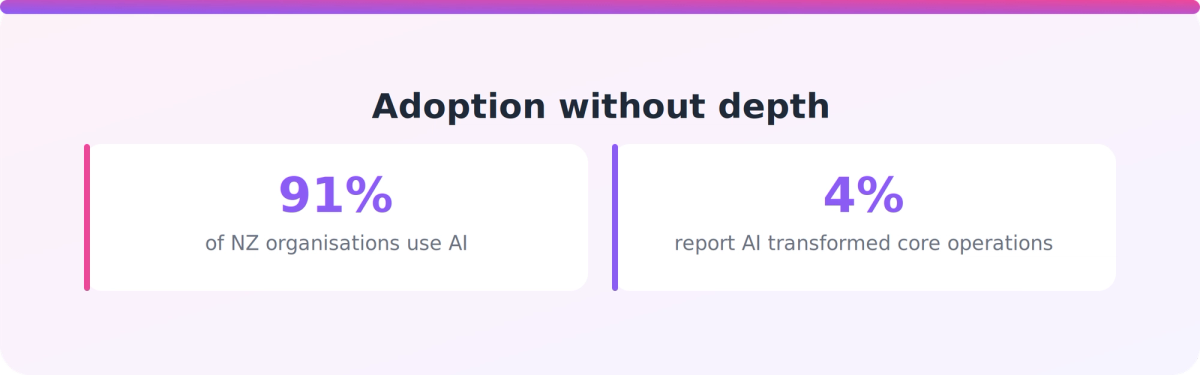
That gap between trying AI and running on it is the real story, and it's most visible in businesses with the most operational complexity to untangle.
Why adoption keeps outpacing transformation
Who owns the AI programme? For most NZ organisations, the honest answer is nobody in particular. Datacom found only 22% of businesses have a dedicated AI leadership role — meaning AI initiatives are often bolted onto someone's existing job rather than run as a proper programme with accountability and a mandate.
Without ownership, tools get trialled, a few staff experiment, and nothing sticks. CAIRN's review of AI Forum NZ research puts a sharper number on this: only 2.7% of the national workforce are genuine 'AI practitioners' with the technology embedded in daily workflows. The other 97% or so of usage is closer to occasional prompting than operational change — a high-use, low-trust pattern that looks a lot like adoption on paper and very little like transformation in practice.
The specific problem for mid-sized exporters
Why are exporters struggling more than most to convert AI activity into returns? RNZ reported that NZ's mid-sized businesses specifically are failing to realise ROI from AI investment, with commentator Voges framing the barrier as foundational rather than a lack of appetite. The underlying survey named the real blockers:
- Cybersecurity and data privacy concerns — 43%
- Skills and change capacity — 40%
- Governance, risk and compliance — 32%
- Cloud and integration readiness — 30%
Three of those four are integration and governance problems, not enthusiasm problems. For an exporter, that plays out very literally: a generic AI layer sitting on top of MYOB, a freight platform and a customs portal has no reliable way to see all three at once, let alone reconcile them in real time.
MYOB's Autonomous Business Report backs this up from the ERP side. It found 75% of mid-sized ANZ decision-makers plan to overhaul or significantly upgrade their ERP within two years, warning that 'without a clean, integrated data environment, AI tools cannot perform reliably and automation cannot scale.'
Where generic tools break down
Enterprise DNA's supply chain guide lists the everyday friction points that off-the-shelf AI simply isn't built to interpret:
- Port of Auckland disruptions affecting shipment timing
- Tauranga customs holds requiring rapid document response
- Sudden freight-cost spikes that shift landed cost overnight
- Manual MYOB reconciliation across multiple currencies and carriers
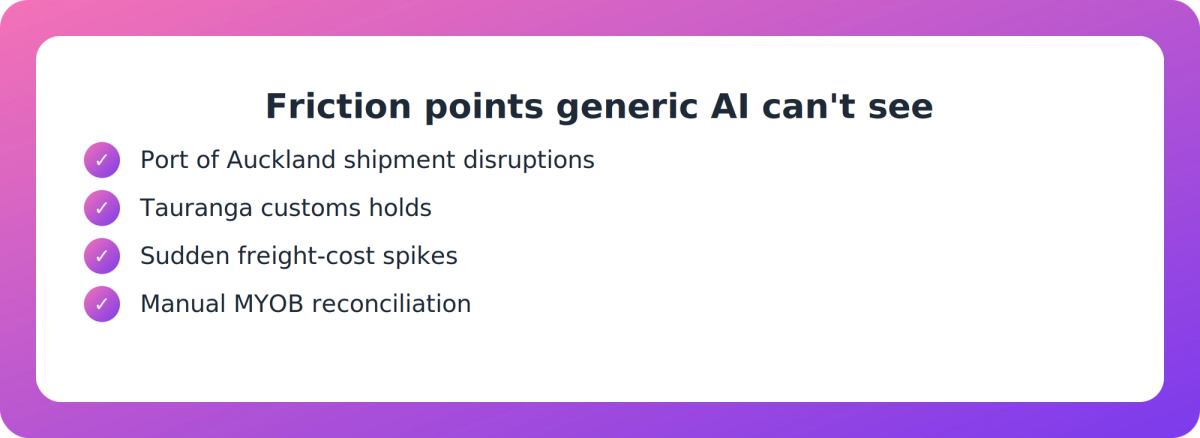
Each of these lives in a different system, updates on a different schedule, and needs to be cross-referenced in near real time. A generic chatbot or productivity add-on has no visibility into any of it. Enterprise DNA's own guidance is blunt: fix the underlying data plumbing before adding an AI model, not after.
Why this is a competitiveness problem, not just an efficiency one
DataForge's analysis of the NZ AI implementation gap makes the stakes explicit: exporters competing against overseas rivals who have already automated large parts of their operations face a widening gap the longer this integration work is deferred. Every quarter spent running exploratory pilots on generic tools is a quarter a better-integrated competitor spends compounding an efficiency advantage — in freight cost forecasting, customs turnaround, or working-capital visibility.
This isn't an argument for more AI. It's an argument for AI that actually sits inside the systems an exporter already runs on — trained on the business's own freight, customs and finance data, not a generic model with no context for how that data behaves.
What actually needs to change first
Before evaluating another AI tool, mid-sized exporters are better served asking three questions:
- Who owns this? Someone needs a clear mandate to run AI as a programme, not a side project.
- Is the data actually connected? ERP, freight and customs systems need to talk to each other before any model can reason across them reliably.
- Does the tool match the workflow, or does the workflow have to bend to the tool? Generic AI products are built for the median business, not for a specific export operation's customs and freight patterns.
Getting these three right is unglamorous work. It's also the difference between a 91%-usage statistic and a business that's genuinely running differently.
Key takeaways
- NZ AI usage hit 91% in 2026, but only 4% of organisations report genuine operational transformation — down from 8% the year before.
- Just 22% of businesses have a dedicated AI leadership role, and 81% remain stuck in exploratory or early implementation phases.
- Mid-sized exporters cite integration and governance issues — cybersecurity (43%), skills (40%), governance (32%), cloud/integration readiness (30%) — as the real blockers, not lack of interest.
- Generic AI tools can't reconcile fragmented ERP, freight, customs and finance data — exactly the multi-system complexity exporters deal with daily.
- DataForge warns the competitive gap against more automated overseas rivals widens the longer this integration work is deferred.
Our take
The data points to a simple conclusion: NZ exporters don't have an AI enthusiasm problem, they have an ownership and integration problem. Buying another generic tool without first connecting ERP, freight and customs data, or without someone accountable for making it work, is why usage keeps climbing while transformation keeps shrinking. The businesses that break out of the 81% stuck in exploratory mode will be the ones that treat AI as an operational build — trained on their own data, wired into their own systems — rather than another subscription added to the pile.
FAQ
Why is NZ AI usage so high but transformation so low? Datacom's 2026 State of AI Index found 91% of NZ organisations use AI, but only 4% report it has transformed core operations — down from 8% the previous year. Adoption is outpacing integration and ownership, so most usage stays shallow.
What's specifically stopping mid-sized exporters from getting ROI on AI? An RNZ-reported survey found the top blockers are cybersecurity and data privacy concerns (43%), skills and change capacity (40%), governance and compliance (32%), and cloud/integration readiness (30%) — foundational issues, not lack of interest.
Why can't off-the-shelf AI tools handle exporter data? Generic tools aren't built to reconcile fragmented, real-time data across ERP, freight, customs and finance systems — the exact combination exporters manage daily, from Tauranga customs holds to MYOB reconciliation, according to Enterprise DNA's supply chain analysis.
Does an exporter need to fix its ERP before using AI? MYOB's Autonomous Business Report found 75% of mid-sized ANZ decision-makers plan to overhaul or significantly upgrade their ERP within two years, warning that AI tools can't perform reliably without a clean, integrated data environment first.
Who should own an AI programme inside a mid-sized exporter? Datacom found only 22% of NZ businesses have a dedicated AI leadership role. Without a named owner accountable for integration and governance, AI initiatives tend to stay stuck in exploratory pilots rather than scaling across the business.