AI Assessment Feedback NZQA: What Assessors Still Sign Off
8 October 2026 · 8 min read
Yes, AI can help draft assessment feedback in New Zealand, but only as support for an assessor who stays accountable. Ministry of Education guidance developed with NZQA favours formative feedback over summative marking, expects teachers to review and validate AI output, and discourages AI marking of NCEA internal assessments. No NZQA approval scheme exists for these tools.
That last point shapes the whole buying decision. You can't lean on a certification badge. You have to judge a tool on visible human review, fit with your own policies, and how it handles learner data.
Where can AI sit in NZQA-facing assessment feedback?
The clearest line in current guidance is formative versus summative. The Ministry of Education's October 2025 principles on marking work with AI tools rest on three ideas: teacher responsibility and professional judgement, human oversight, and appropriate use cases. AI should support professional judgement, not replace it.
The same guidance says AI suits formative feedback (assessment for learning) better than summative assessment. Teachers must review and validate AI-generated feedback or marks. Students should be told when AI has been used.
In practice, that gives you a rough map:
- Comfortable territory: draft, formative feedback on practice work or drafts, reviewed by the assessor before the learner sees it.
- Needs care: feedback on work that feeds directly into a judgement about achievement.
- Discouraged: using AI to mark NCEA internal assessments. Any use is limited to supporting the assessor's own final judgement. GenAI is not permitted in NCEA external assessment.
What must the assessor still sign off?
The assessor carries responsibility for the claim of achievement. A tool can suggest wording. It can't hold that responsibility.
An NZQA official-information release on AI marking and the related AI release make two things clear. AI isn't explicitly prohibited for internal assessment marking. But moderation and verification must still be done by a subject specialist with standard-specific knowledge.
So the assessor still needs to:
- Read every piece of AI-drafted feedback and edit or reject it.
- Check it against the actual outcomes and performance criteria of the standard.
- Make the competency or achievement decision themselves.
- Keep the record that shows they did.
Don't read NZQA's own use of AI as an endorsement of third-party tools. NZQA used Automated Text Scoring on more than 55,000 writing assessments in May 2025 under a "human at the helm" approach, with human check-marking as quality assurance, including over a third of responses near the achievement boundary. That's NZQA's own marking, not a green light for yours.
What should you check before buying an AI assessment feedback tool?
Start with your own house. NZQA expects tertiary providers to have a coherent assessment and moderation system and to review their academic integrity policy so it covers generative AI. NZQA's monitoring of internal moderation systems from 2020 to 2024 found policies commonly did not cover generative AI. Its academic integrity guidelines say policy should describe when AI use is acceptable and under what conditions.
If your policy is silent, fix that before you shortlist anything.
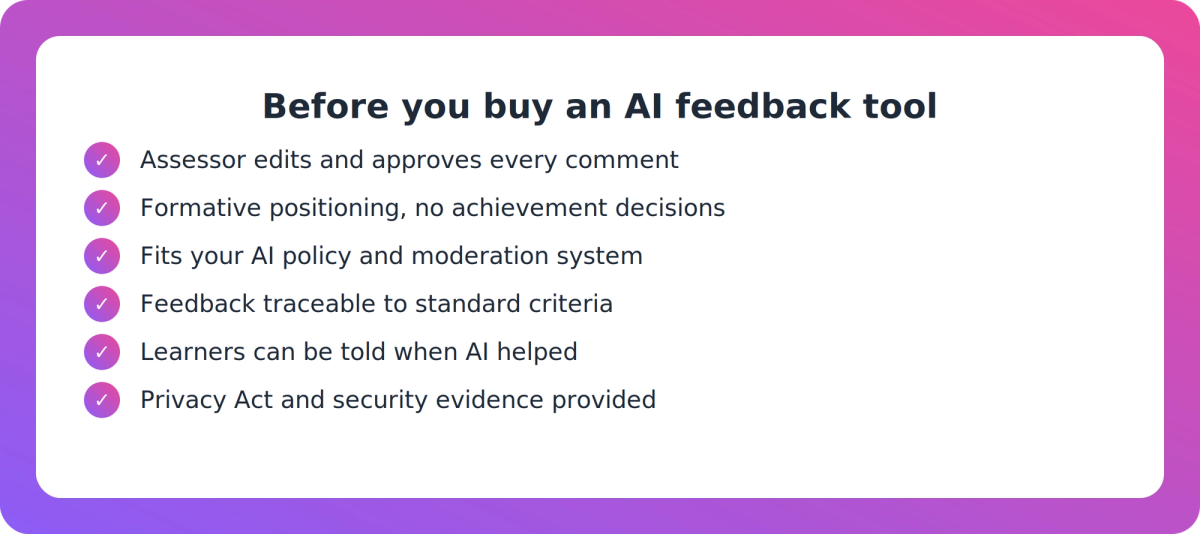
The buyer's checklist
- Visible human review. Can the assessor edit, query and approve every piece of feedback before a learner sees it? Is that approval recorded?
- Formative positioning. Is it built for draft or formative feedback? Does it avoid making competency or achievement decisions?
- Policy and moderation fit. Does it work within your AI-use policy, your moderation system and the conditions of assessment for the specific standards?
- Standard-specific accuracy. Does feedback map to the real outcomes and performance criteria, and can you trace that mapping?
- Student disclosure. Can you easily tell learners when AI contributed?
- Privacy and security. How does the vendor meet the Information Privacy Principles? The Privacy Act applies to AI tools, and the Privacy Commissioner has published guidance on AI and the IPPs. Ask where data is hosted and what independent evidence backs security claims. ISO 27001 or NZISM alignment is a self-claim until it's evidenced.
- Audit trail. Is there version history so you can answer a moderation request from the record?
- Relevant evidence. Ask for customer outcomes specific to assessment feedback, not adjacent wins like faster content creation.
- Currency. Does the vendor track changes to Ministry and NZQA positions?
Is there an NZQA-approved AI feedback tool?
Not that we could find. There's no published NZQA accreditation, approval or certification process for AI feedback tools, and no independent NZQA audit of a specific product. Be wary of any listing that implies otherwise.
Guidance is also still moving. The NZ Herald has reported the Ministry revising its AI marking rules amid teacher confusion. Check the Ministry of Education and NZQA pages directly before you sign anything, and write a review point into the contract.
Where does VETos fit, honestly?
We build VETos, so weigh this accordingly. Based on our own published material, it's a partial fit for this category, and the boundaries matter.
- What it describes: a qualified person stays in charge. Everything generated is mapped to the relevant unit and standard with traceable mapping, and a qualified person reviews and signs off.
- What it says it doesn't do: it doesn't mark work and never makes a competency decision. Assessors do.
- Feedback today: structured formative feedback to learners on a mock assessment, criterion by criterion against the unit's requirements. That's formative learner support, not AI-drafted assessor feedback on submitted work.
- Records: version history, currency control and audit trails, plus a QA Engine that checks assessments against the NZQA Principles of Assessment.
- Not yet available: Assessor Quality Assurance and Student Coach are listed as coming soon. Don't buy on them.
Our AI Studio builds custom AI as a managed service for education providers, but assessment feedback drafting isn't among its listed services. Our one quantified NZ education result, at Mast Academy, is about assessment creation being 80% faster. That's content creation, not feedback. A bespoke feedback tool would be scoped work you should ask us to evidence. Security details such as AWS hosting in Australia, SSO and ISO 27001 / NZISM-aligned controls are our own descriptions, so ask for proof from us as you would from anyone. More on the NZ offering is at vet.supahuman.com/nz.
Key takeaways
- AI may draft assessment feedback in NZ only as support. The assessor stays accountable for the achievement claim.
- Official guidance favours formative feedback and discourages AI marking of NCEA internal assessments.
- Moderation and verification must be done by a subject specialist with standard-specific knowledge.
- No NZQA approval scheme exists for AI feedback tools, so judge on human review, policy fit, accuracy and Privacy Act compliance.
- Guidance is still changing. Check current Ministry and NZQA positions before you buy.
Our take
The smart question isn't "which tool is best?" It's "where in our process are we comfortable with a draft, and can we prove a person approved it?" A tool that makes human review quick and recorded beats one that promises to remove it. And if your AI policy is still a paragraph in the academic integrity document, that's the first purchase to make, and it's free.
FAQ
Can AI be used to draft assessment feedback in NZ, and what must assessors still do?
Yes, as support. Ministry guidance developed with NZQA expects teachers to review and validate AI-generated feedback, and the assessor remains responsible for the final judgement. Moderation and verification must still be done by a subject specialist with standard-specific knowledge.
Is AI-drafted feedback acceptable for NCEA internal assessment or tertiary unit standard assessment, or only for formative use?
The guidance favours formative use. For NCEA internal assessment it discourages AI marking and limits any use to supporting the assessor's own final judgement. NZQA hasn't explicitly prohibited AI in internal marking, but human accountability and specialist moderation still apply.
What should a PTE, polytechnic or school check before buying an AI feedback tool?
Check that assessors can edit and approve all feedback, with that approval recorded. Check fit with your AI and academic integrity policies, moderation system and standard-specific accuracy. Confirm that learners can be told when AI was used, and that the vendor meets the Information Privacy Principles.
Is there an NZQA-approved or certified AI feedback tool?
We found no published NZQA approval, accreditation or certification process for AI feedback tools, and no independent NZQA audit of a specific product. Treat any claim of NZQA approval with caution and ask the vendor for evidence.
A next step that doesn't require buying anything
Take the checklist above and run it against your current AI policy and moderation process, then against any vendor you're considering, including us. If you'd like to see how VETos handles mapping, review and audit trails, you can book a demo and ask the awkward questions.