AI Assessment Writing & NZQA Compliance: A PTE Buyer Guide
14 October 2026 · 7 min read
A PTE can use AI to draft unit standard assessment materials, but we found no NZQA rule written specifically for it, so the existing requirements still apply. Drafts must be moderated before use, rest on valid, authentic, current and sufficient evidence, and respect the Privacy Act 2020. The safest set-up has a named, qualified person sign off every draft first.
What does NZQA actually require when AI drafts assessment material?
NZQA's AI material that we found covers learner use of AI and academic integrity. It doesn't address providers using AI to write assessments. That means no new rulebook applies, and no loophole either. The controls you already work under apply to AI-drafted material as they would to anything a person wrote.
The ones that matter most:
- Pre-use moderation. NZQA Rules require an effective system for moderating assessment materials and decisions. New materials (tasks and marking guidance) are moderated before use with learners, and again when they change.
- Consent and Moderation Requirements (CMR). Each standard on the Directory of Assessment and Skill Standards has its own CMR document, according to a vendor guide. The PTE Rules 2026 define a standard by reference to that Directory.
- Quality of evidence. Judgements must rest on evidence that is valid, authentic, current and sufficient (see unit standard 30421). NZQA also expects assessors to verify that submitted work was produced by the learner.
- Record-keeping. PTEs must keep student assessment materials, or full copies, for at least 12 months from completion of the education or training. They must also keep meeting their approval, accreditation and consent-to-assess criteria.
- Privacy. The Privacy Act 2020 applies to anyone using AI tools in New Zealand. There is no standalone NZ AI law.
None of this can be delegated to software. A tool can speed up the drafting. It can't be the accountable party.
How do you keep a qualified human accountable before moderation?
Think of it like a lawyer signing off a document. A junior can prepare the draft, but a named person with the right qualifications reads it, changes it and puts their name to it. To be clear, "lawyer-style sign-off" is a design approach, not an NZQA standard. It does fit neatly with moderation requirements and with the Privacy Commissioner's guidance expecting human review where decisions affect people.
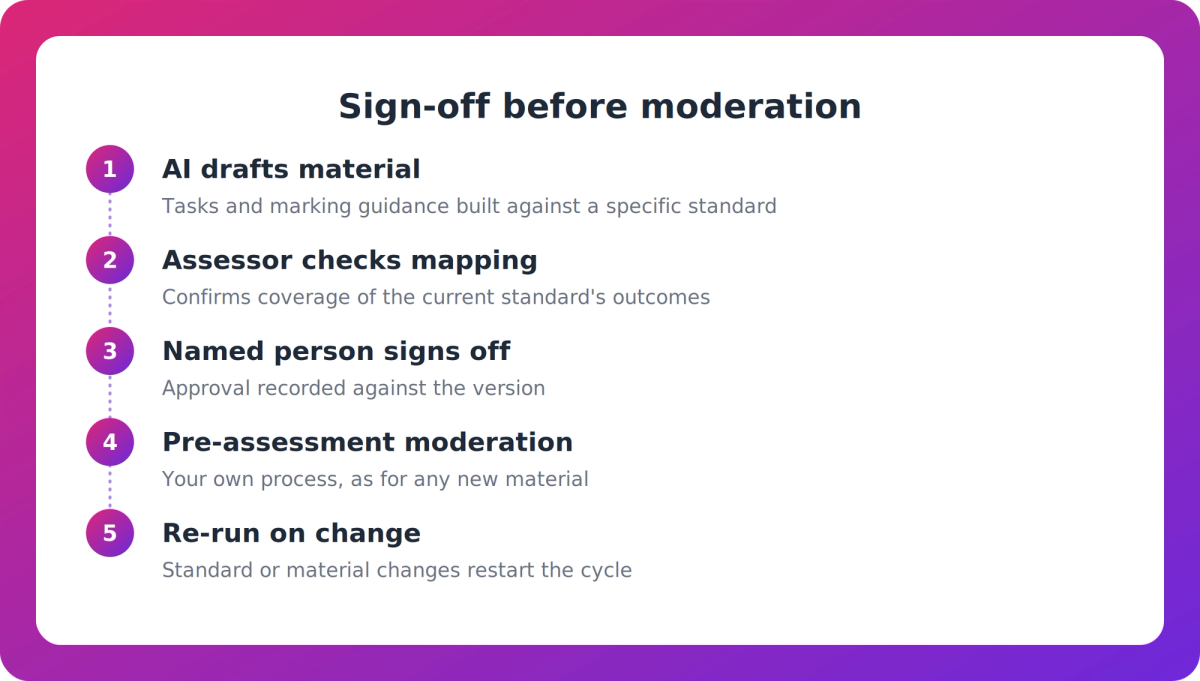
A workable version looks like this:
- Draft. The tool produces tasks, marking guidance and assessor guides against a specific standard.
- Check the mapping. A subject-matter assessor confirms each task actually covers the outcomes and evidence requirements of the current standard.
- Sign off. A named, qualified person approves, or sends back, each draft. The approval is recorded with the version.
- Moderate. The signed-off material goes through your own pre-assessment moderation, as any new or changed material would.
- Re-run on change. When a standard or the material changes, the cycle starts again.
The point is that the sign-off can't be skipped or quietly bypassed. If a tool makes it easy to export unreviewed drafts straight to learners, treat that as a design flaw.
Is there an NZQA-approved AI assessment tool?
No. We found no NZQA accreditation, certification or approved-vendor list for AI assessment-writing tools. NZQA evaluates the provider's assessment and moderation system.
That has a practical consequence. Any claim of "NZQA-approved" or "NZQA-certified" software deserves a polite, direct question about what it means. "Built around NZQA standards" is a fair description of a design intent. It isn't an endorsement.
We also found no independent benchmarks or accuracy studies for these tools. So your best evidence is a pilot: run the tool's outputs through your own pre-assessment moderation and see what your moderators would have changed.
What should you ask an AI assessment-writing vendor?
Standards mapping and the move to skill standards
Judge this before speed. A fast draft that maps loosely to the wrong version of a standard just moves the work to your moderators.
- How does the tool pull in the current unit or skill standard, and how does it handle updates?
- What happens to existing materials as unit standards move to skill standards? Is mapping regenerated, and does a person review it?
- Does it flag what it can't evidence, or does it guess?
Audit trail and sign-off
- Can assessors and moderators easily edit, query and approve content?
- Is each sign-off recorded against a named person and a version?
- Are there version history, assessor guides and change logs that support CMR and moderation expectations?
- How does it fit your record-keeping, including the 12-month retention minimum?
Privacy and security
- Does the vendor support a Privacy Impact Assessment? The Privacy Commissioner recommends one before you start, with regular updates.
- What personal information goes in? Can you avoid putting learner data in at all?
- Are there contractual limits on the provider retaining personal information, and where is data hosted?
- Can you see a certificate or independent audit report? "ISO 27001 aligned" or "NZISM aligned" is not the same as certified.
Scope and price
- Which capabilities exist today, and which are marked "coming soon"?
- Is pricing transparent, with defined success milestones?
Where does VETos fit?
VETos NZ is one option built specifically around NZQA assessment drafting. Its site describes pulling a unit or skill standard into a workspace and building against it, with mapping to the standard and assessor guidance. The listed workspace features include version control, audit logs, a QA engine that checks against the NZQA Principles of Assessment, and detection of unit standard updates that triggers regeneration of dependent materials. It also describes an upgrade path from unit-standard materials to skill-standard replacements.
Its FAQ is clear that a qualified person still reviews and signs off, and that outputs are traceable to the relevant standard. That's the human-in-the-loop stance this guide recommends. Assessor Quality Assurance is listed as "Coming Soon", so don't count it as a current capability. Mast Academy, an NZ PTE, uses VETos, but its reported outcomes are self-reported by Supahuman.
A separate note on bespoke builds. Supahuman's Custom AI Studio does custom work, but its sites don't describe an engagement that drafts learner assessment evidence for NZ PTEs. Its security claims are "aligned" rather than certified. Ask for evidence, as you would with any vendor.
Key takeaways
- No NZQA rule specifically governs AI-drafted assessment materials, and no NZQA approval scheme exists for the tools. Existing moderation, CMR, evidence and Privacy Act requirements apply.
- AI drafts; a named, qualified person reviews and signs off before the material enters your own pre-assessment moderation.
- Weigh standards-mapping accuracy, audit trail, recorded sign-off and privacy and security evidence above speed.
- Ask for certificates or audit reports, not "aligned" statements, and check what is live versus "coming soon".
- Pilot the tool through your own moderation, because no independent accuracy benchmarks were found.
Our take
The tool matters less than the process around it. A PTE with a disciplined sign-off and moderation routine can use a mediocre drafting tool safely, and a PTE without one can get into trouble with a very good tool. So buy for traceability and for how easily your assessors can say "no, redo this", and treat speed as a bonus. And pilot before you commit: your moderators will tell you more than any demo.
FAQ
Does NZQA allow a PTE to use AI to draft unit standard assessment materials?
We found no NZQA rule that prohibits it or specifically governs it. NZQA's AI material found covers learner use and academic integrity. Existing requirements still apply: pre-use moderation of new and changed materials, CMR, valid, authentic, current and sufficient evidence, and the Privacy Act 2020.
How do we keep a qualified human accountable for AI-drafted material?
Make a named, qualified person review and approve every draft, record the sign-off against the version, then run it through your own pre-assessment moderation. "Lawyer-style sign-off" is a design approach, not an NZQA standard, but it is consistent with moderation requirements.
Is there any NZQA approval or certification for AI assessment-writing tools?
No. We found no NZQA accreditation, certification or approved-vendor list for these tools. NZQA evaluates the provider's assessment and moderation system, so a pilot run through your own moderation is the practical test.
What should we ask a vendor about privacy and security?
Ask whether it supports a Privacy Impact Assessment, how it minimises personal information, what contractual limits apply to retention, and where data is hosted. Ask for certificates or independent audit reports, since "aligned with ISO 27001 or NZISM" is not certification.