AI Chatbot Software for NZ PTE Enrolments: Buyer Guide
4 October 2026 · 8 min read
A New Zealand PTE without developers will most likely get a custom enrolment chatbot from a service provider that builds and runs it, not from one off-the-shelf software category. A DIY no-code tool is the other route. Either way, your PTE stays accountable under the Pastoral Care Code and the Privacy Act 2020.
That shapes how you should shop. Feature lists matter less than four questions: where the data sits, how the bot hands over to a person, what gets logged, and who actually runs it.
What are your options for AI chatbot software for NZ PTE enrolments?
The research behind this guide found no independent analyst or regulator definition of "enrolment chatbot software for NZ PTEs". The NZ market looks like a spread of service providers who build and run bots for you. Examples include Ez-AI, Custom AI Solutions NZ and Arkham Solutions. Their claims are marketing, and we haven't verified them.
For a PTE with no developers, it comes down to two routes:
- DIY no-code tool. Cheaper to start, and you control the content. But you maintain it, test it, fix it and monitor it. Someone on your team has to own that work every week.
- Done-for-you build-and-run service. A vendor designs, hosts, monitors and improves the bot. You pay for that, and you depend on the vendor's practices, so contract detail matters more.
Neither is automatically better. If you have a capable operations or marketing person with time, DIY can work for a narrow FAQ bot. If enrolment chats touch international learners, funding or pastoral care, the managed route usually carries less operational risk. It doesn't carry less accountability.
Who is accountable if a vendor builds and runs the bot?
You are. Handing the work to a vendor doesn't hand over the responsibility.
The Education (Pastoral Care of Tertiary and International Learners) Code of Practice 2021 applies to registered PTEs, Te Pūkenga, universities and wānanga that enrol domestic tertiary and/or international learners. A provider must be an approved signatory before enrolling international students. NZQA expects providers to take responsibility for practice, including practice by contracted third parties. That wording was stated in the context of offshore learners, so treat it as a strong signal rather than a chatbot-specific rule.
The Privacy Act 2020 applies whenever personal information is collected, used or shared. Enrolment chats will typically involve it. One change to note: IPP 3A, a new notification obligation for information collected from someone other than the individual, came into force on 1 May 2026. It matters if your bot or its integrations pull data from third parties.
Is there an NZQA rule or certification for enrolment chatbots?
No. We found no NZQA rule or standard specifically governing AI enrolment chatbots, and no NZ certification scheme for them. The government's July 2025 AI strategy says NZ isn't introducing AI-specific legislation. It will rely on existing privacy, consumer protection and human rights law.
So the practical evaluation basis is existing law plus voluntary guidance:
- The Privacy Commissioner's September 2023 guidance on AI and the Information Privacy Principles. It is non-binding, but maps well to vendor due diligence: privacy impact assessments, transparency, human review, data minimisation and contractual safeguards.
- MBIE's Responsible AI guidance for businesses. It is voluntary and covers risks including cybersecurity, privacy, human rights and intellectual property.
One caveat. The checklist below is our inference from these sources and from vendor claims. It is not a published NZ standard.
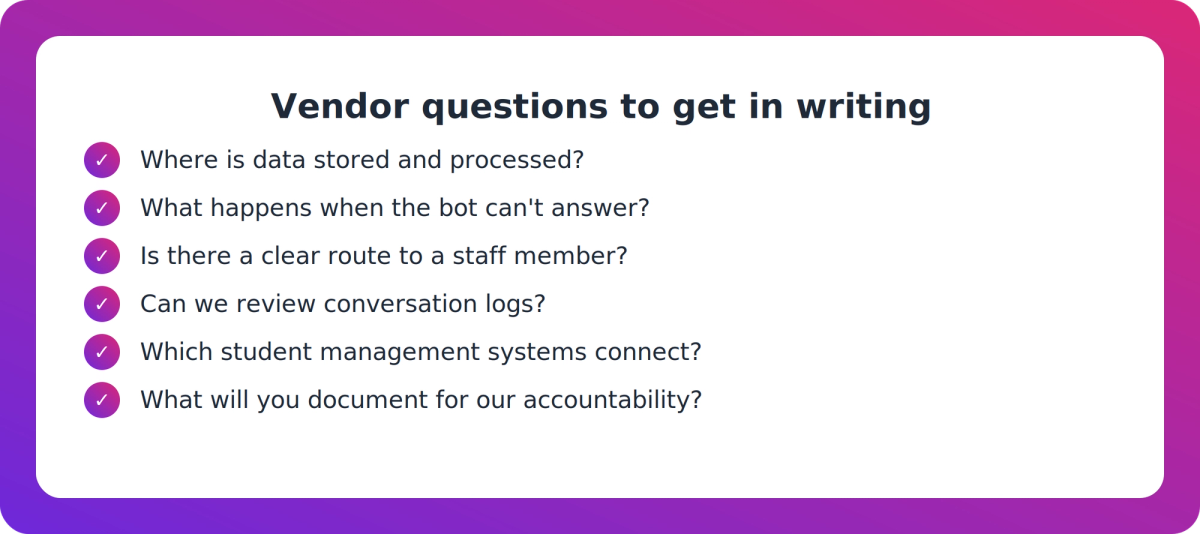
What should you ask a chatbot vendor before you sign?
Put these in writing, and don't accept "yes, we do that" on a call.
- Data location. Where is conversation data stored and processed? Ez-AI, for example, says it defaults to AWS Sydney for ANZ data residency. Ask for evidence, then weigh the answer in your own privacy impact assessment.
- Grounding. Are answers drawn only from documents you approve (retrieval-augmented generation, or RAG)? What happens when the bot can't find an answer? The behaviour you want is refuse and escalate, not guess.
- Human handover. Is there a clear route to a named enrolment staff member? This matters most for international learner and pastoral care questions under the Code.
- Logging and audit trail. Can your team review what prospective learners were told, and for how long are logs kept?
- Transparency and minimisation. Does the bot say plainly that it's an AI? Does it collect only what it needs?
- Student management system (SMS) integration. Which systems, how, and who maintains the connection? Get this confirmed in writing rather than assumed.
- Accountability in the contract. What will the vendor document and support so you can answer to NZQA and the Privacy Commissioner?
- Evidence. Ask for NZ education references. We found no independent accuracy benchmarks for any vendor.
How should you read pricing claims?
Treat headline numbers as claims to verify against scope. Custom AI Solutions NZ, for instance, advertises pilots or small projects from $500 to $5k with a one to two week turnaround. That might suit a narrow pilot. It tells you little about SMS integration, hosting, monitoring or what happens after launch.
Ask for a breakdown: build fee, ongoing hosting and support, and defined milestones. Then ask what's excluded.
Where does Supahuman fit?
Modestly, and with gaps you should probe. Supahuman's AI Studio is a custom-build, managed-service offering for education providers, including PTEs, wānanga, Te Pūkenga, universities and government. That is the nearest fit to a PTE without developers. The stated model is a project fee covering the build in small blocks, then one monthly subscription for hosting, monitoring, support and ongoing improvement, delivered by a dedicated squad of at least two people.
Here is what to check:
- Enrolment chatbots aren't a listed focus. Its stated areas are compliance and audit intelligence, reporting, standards development and RPL at scale. Ask directly whether they would build one.
- Hosting is on AWS in Australia. The site also cites multi-tenant architecture, SSO and ISO 27001 / NZISM-aligned controls. Australian hosting is a data-location point to weigh in your own privacy assessment.
- SMS integration isn't described. The AI Workspace is described as connecting with SharePoint, Microsoft 365, Teams and CRMs. Confirm anything beyond that.
- NZ evidence is in content, not enrolment. The Mast Academy case covers NZQA-aligned course content, with a claimed 80% cut in authoring time. VETos supports NZ PTEs with NZQA-aligned assessments, and qualified staff still review the output. Neither is an enrolment chatbot.
- Pricing. We found no AI Studio pricing. Don't read the VETos sign-up pricing as NZ AI Studio pricing.
Other vendors on your shortlist deserve the same questions.
What did this guide not cover?
Check these separately: Consumer Guarantees Act and Fair Trading Act implications, Unsolicited Electronic Messages Act requirements, and any NZ-specific accreditation of AI vendors. We also didn't verify whether the Code has been amended since 2021. Confirm the current version with NZQA.
Key takeaways
- Most NZ PTEs without developers will end up with a vendor-built-and-run chatbot, or a no-code tool they maintain themselves.
- Your PTE stays accountable under the Pastoral Care Code (including for contracted third parties) and the Privacy Act 2020.
- No NZQA rule or certification scheme covers AI enrolment chatbots. Use existing law, OPC guidance and MBIE's voluntary Responsible AI guidance as your basis.
- The sharpest filters are data location, human escalation, logging and who runs the bot.
- Vendor claims on pricing, accuracy and hosting are unverified. Get them in writing.
Our take
The temptation is to compare chatbot builders on how clever the bot sounds. We'd flip it: judge the vendor on what happens when the bot is wrong or out of its depth. An enrolment bot that cleanly says "I can't answer that, here's a person" is worth more than one that always has an answer. Decide who owns the bot after launch before you decide who builds it, and run a privacy impact assessment early, not as a sign-off at the end.
FAQ
What kind of software or service can a NZ PTE use to get a custom enrolment chatbot without developers?
Typically either a no-code chatbot tool you maintain yourself, or a service provider that builds and runs a custom bot for you. The research found no single defined software category for this, and vendor claims are unverified marketing. For a PTE with no developers, a managed build-and-run service is usually the lower-effort route.
If a vendor runs the chatbot, who is accountable under the Pastoral Care Code and the Privacy Act 2020?
Your PTE. NZQA expects providers to take responsibility for practice, including by contracted third parties, and the Privacy Act 2020 applies whenever personal information is collected, used or shared. The contracted-third-party wording was stated for offshore learners, so treat it as a strong signal rather than a chatbot-specific rule.
What should we ask a vendor about hosting, escalation, logging and SMS integration?
Ask where data is stored and processed, with evidence. Ask what the bot does when it can't answer, and how it hands over to enrolment staff. Ask how conversations are logged and reviewed, and which student management systems it integrates with. Get all answers in writing. This checklist is our inference, not a published NZ standard.
Is there an NZQA rule or certification for AI enrolment chatbots?
No rule or certification scheme specific to AI enrolment chatbots was found. The practical basis is existing law, including the Privacy Act 2020, plus the Privacy Commissioner's 2023 AI guidance and MBIE's voluntary Responsible AI guidance. The government's July 2025 AI strategy confirms NZ is not introducing AI-specific legislation.