AI Customer Insights NZ Retail: Beyond the POS Report
11 October 2026 · 7 min read
A POS report tells you what sold. It can't tell you how the shopper got there. NZ retailers are closing that gap with AI agents that query company data directly. But only those with documented governance, human oversight and clear privacy practice will be able to keep using what they learn.
What can't a POS report see?
The till records the end of a journey. It misses the research that came before it.
PwC New Zealand's 2026 research on the AI-powered consumer found that shoppers mainly use AI to compare products and prices (64%). AI-assisted online conversion was strongest in travel, electronics, gifts and fashion. Grocery and homeware stayed more store-led and tactile.
So the blind spot isn't uniform. If you sell electronics or gifts, a growing share of the decision may happen in an AI tool before anyone walks in or reaches your checkout. If you sell groceries, the till still captures more of the story.
How are NZ retailers moving from dashboards to AI agents?
The Post, reporting on Snowflake World Tour talks in Auckland, says some of New Zealand's largest retailers are using AI agents to search, analyse and act on company data. The aim is to cut the need for dashboards or digging through folders.
One group used advanced AI and analytics to decide where to move the next box of stock. It also used them for monitoring and risk assessment.
The shift is subtle but real. Instead of waiting for an analyst to build a report, a merchandiser asks a question and gets an answer from the underlying data. The value comes from joining up sources that used to sit apart: POS, loyalty, web and in-store.
What does purchase history reveal, and where's the line?
Past purchases are one of the richest behavioural signals a retailer holds. Woolworths NZ's Olive agent, covered by Inside Retail NZ in February 2026, can place suggested items directly into a basket. It draws on past purchase behaviour, seasonal patterns and contextual cues. RNZ reports it will use Google's Gemini Enterprise AI and insights collected over seven years.
That's a large retailer with seven years of data, and it's slightly outside our usual window, so treat it as context rather than a template. It also comes with a caution. A University of Auckland marketing lecturer warned that pre-made baskets reduce shoppers' tendency to change them.
The same data that lets you serve a customer better can quietly narrow their choices. That's worth deciding on deliberately, not by default.
What changed on 3 August 2026 for in-store data?
In-store tracking is where behavioural insight meets the sharpest regulation. According to a SecSolutionsHub write-up, the Biometric Processing Privacy Code grace period ended on 3 August 2026. Existing biometric and camera systems, such as dwell-time analysis, demographic estimation and face matching, now need to fully comply. That's a vendor blog, so confirm the detail against Office of the Privacy Commissioner guidance.
Two other points from the Equal Justice Project are worth noting:
- The 2025 Privacy Amendment Act added IPP 3A, which requires notification when personal information is collected indirectly.
- Bunnings has rolled out facial recognition across 34 North Island stores. That's an advocacy-style source, but it shows these systems are already in public view.
If you run cameras, Wi-Fi analytics or any in-store sensing, the practical question is simple. Can you show what you collect, why, and how you've told people?
Why is trust a commercial issue, not just a legal one?
Privacy Commissioner survey data, reported by Biometric Update in May 2026, shows 67% of New Zealanders are concerned about businesses and agencies using AI to make decisions about them with personal data. And 66% would consider switching providers over poor privacy and security practices.
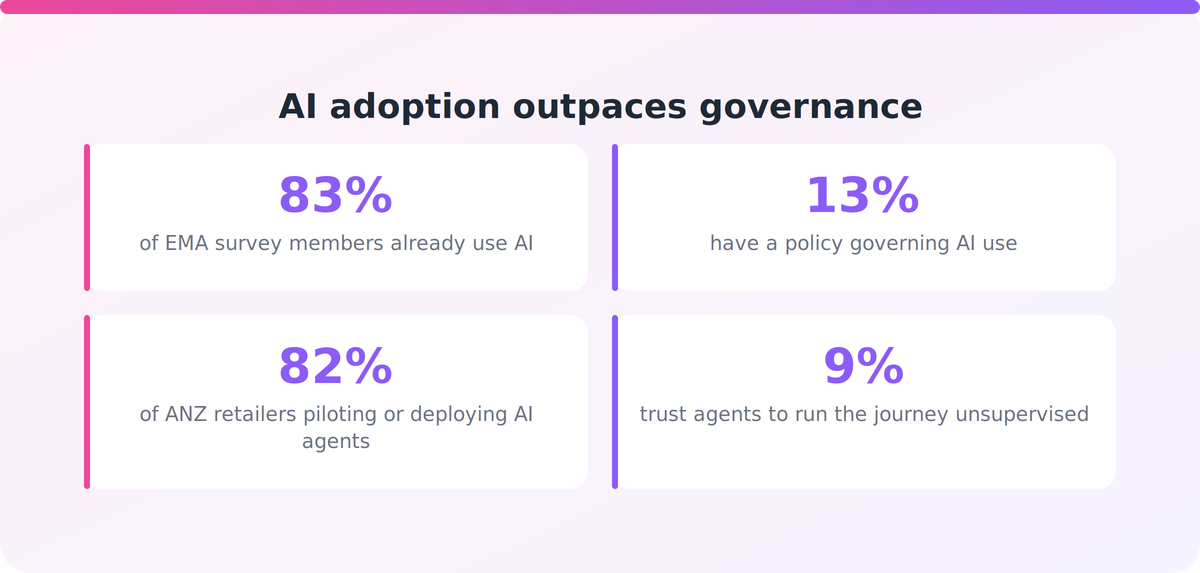
That turns governance into a retention issue. It also matters because most adoption is broad but shallow. Newswire NZ's write-up of an EMA survey of 300+ members says 83% already use AI, but only 13% have a policy governing it. Regional ANZ data from monday.com (vendor-commissioned) shows 82% of retailers piloting or deploying AI agents. Only 9% trust them to run the whole customer journey without human intervention.
Retailers are using AI widely, but few trust it unsupervised, and few have written the rules down.
What can a mid-size or smaller NZ retailer realistically do?
Honest answer first: our research found no in-window NZ case study of a mid-size or SME retailer combining POS, loyalty, web and in-store data with AI. The named examples are mostly large players like Woolworths NZ, Foodstuffs and Bunnings.
Practitioner commentary from Enterprise DNA, itself a vendor blog, points to realistic starting uses: email segmentation, send-time prediction and POS demand forecasting. A sensible path looks like this:
- Start with the question, not the tool. Pick one decision, such as what to reorder or who to email, and name the data it needs.
- Join up what you already own. POS, loyalty and web data answer more together than apart.
- Write a one-page AI policy. Cover who can use what, with which data, and who reviews the output.
- Keep a human in the loop. Let AI recommend, and let a person approve anything that affects a customer.
- Check vendor terms. Enterprise DNA flags IPP 12 disclosure obligations when using offshore AI vendors.
- Audit in-store sensing. If you capture anything biometric, confirm compliance with the Biometric Processing Privacy Code.
Key takeaways
- A POS report can't see pre-purchase AI research, and the effect varies by category. Grocery and homeware stay more store-led.
- Large NZ retailers are moving from dashboards to AI agents that answer questions straight from company data.
- The Biometric Processing Privacy Code grace period has ended, so in-store biometric and camera analytics need to comply now. Verify with the Office of the Privacy Commissioner.
- 67% of New Zealanders are concerned about AI decisions made with their personal data, and 66% would consider switching providers over poor privacy practices.
- Smaller retailers should start with narrow, governed use cases and keep humans in the loop.
Our take
Most of the noise is about which AI agent to buy. We think the harder, more valuable work is the unglamorous part: clean, joined-up data and a written policy. With only 13% of AI-using organisations holding a policy, the retailers who document how they use customer data will be the ones able to keep using it. Smaller retailers shouldn't wait for a local case study. Pick one decision, prove it with your own data, and build trust in at the start, not after a complaint.
FAQ
What does AI add to a POS report?
A POS report shows what sold. AI agents can query POS, loyalty, web and other company data together to answer why and what next, such as where to move stock. That cuts the reliance on static dashboards.
Do NZ shoppers really research with AI before buying?
PwC New Zealand found consumers mainly use AI to compare products and prices (64%). The effect varies by category. Travel, electronics, gifts and fashion saw stronger AI-assisted online conversion, while grocery and homeware stayed more store-led.
Does the Biometric Processing Privacy Code affect in-store analytics?
Yes, if you use biometric or camera-based systems such as dwell-time analysis, demographic estimation or face matching. A SecSolutionsHub write-up says the grace period ended on 3 August 2026, so confirm your obligations against Office of the Privacy Commissioner guidance.
Can a small NZ retailer use AI customer insights without a big data team?
Yes, in narrow ways. Practitioner commentary points to email segmentation, send-time prediction and POS demand forecasting. Keep a human reviewing outputs, write a simple AI policy, and check IPP 12 obligations if your vendor is offshore.
Why does AI governance matter for retail?
Customers care. The Privacy Commissioner's survey data shows 66% would consider switching providers over poor privacy and security practices. Yet an EMA survey reported by Newswire NZ found only 13% of AI-using members have a governing policy.