AI for NZ Healthcare Clinics: Build Around Your Records
7 October 2026 · 6 min read
NZ clinics don't have a shortage of AI tools. They have a shortage of AI they can trust with patient records. The scribes arriving first have raised open questions on consent, data residency and record integrity. That's why AI for NZ healthcare clinics is moving toward systems grounded in, and governed around, a clinic's own data.
Why is capacity pressure pushing clinics toward AI?
Because demand is outrunning supply. In 2024-25, one in four NZ adults reported not seeing a GP because wait times were too long. As of December 2025, 26% of general practices weren't accepting new enrolments (Reseller News). The Ministry of Health says digital health and AI offer opportunities to improve access, productivity and outcomes.
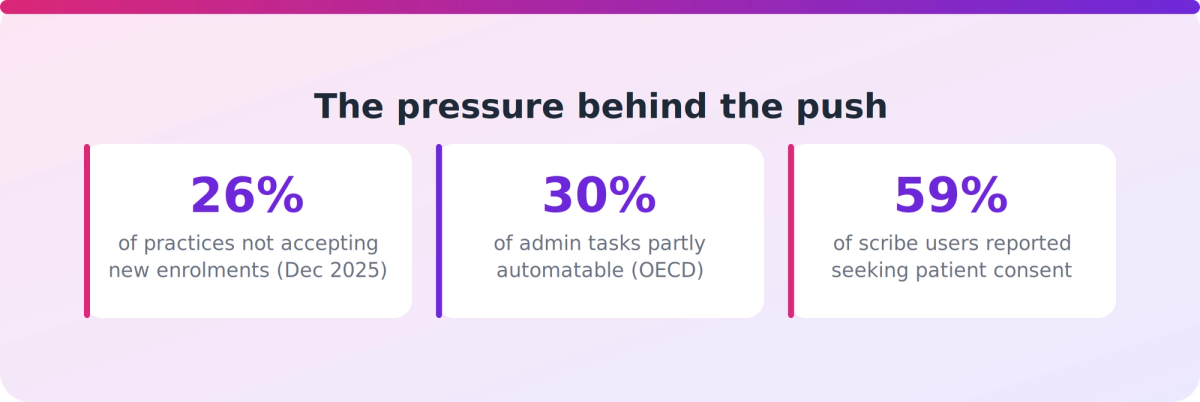
The OECD Economic Surveys: New Zealand 2026 puts a number on the admin side. It says up to 30% of administrative tasks could be partially automated through digital solutions. That is the pool of work clinics are hoping AI can shrink.
What new data demands are landing on practices?
More of them, and sooner than many expected. From April 2026, participating practices began securely sharing general practice encounter and appointment information through Health NZ's National Primary Care Dataset. Health NZ says the data is encrypted, role-based and monitored, and anonymised or aggregated for reporting.
The OECD also notes Health NZ is implementing a Shared Digital Health Record data service. The direction is clear. Practice data is becoming more visible and more connected, so a clinic that can't organise and query its own records will struggle to keep up.
What has the AI scribe rollout taught us?
That capability isn't the sticking point. Governance is.
A University of Otago-led survey of AI scribes in NZ primary care, published in the Journal of Primary Health Care, asked clinicians about their concerns. The survey ran in early 2024. The top concerns were:
- NZ legal and ethical compliance (n=108)
- Data security (n=98)
- Errors or omissions (n=93)
- Data leaving New Zealand (n=91)
Only 59% of respondents who used AI scribes reported seeking patient consent. Creative HQ, in commentary that relies on the Otago survey, says NZ patient data was stored on encrypted servers in Sydney as of late 2025. It also says 41% of providers using scribes weren't seeking explicit consent. Treat that as secondary sourcing, but it points at a real gap.
Where does the public system stand?
Health NZ is standardising on a single scribe. It is securing 1,000 additional licences for mental health teams in public emergency departments (Healthcare IT News ANZ, March 2026). Health NZ has also endorsed two scribes in total, according to Health Informatics New Zealand.
A vendor-published Hawke's Bay ED pilot (Heidi Health, November 2025) reports documentation time falling from about 17 minutes to just over 4 minutes per patient. That's a vendor claim, so read it as a signal, not proof. RNZ reported emergency doctors estimating savings of up to 10 minutes per patient.
Either way, that leaves primary-care and private clinics making their own choices, with their own risk.
What does AI grounded in a clinic's own records look like?
It starts from a different question. A generic tool asks, "what can this model do?" A grounded one asks, "what does this clinic already know, and who is allowed to see it?"
In practice, that means a system that retrieves from the clinic's own records and workflows, rather than a general-purpose tool bolted on beside them. The market is already drifting this way. Medtech's vendor page describes AI that reads patient context from the practice management system without retaining audio or learning from the data. It's marketing material and unverified, but it shows where buyers are being pointed.
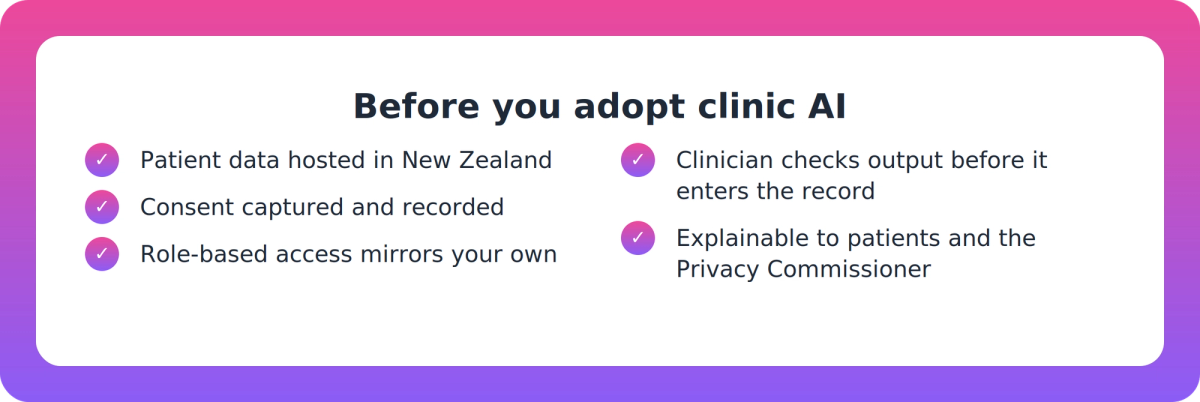
A useful test for any clinic AI is whether it can answer yes to each of these:
- Is patient data hosted in New Zealand, and can you show where?
- Is patient consent captured and recorded, not assumed?
- Does it work from your records, with role-based access that mirrors your own?
- Can a clinician check and correct what it writes before it enters the record?
- Can you explain it to a patient and to the Office of the Privacy Commissioner?
Which rules apply?
The Health Information Privacy Code 2020 is the primary legal framework, and the Office of the Privacy Commissioner issued AI guidance in 2023. The OECD goes further. It recommends updating the Code and clarifying expectations for high-risk clinical AI.
A Living Whitepaper on AI in the NZ public sector (authorship unclear) lists similar risks. They include clinical boundaries, privacy, safety evaluation, cultural appropriateness, and making sure AI-generated documentation doesn't introduce new risks into patient records. Use it as a checklist, not an authority.
What's still uncertain?
Quite a lot. Evidence on custom or retrieval-based clinic AI in NZ is thin. Several of the figures above come from vendors or commentary, and the clinician survey is from early 2024, so practice has likely moved. Nobody can yet say how much a grounded approach saves compared with a scribe.
What we can say is that the barriers clinicians name are the ones this approach is built to address. Before you pick a tool, it's worth asking where your records live, who can touch them, and who answers when the AI gets something wrong.
Key takeaways
- Capacity is the driver: 26% of practices weren't taking new enrolments as of December 2025, and the OECD sees up to 30% of admin tasks as partly automatable.
- Data obligations are growing, with the National Primary Care Dataset live from April 2026.
- Clinician concerns centre on compliance, security, errors and data leaving New Zealand, not on whether AI works.
- Only 59% of scribe users in the Otago survey reported seeking patient consent.
- AI built around a clinic's own records, hosted in NZ and consent-aware, is a credible next step, though the evidence is still thin.
Our take
Scribes were the easy first use case, and they've taught the sector what to worry about. We think the next wave will be won by tools that treat a clinic's records as an asset to be governed, not material to be fed into someone else's model. Clinics shouldn't wait for the Privacy Code update to ask hard questions about residency and consent. Those questions are already answerable, and a vendor who can't answer them has told you something.
FAQ
What does AI for NZ healthcare clinics actually cover?
Mostly administrative work today: clinical note-taking with AI scribes, plus tasks like summarising records and handling routine queries. The OECD says up to 30% of administrative tasks could be partially automated. Clinical decision support is higher risk and less settled.
Do clinics need patient consent to use an AI scribe?
Consent is a central concern. In the Otago-led survey, only 59% of respondents who used AI scribes reported seeking patient consent. The Health Information Privacy Code 2020 and the Privacy Commissioner's 2023 AI guidance are the starting points for what's expected.
Why does data residency matter?
Clinicians ranked data leaving New Zealand among their top four concerns (n=91). Creative HQ's commentary says NZ patient data was held on servers in Sydney as of late 2025. Clinics should ask any vendor exactly where data is stored and processed.
What is the National Primary Care Dataset?
It is Health NZ's dataset of general practice encounter and appointment information. Participating practices began securely sharing data from April 2026. Health NZ says it is encrypted, role-based and monitored, and anonymised or aggregated for reporting.
Is there proof that custom clinic AI works better than scribes?
Not yet. Evidence on custom or retrieval-based clinic AI is thin, and many published time-saving figures come from vendors. The case rests on governance fit, not on proven savings.