AI Learner Feedback Analysis Software NZ: A Buyer Guide
25 August 2026 · 9 min read

AI learner feedback analysis software only counts as NZQA-ready when its output traces to specific unit standard elements and Key Evaluation Questions, sits in a file a moderator can verify, and is retained for at least 12 months under the Private Training Establishment Rules 2026 — not when it's just a sentiment dashboard a qualified assessor still has to check.
That distinction matters because most "AI feedback tool" marketing is written for the wrong buyer. Generic sentiment-analysis platforms are built to tell a business whether customers are happy. NZQA doesn't ask PTEs whether learners are happy — it asks whether programme design and delivery match the needs of students and other stakeholders, and whether the evidence behind that judgement can be traced and verified. Those are different jobs, and it's worth being precise about which one a tool actually does before you buy it.
What makes learner feedback 'NZQA-ready' rather than just sentiment scores
NZQA quality-assures PTEs mainly through External Evaluation and Review (EER), judged against Key Evaluation Questions (KEQs) and Tertiary Evaluation Indicators. One KEQ asks directly how well programme design and delivery match the needs of students and other stakeholders — this is exactly where learner-feedback evidence gets used, and exactly where a raw sentiment score falls short.
NZQA's own assessment guidance goes further: evidence must be "recorded in ways that can be verified by another subject specialist or a moderator." Where feedback or dialogue with learners is used as assessment evidence, assessors are expected to provide a checklist or an annotated file note describing that evidence — not just an AI-generated output sitting in a dashboard. In practice, that means a tool needs to produce something a moderator could pick up cold and understand, not just a chart of positive-versus-negative comments.
How AI learner feedback analysis software actually works
Most tools in this category use natural language processing and machine learning to detect themes and sentiment in open-text responses at a scale manual review can't match — reading hundreds of free-text survey answers in minutes rather than days. That part genuinely works, and it's the reason these tools exist.
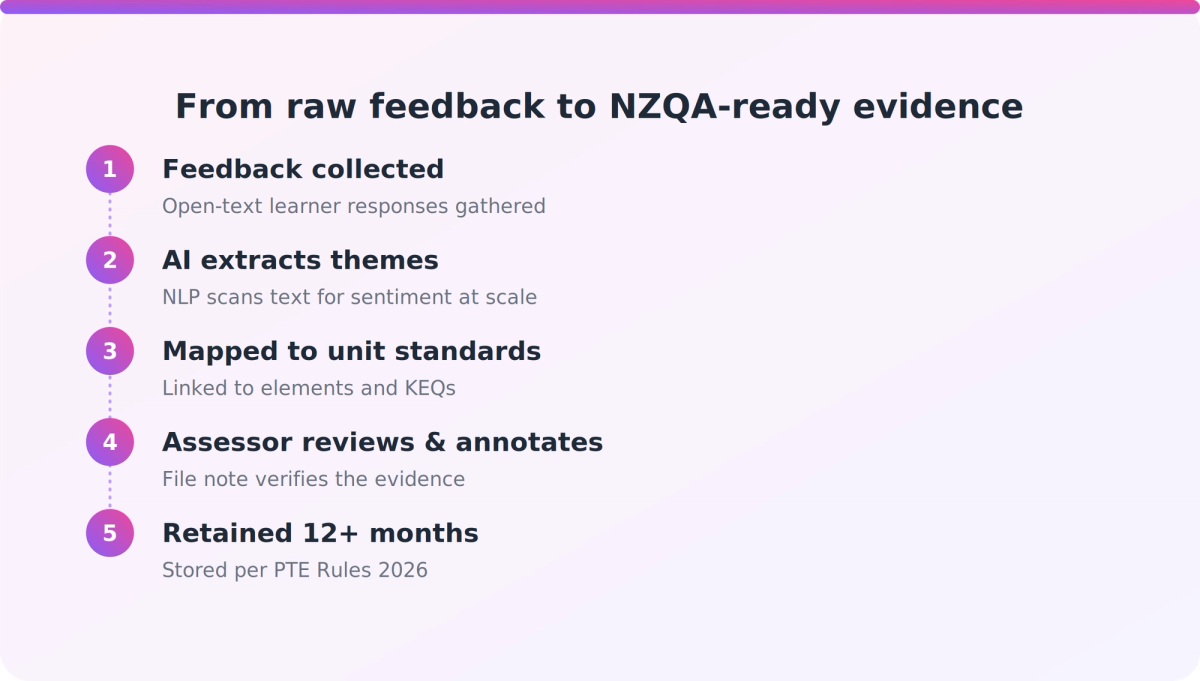
Where it gets more contested is accuracy and bias. Published research on sentiment analysis in education notes that pre-trained large language models can carry bias and raise privacy concerns, which is why some purpose-built tools use domain-specific supervised models trained on education data instead of a general-purpose model. For a PTE, that's a legitimate question to put to any vendor: is this reading learner feedback with a model tuned for training and assessment contexts, or a generic model repurposed for the job?
Does AI-processed feedback still need a qualified assessor to sign off?
Yes. Nothing in NZQA's guidance suggests that AI-processed feedback can stand alone as assessment evidence. The requirement for evidence to be verifiable by a subject specialist or moderator applies regardless of how the theme or sentiment analysis was generated. AI can surface what learners said and where it maps to programme or unit standard criteria; a qualified assessor still has to check that mapping, add context through a file note, and make the actual judgement.
Some NZ PTEs are already using tools that lean into this division of labour rather than fighting it — mapping learner responses to unit standard elements, performance criteria and Key Evaluation Questions while explicitly leaving the competency or quality decision with the assessor. That's a meaningfully different design choice from a sentiment dashboard, and it's the direction worth favouring if the output needs to hold up at EER or in moderation.
How long do you need to keep this evidence, and does the software support it?
Under the Private Training Establishment Rules 2026 (in force from 19 January 2026) and the Quality Assurance of Tertiary Education Providers Rules, PTEs must keep student assessment materials for at least 12 months from completion of the education or training. If learner feedback is being used as assessment evidence, it falls under that same retention obligation — so a tool that lets feedback expire, get overwritten, or disappear once a survey closes is a compliance gap, not a convenience.
There's a second retention pressure coming. From July 2026, self-review becomes mandatory for all non-university tertiary providers — PTEs, ITPs/Te Pūkenga and wānanga alike — covering quality of education and training, learner wellbeing and safety, and learner outcomes. Under the Code of Practice, self-review reports must be publicly accessible on the provider's website, and "learner voice" is named as an explicit outcome area. That means feedback-derived evidence isn't just an internal file anymore — it needs to be organised well enough to support a public-facing report.
What privacy rules apply when learner feedback runs through an AI tool?
New Zealand doesn't have an AI-specific statute. What applies is the Privacy Act 2020 and its Information Privacy Principles, and the Office of the Privacy Commissioner issued guidance in September 2023 clarifying how those principles apply to AI systems — including tools that process learner data such as open-text feedback. In practice that means asking any vendor where feedback text is stored, who can access it, whether it's used to train models beyond your own PTE's data, and how long it's retained beyond your own compliance window.
What to weigh when comparing tools
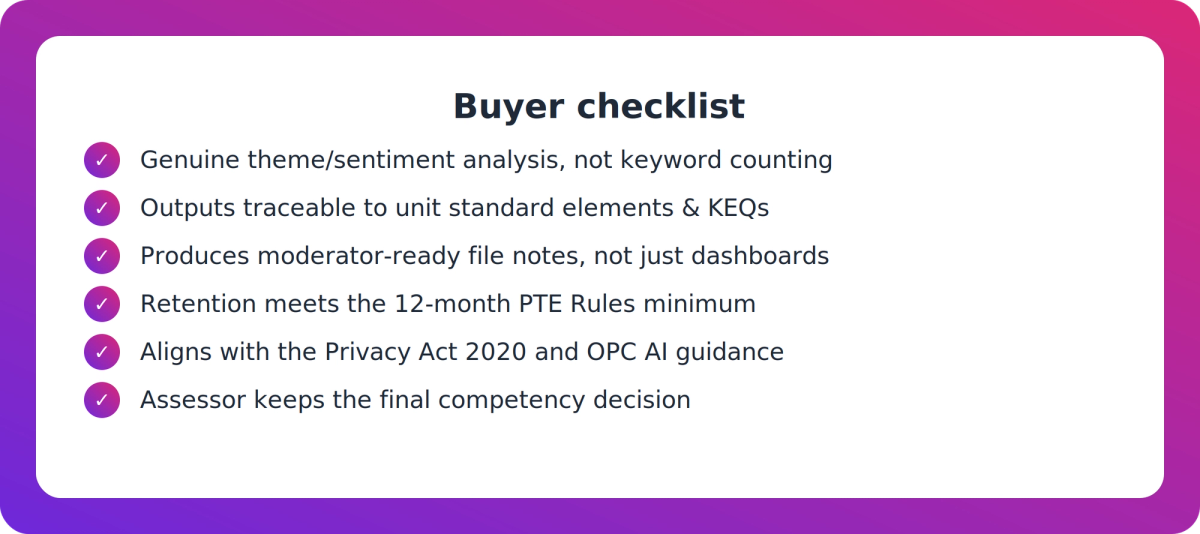
This category is young in New Zealand — there's no dominant, NZ-specific vendor that's clearly established itself the way some sentiment-analysis platforms have in other sectors. That means due diligence matters more than usual. Weigh:
- Genuine theme and sentiment analysis on open-text responses, not just keyword counting dressed up as AI
- Outputs that trace to unit standard elements, performance criteria and NZQA's Key Evaluation Questions, ready to drop into an EER or self-review submission
- Moderator-ready records — annotated file notes or checklists — rather than a dashboard alone
- Retention that meets or exceeds the 12-month minimum under the PTE Rules 2026
- Clear alignment with the Privacy Act 2020 and OPC's 2023 AI guidance, including where and how long feedback text is stored
- A design that keeps the final competency or quality judgement with a qualified assessor, not the algorithm
- An actual NZ PTE track record — ask for a named reference, not a generic case study
One adjacent NZ data point worth knowing: Mast Academy, a New Zealand PTE, used Supahuman's AI Workspace to auto-generate NZQA-aligned assessment materials from its own approved content, cutting course-creation time from roughly six weeks to minutes. That's a course-creation use case rather than feedback analysis specifically, but it shows the same underlying approach — mapping AI output to unit standards while an assessor validates the result — starting to get real NZ traction. Supahuman's Nova 5 tool applies a similar model directly to learner responses, turning an uploaded practice test or piece of feedback into formative, criterion-by-criterion notes mapped to unit standard elements — framed as coaching input for the assessor, with every competency decision still made by a human.
Key takeaways
- A sentiment score alone isn't NZQA-ready evidence — it needs to trace to unit standard elements and Key Evaluation Questions and be verifiable by a subject specialist or moderator.
- AI can process open-text feedback at scale, but a qualified assessor must still check, annotate and sign off any feedback used as assessment evidence.
- Feedback-derived evidence must be retained for at least 12 months under the PTE Rules 2026, and needs to be organised well enough to support mandatory self-review reporting from July 2026.
- New Zealand has no AI-specific law — the Privacy Act 2020 and the Privacy Commissioner's 2023 AI guidance govern how learner feedback data is handled.
- No NZ vendor has yet established itself as the clear category leader, so ask for a named PTE reference before you commit.
Our take
The honest state of this category is that the compliance bar is well defined — NZQA has been explicit about traceability, verification and retention for years — but the tooling built specifically to meet it is still catching up. Buyers should be sceptical of any vendor selling a generic sentiment dashboard as "NZQA-ready," and equally sceptical of any pitch that implies the tool replaces the assessor's judgement. The tools worth watching are the ones that treat AI as a mapping and drafting layer, with a qualified human making every call that actually counts.
FAQ
What actually makes learner-feedback analysis 'NZQA-ready' rather than just a sentiment dashboard? It has to trace to specific unit standard elements, performance criteria or Key Evaluation Questions, and be recorded in a way a subject specialist or moderator can verify — typically an annotated file note, not just a chart of sentiment scores.
Does AI-processed feedback still need a qualified assessor or moderator to validate it before it counts as evidence? Yes. NZQA's assessment guidance requires feedback used as evidence to be verifiable and, where dialogue or feedback is involved, accompanied by a checklist or file note from the assessor — AI can surface and map the content, but the assessor makes the final call.
How long do we need to retain this feedback-derived evidence? At least 12 months from completion of the education or training, under the Private Training Establishment Rules 2026 and the Quality Assurance of Tertiary Education Providers Rules. Any tool you use needs to support that retention window without letting records lapse.
What privacy rules apply when we run learner feedback through an AI tool in New Zealand? There's no AI-specific law, but the Privacy Act 2020 and its Information Privacy Principles apply, and the Office of the Privacy Commissioner's September 2023 guidance sets out how those principles cover AI systems that process learner data, including feedback text.
Is there a dominant NZ-specific vendor for this category yet? No — current research doesn't identify an established, named NZ vendor that owns this exact category. Buyers should ask any vendor for a real PTE reference and check the tool against NZQA's traceability and retention requirements directly, rather than assuming a category leader exists.