AI ROI for NZ Businesses: Ask Before You Buy
14 October 2026 · 6 min read
Most New Zealand organisations now use AI, but few can prove it pays. Datacom's 2026 State of AI Index found 91% adoption and 79% raising investment, yet only 33% say returns exceeded costs. The fix is a pre-purchase ROI conversation: a named use case, a baseline, an ownership check and the full cost.
Why is AI spend running ahead of proof?
Because buying is easier than measuring. Datacom's index (as reported in the press release and trade coverage) shows adoption climbing from 66% in 2024 to 87% in 2025 and 91% in 2026. Over the same period, depth hasn't followed.
- Only 4% say AI has transformed core operations, down from 8%.
- Only 15% are scaling it across the organisation.
- 33% say returns have exceeded costs. A further 30% say benefits and costs are broadly balanced.
- 73% plan to invest more.
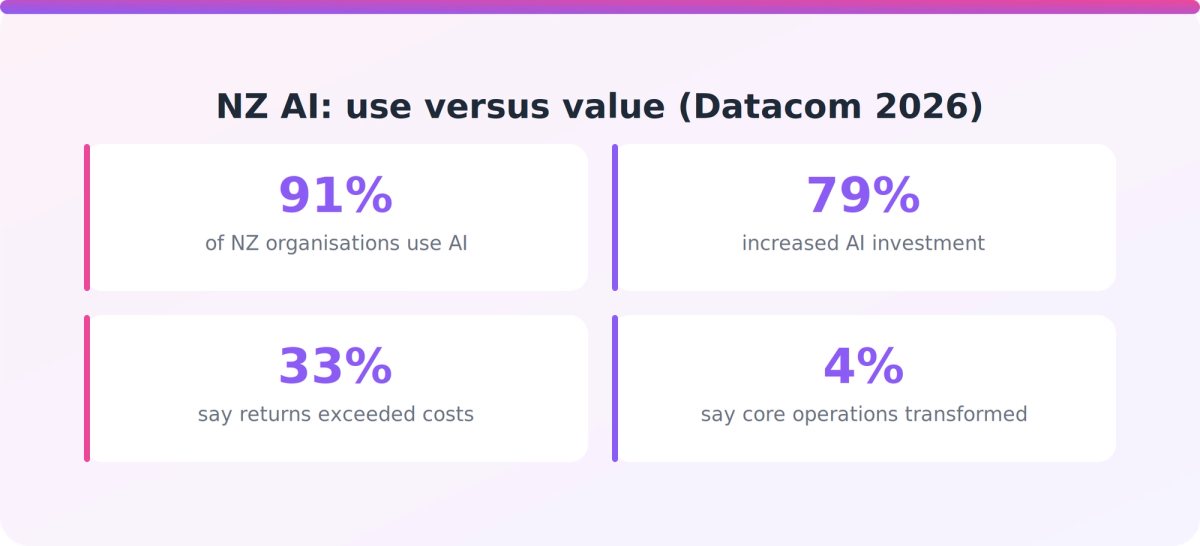
Datacom's Lou Compagnone said the strongest returns come from organisations that focus on specific business challenges with measurable outcomes, not from those spending the most. Advisory firm CAIRN describes something similar: ‘activity without accountability’, with teams using AI daily and nobody measuring the impact. CAIRN sells advice, so treat that as commentary rather than hard data. It still matches what Datacom found.
What should you settle before signing anything?
Four things, in this order. If you can't answer them, you're not ready to buy.
- Name the use case. One workflow, one team, one problem.
- Set the baseline and the metric. Hours per task, error rate, turnaround time, cost per case. Measure it now, before the tool arrives.
- Run the ‘do we already own this?’ test.
- Count the full cost, including privacy and vendor diligence.

Name one use case and one metric
‘Improve productivity’ isn't a use case. ‘Cut the time our team spends summarising customer emails’ is. Once you've written it down, you can put a number on it.
A training provider might pick a task like drafting learner feedback or matching evidence against unit standards. The principle is the same. Pick the task, time it today, and decide what ‘better’ looks like in numbers.
Run the ‘do we already own this?’ test
This step is the one most often skipped. Deloitte Access Economics, in a report for 2degrees (Productivity Propelled, April 2026), found most NZ businesses rely on AI features built into tools they already own. Think your office suite, CRM, accounting or learner management system.
The same report estimated the average SME earned about $400,000 more in FY25 than a comparable non-adopter. Be careful with that number. It's correlational, and a telco commissioned the work. It doesn't prove AI caused the gain.
The useful point is the baseline. Any new purchase has to beat what you can switch on in a tool you're already paying for.
What does AI really cost?
More than the licence. A sound business case counts:
- Internal staff time to set up, test and supervise the tool
- Change management and skills, because people have to actually use it
- Privacy, governance and legal review
- Ongoing support and maintenance
Pricing models are also moving. Datacom's NZ managing director flagged that as AI platforms shift to consumption-based pricing, knowing where AI creates measurable value will matter more for investment decisions. Usage-based bills punish vague use. If you can't say which tasks the tool is for, you can't predict the invoice.
Execution is the other hidden cost. The Concentrix 2026 CX Capability Index, reported by Reseller News and RNZ, found 86% of NZ businesses plan to boost CX budgets, yet 98% still face barriers to scaling AI within CX. That's trans-Tasman survey data, so read it as a signal, not a NZ-only figure. The barrier isn't access to tools. It's getting them embedded.
Where do privacy and vendor diligence fit in the maths?
Inside it. NZ has no AI-specific law, and MBIE's Responsible AI Guidance for businesses is voluntary. That doesn't mean you're unregulated. Existing law still applies:
- The Privacy Act 2020
- Fair trading and consumer protection law, enforced by the Commerce Commission
- WorkSafe obligations
The Office of the Privacy Commissioner expects senior leadership approval, necessity and proportionality assessments, privacy impact assessments and human review. Law firm Bell Gully advises that organisations stay responsible for decisions made using AI, and should use vendor audit or information rights in practice, not just hold them on paper.
That work takes time and money, so put it in the business case. It may also grow. Datacom found 64% of respondents think NZ should introduce specific AI legislation.
When does a custom build earn its place?
When the off-the-shelf option genuinely doesn't fit. Enterprise DNA and CAIRN both lean towards using existing tools first, and we agree. A custom build needs a reason. Three good ones:
- A workflow that generic tools don't fit, such as a process that's specific to your sector or your systems.
- Proprietary or unstructured data that's valuable but hard to use, like thousands of documents, assessments or case notes.
- Integration needs where the tool has to work inside your existing systems rather than beside them.
We build custom AI at Supahuman, so weigh that view accordingly. Even so, a custom build should clear the same bar as any purchase: a baseline, a metric and a total cost you can defend.
Key takeaways
- NZ AI use is at 91%, but only 33% report returns above costs and 4% report transformed core operations.
- Focus beats spend. Measurable, specific use cases drive the returns Datacom highlights.
- Check what's already built into tools you own before buying anything new.
- Count staff time, change effort, governance and consumption-based pricing, not just the licence.
- Privacy and vendor diligence under existing NZ law belong in the ROI case, and compliance cost may rise.
Our take
The 79% investing against 33% seeing returns suggests many organisations are buying first and measuring later. We'd flip that. If a team can't write down its baseline in an afternoon, it isn't ready for a bigger AI budget, and the fastest return is often a feature it already pays for. Custom work is justified when the workflow is genuinely unusual, and not before.
FAQ
What is a good ROI test for AI in a NZ business?
Name one use case, measure the current baseline, pick a metric, and compare the tool's total cost against the improvement. Add staff time, change effort and compliance work to the cost side. If returns don't beat a tool you already own, don't buy.
How many NZ businesses actually see returns from AI?
Datacom's 2026 State of AI Index found 33% say returns exceeded costs, and a further 30% say benefits and costs are broadly balanced. That's against 91% adoption, so most organisations can't yet show a clear payoff.
Does NZ have AI-specific legislation?
No. MBIE's Responsible AI Guidance is voluntary. Businesses must still comply with the Privacy Act 2020, fair trading and consumer protection law, and WorkSafe obligations. Datacom found 64% think NZ should introduce specific AI legislation.
Should we buy a new AI tool or use what we already have?
Start with what you have. Deloitte Access Economics found most NZ businesses rely on AI features in existing tools. Consider a new or custom build only if your workflow, data or integration needs aren't met.
What privacy steps should come before adopting AI?
The Office of the Privacy Commissioner expects senior leadership approval, necessity and proportionality assessments, privacy impact assessments and human review. Bell Gully also advises using vendor audit or information rights in practice.