AI System Integration in NZ: The Hidden Adoption Brake
4 October 2026 · 6 min read
Nearly every New Zealand organisation now uses AI, but very few have built it into how they actually operate. Datacom's 2026 index puts adoption at 91% and core-operations transformation at 4%. Legacy-system integration may explain part of that gap, though no NZ survey measures it directly yet.
What does the NZ data actually say?
Datacom's 2026 State of AI Index, reported by NZ Herald in late August 2026, shows a sharp split between using AI and relying on it.
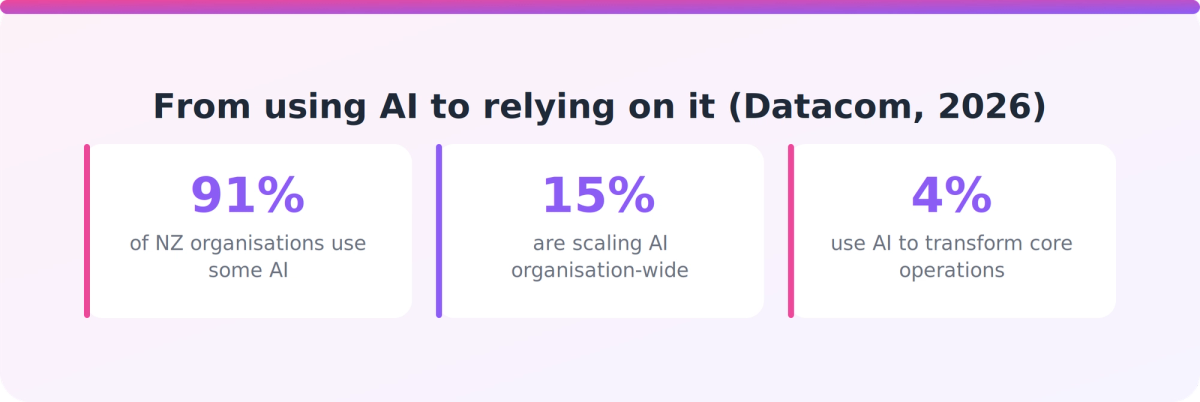
- 91% of NZ organisations use some form of AI, up from 87% in 2025 and 66% in 2024.
- 15% are scaling AI organisation-wide.
- 4% use AI to transform core operations, down from 8%.
- 16% have a standalone AI strategy.
The research was run by Curia Market Research with 207 senior business managers. That's a small sample, so treat the figures as indicative rather than definitive.
What do organisations say is stopping them?
The stated barriers in the Datacom data are lack of internal capability or skills (20%), employee resistance (18%) and implementation costs (17%).
Legacy integration isn't named as a top barrier in the material we reviewed. So the argument in this piece is an inference from the "can't scale" pattern, not a finding. We'd rather say that plainly than dress it up.
Why might integration be the hidden constraint?
A pilot can run beside your core systems. Embedding AI in daily operations means it has to read from them and write back to them. That's where old platforms and messy data bite.
NZ banking gives the clearest local example. NZ Herald reports that some bank technology components date back to the 1960s. KPMG's Rachael Niao says legacy systems store data in formats that make it hard for AI to access and process.
A second, indirect signal comes from AI Forum NZ's review of 28 studies, as summarised by CAIRN. It scored training and capability lowest (2.0), then process integration (2.4), with data readiness higher (2.9). That fits a "tools without process redesign" reading. It's a secondary source, so check it against the AI Forum NZ original before quoting it.
What does global research say about legacy systems?
This is a cross-market comparison, not NZ data.
- A Tata Communications and Bloomberg Media Studios study of large enterprises across Asia, North America and Europe (reported around June 2026) found that integrating AI with legacy systems was a primary roadblock to creating value. In it, 38% said integration concerns delayed approval and procurement.
- The Linux Foundation's 2026 State of Tech Talent Report found legacy limitations cited by 30% of organisations failing to get value from AI. That sits behind security (43%), cost (36%) and skills (34%).
So legacy is a real factor, but not the leading one. Any honest reading puts integration alongside skills, cost and security, not above them.
Does organisation size change the picture?
Yes. The MYOB 2026 Business Monitor, reported by NZ Herald, shows 36% of NZ SMEs use AI, up from 32%. Use is 64% in firms with 20 or more staff, and 30% in small firms.
Governance is thin too. An EMA survey of 300+ members (July 2026, reported via a vendor blog) found only 13% have an AI policy.
Larger organisations tend to have more systems, and more history baked into them. Smaller ones have fewer integration headaches but less capacity to solve them. Different problem, same stall.
Why isn't this in the national conversation?
MBIE's AI Strategy, *Investing with confidence* (8 July 2025), is light-touch and adoption-focused. It lists regulatory uncertainty, complexity and risk, and low understanding of value as barriers. Legacy integration isn't on that list.
That may change with data. The Stats NZ and MBIE Survey of Business Operations, announced in April 2026 with results expected later this year, should give the first official, representative NZ measure of AI use and barriers. If it asks about integration, we'll know. If it doesn't, the gap stays invisible.
What can a training organisation do now?
PTEs, ITPs and Te Pūkenga subsidiaries run on student management systems, learning platforms and reporting pipelines built long before generative AI. We don't have NZ data on how that affects them. But the logic applies, and the checks are cheap.
- Map one workflow end to end. Pick something manual and repetitive, like evidence collection or moderation, and list every system it touches.
- Check the data, not the tool. Where does the information live, in what format, and who can export it?
- Start where integration is simplest. A pilot that needs no system access proves little about scaling.
- Set milestones before you build. Define what "embedded" means in measurable terms, such as hours saved or turnaround time.
- Write the policy early. Only 13% of EMA respondents have one, so doing it makes you the exception.
Key takeaways
- NZ AI adoption is near-universal at 91%, but only 4% use it to transform core operations (Datacom, 2026).
- Stated barriers are skills, resistance and cost. Legacy integration isn't measured directly in NZ.
- Banking commentary and global studies make integration a plausible hidden constraint, but not the leading one.
- The evidence is indicative, partly vendor-run and based on small samples.
- The Stats NZ and MBIE Survey of Business Operations is the best near-term chance to fill the measurement gap.
Our take
We think NZ is asking "who's using AI?" when it should be asking "what can AI actually reach?" Adoption at 91% tells us little if the tool can't touch the systems where work happens. Until someone measures integration, organisations should assume it's part of their own stall and check, rather than wait for a national survey to confirm it.
FAQ
What percentage of NZ organisations use AI?
Datacom's 2026 State of AI Index found 91% of NZ organisations use some form of AI, up from 87% in 2025 and 66% in 2024. Only 15% are scaling it organisation-wide, and 4% use it to transform core operations.
Is legacy-system integration a proven barrier to AI in NZ?
Not directly. NZ surveys name skills (20%), employee resistance (18%) and implementation costs (17%) as top barriers. Legacy integration is an inference drawn from the scaling gap, NZ banking commentary and global research.
How do legacy systems hold back AI?
KPMG's Rachael Niao says legacy systems store data in formats that make it hard for AI to access and process. If AI can't reliably read or write to core systems, it tends to stay in pilots.
Will official NZ data on AI barriers be available?
Yes. The Stats NZ and MBIE Survey of Business Operations, announced in April 2026, should give the first official, representative measure of AI use and barriers, with results expected later in 2026.
Does this matter for small organisations?
It can. MYOB's 2026 Business Monitor shows 30% of small firms use AI, against 64% of firms with 20 or more staff. Smaller organisations have fewer systems to untangle, but less capacity to do it.