Evidence Management for PTE Compliance: Beyond the Shared Drive
6 October 2026 · 7 min read
A shared drive tells you where files sit. It doesn't tell you whether they're current, who owns them, or which rule they answer to. Under NZQA's iQAF, that gap is the real compliance risk. Evidence management for PTE compliance now has to hold up at any point in the year, not just in the weeks before a visit.
Why this lands on your desk
NZQA announced on 15 January 2026 that its integrated Quality Assurance Framework (iQAF) is live. From 1 January it began no new external evaluation and review (EER) processes, though those already underway are being completed. The periodic visit has been replaced by a yearly cycle, and you're the person who answers for it.
The Quality Assurance of Tertiary Education Providers Rules 2026 require an up-to-date quality management system. They also require an organisational self-review every calendar year, reporting to NZQA, and a discussion about it. The same rules cover assessment records retention. Providers without a quality management system of the required kind on 1 January 2026 need to have one in place before 1 January 2027.
Then there's the calendar problem. The self-review template is only accessible 10 weeks before your submission date. It must be completed online through MyNZQA, because NZQA won't accept PDF or Word versions. If you start organising evidence when the template opens, you've started late.
What the annual self-review actually asks for
The self-review summary report covers teaching and learning, assessment, and learner wellbeing and safety. Each year NZQA also adds a thematic question on an area it's interested in. The template asks for your context, NZQA's areas of interest, your quality improvement plans, and compliance with relevant rules and regulations.
The report must identify areas for improvement and your plan to address them. You then meet NZQA to discuss that plan. Reporting on your Pastoral Care Code self-review will be combined with the same annual submission.
Notice what that asks of evidence. It isn't a folder of proof that you passed. It's material that supports an honest account of where you're strong, where you're not, and what you're doing about it. That's a different standard from "can we find it".
The readiness test: current, owned, traceable
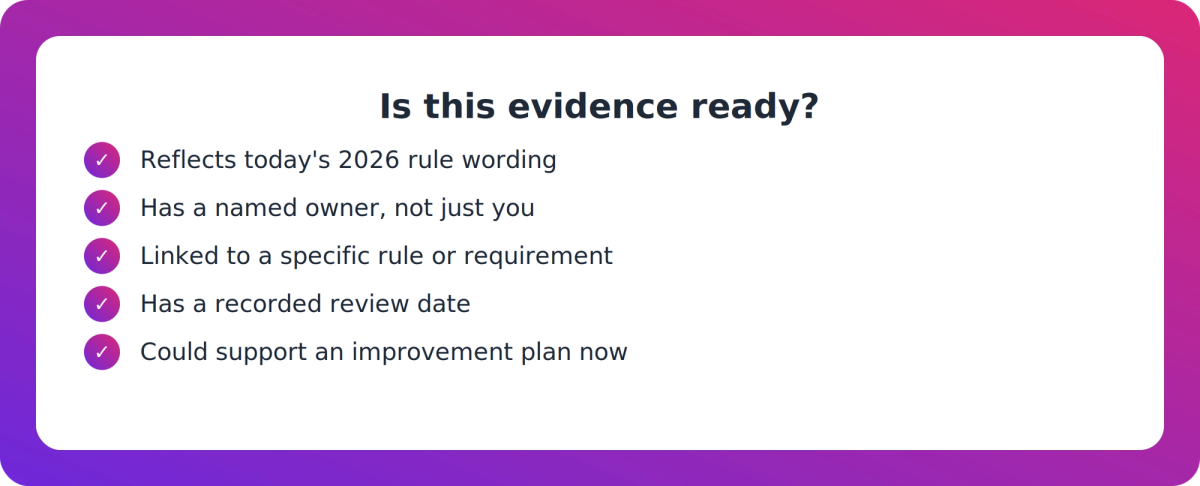
A file in the right folder can still fail you. Three questions separate location from readiness.
- Is it current? Does it reflect today's rules and wording, not last year's?
- Is it owned? Is there a named person responsible for keeping it up to date, who isn't you by default?
- Is it traceable? Can you point to the rule or requirement it supports, and to the improvement action it feeds?
Most shared drives answer none of these. A folder named "Assessment evidence 2025" tells you a year and a topic. It doesn't tell you who reviewed it last, or whether the policy it cites still exists in that form.
Why currency is harder than it looks in 2026
The rulebook moved under your feet this year, and each change can quietly date a document.
- The PTE Rules 2026 were re-issued on 19 January 2026 to reflect the removal of EER.
- The enrolment and academic records rules moved into the PTE Rules, and the PTE Enrolment and Academic Records Rules 2022 were revoked.
- Financial returns moved from annual to biennial, unless NZQA notifies a PTE otherwise.
- Industry Skills Boards replaced Workforce Development Councils from 1 January 2026, and the DASS Rules 2026 were updated for the change.
- The EER category rating system will cease. If you keep citing an EER category, Rule 10 of the QA Rules 2026 requires an accompanying statement. Immigration New Zealand will keep using existing EER ratings for 12 months from early 2026.
Policies, programme documents, marketing copy, moderation references and consent references that cite the old wording may need checking. That check is yours to own. Nobody else will notice a stale reference until a panel or a prospective student does.
Getting ready before the template opens
You don't need a new system to start. You need a clearer map of what you already hold. Try this over the next quarter.
- List what each self-review area needs. Take teaching and learning, assessment, and learner wellbeing and safety, and write down the evidence that would credibly support each.
- Give every item an owner and a review date. If the owner is you, ask whether that's sensible or just habit.
- Tag each item to a rule. Name the QA Rules 2026, PTE Rules 2026 or Code requirement it supports.
- Run a wording sweep. Search policies and programme documents for EER categories, Workforce Development Councils, and the superseded 2022 records rules.
- Work backwards from your submission date. Count back 10 weeks, and set an internal deadline well before it.
This also eases the bottleneck. Once owners hold their own evidence, you stop being the single review point for every document and become the person who checks the system is working.
Where the guidance is still unsettled
Not everything is published. NZQA hasn't yet said how it will describe a provider's overall quality, or how iQAF affects Code attestations. It said it would update providers in 2026 on the Code. Submitters to the iQAF consultation also asked NZQA to clarify the evidence required.
So you'll make judgement calls on what counts as sufficient. Record the reasoning behind them. One consultation-stage statement said self-review isn't intended to trigger enforcement. That came from the 2024 consultation, so check final guidance before relying on it.
Key takeaways
- iQAF replaces periodic EER visits with an annual, provider-led self-review submitted through MyNZQA and discussed with NZQA.
- The template opens only 10 weeks before submission, so evidence must be organised beforehand.
- Evidence is ready only when it is current, owned and traceable to a rule, not merely stored.
- 2026 changes to the PTE Rules, records rules, EER ratings and standard-setting bodies mean documents need a wording check.
- Where NZQA guidance is incomplete, document your judgement on what counts as sufficient evidence.
Our take
The shared drive isn't the villain. It's a perfectly good filing cabinet. The mistake is treating a filing cabinet as a compliance system.
We think the compliance managers who'll find iQAF easiest are the ones who stop measuring themselves by how fast they can retrieve a document. A better measure is how many documents they'd be comfortable putting in front of NZQA today without a rewrite. That number is usually lower than expected, and it's far more useful to know it now than in week eight of ten.
Be modest about what's still unknown. Build for the rules that are published, and keep room to adjust when NZQA's guidance lands.
FAQ
What does iQAF change for PTE compliance managers?
EER visits have been replaced with an annual, provider-led self-review. You submit it online through MyNZQA, identify improvement areas and plans, and discuss them with NZQA. NZQA began no new EER processes from 1 January 2026.
When can we access the self-review template?
Only 10 weeks before your organisation's submission date. NZQA doesn't accept PDF or Word versions, so it must be completed in MyNZQA. Organise your evidence before the template opens.
Which 2026 changes might make existing documents out of date?
The re-issued PTE Rules 2026, the move of enrolment and academic records rules into the PTE Rules, and the revoked 2022 records rules. Also the shift to biennial financial returns, Industry Skills Boards replacing Workforce Development Councils, and the end of EER category ratings.
Do we still need to cite our EER category?
The category rating system will cease. If you keep citing an EER category, Rule 10 of the QA Rules 2026 requires an accompanying statement. Immigration New Zealand will keep using existing EER ratings for 12 months from early 2026.
Pick one self-review area this week and ask of each piece of evidence: current, owned, traceable? The ones that fail are your starting list.