Six-Week Warning Signs Every Head of Training Should Track
31 August 2026 · 8 min read

By the time a completion report shows a shortfall, the learner behind it disengaged roughly six weeks earlier — quietly, in ways your paperwork never captured. NZQA's shift to provider-led self-review means there's no external auditor coming to catch that slide for you anymore. Your own visibility systems are now the only thing standing between a quiet drop-off and a number you have to explain.
Why this lands on your desk, specifically
Under NZQA's new integrated Quality Assurance Framework, in force from 19 January 2026, External Evaluation and Review and consistency reviews are discontinued. In their place: mandatory provider-led self-review, backed by a quality management system every provider must have operating by 1 January 2027. That's not a paperwork exercise you can backfill at reporting time — it requires you to evidence, in real time, that learner progress and assessment quality are being monitored as delivery happens, not reconstructed afterwards.
At the same time, the Tertiary Education Strategy 2025-2030 ties future TEC funding decisions — with guidance due by March 2026, governing funding from 2027 — to completion rates, employment outcomes and skills relevance. Learner progress has moved from an internal KPI to a funding-relevant metric. And with moderation authority now sitting with Industry Skills Boards, established 1 January 2026 to replace Workforce Development Councils, there's a new layer checking consistency of judgement across your sector — while the external check on your delivery quality overall has just been removed.
Put those three things together and the maths is simple: less external checking, more funding exposure, and the evidence burden sitting squarely with you.
The numbers already show where this goes unwatched
National data gives you the downside case if visibility slips. TEC's 2024 Tertiary Learner Snapshot shows workplace-based learner numbers falling to 122,475, down from a 2022 peak of 158,580 — a loss of more than 36,000 learners. New entrants into workplace-based training dropped a further 16% in 2025, to 16,780.
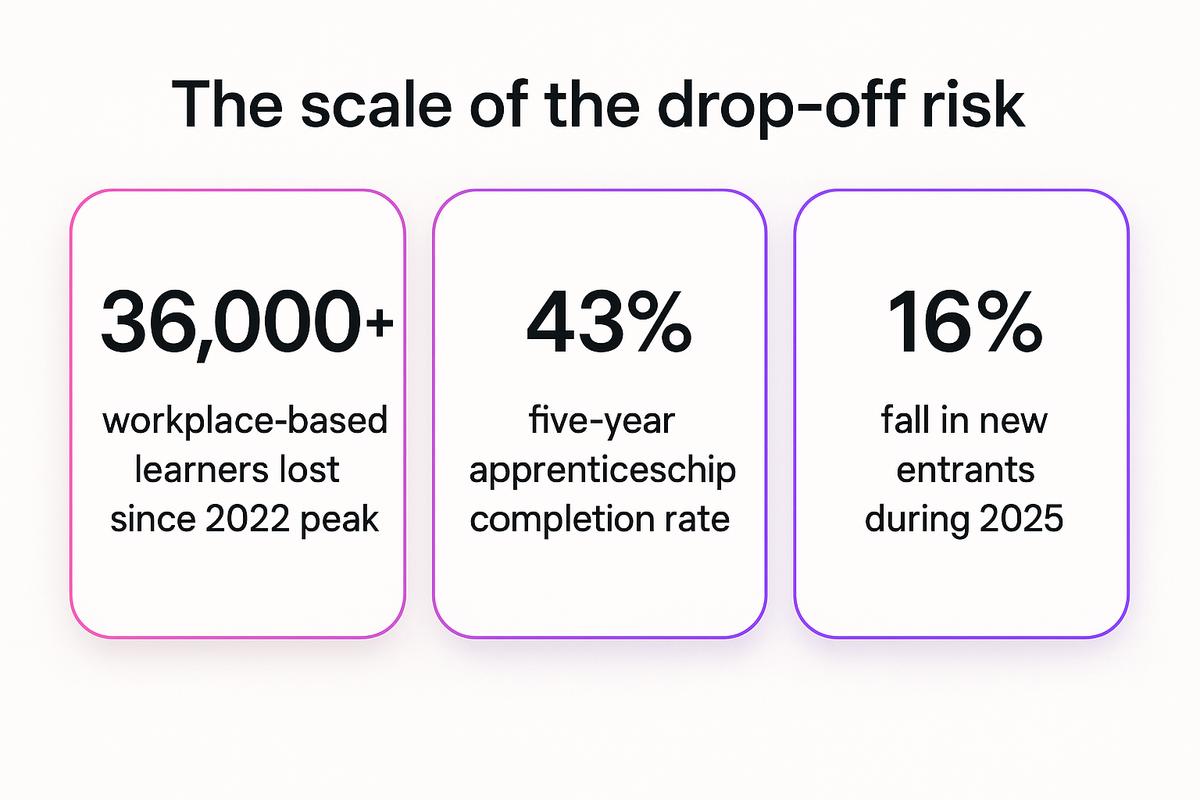
Five-year completion for apprentices sits at 43%. Construction alone hosts 49% of all apprentices, which means completion risk isn't evenly spread — it's concentrated in specific trades and cohorts, and a slide there hits your numbers harder than a slide anywhere else.
The outcomes gap compounds the risk. TEC data shows 78% of degree completers are employed three years out, against 58% for Level 1-3 completers. Lower-level programmes carry both the highest drop-off risk and the weakest downstream outcomes if they don't complete — which is exactly where your closest monitoring needs to sit, not your lightest.
What actually happens in the six weeks before a learner walks
Formal withdrawal is a paperwork event. Disengagement is a process, and it starts well before anyone files anything. A learner stops replying to the same trainer within a day. Assessment submissions slip from early to late to overdue. Attendance at practical blocks gets patchy before it stops. None of this trips a compliance flag on its own — each instance looks like a one-off, until you look back and realise it's been six weeks of one-offs from the same person.
The problem isn't that this pattern is invisible. It's that nobody is looking across trainers, across cohorts, across weeks, in a way that surfaces it before the learner has already made up their mind. A trainer managing their own caseload sees their own patchy attendee. They rarely see that three other trainers are watching the same slide in three other learners, in the same programme, for the same underlying reason.
Where your own paperwork becomes the blind spot
The progressive replacement of unit standards with skill standards is a live transition risk right now, not a future one. Training materials, training and assessment strategy documentation, and moderation evidence mapped against old unit standards all need re-mapping. That's exactly the kind of version-control load that eats trainer time and obscures the early signals you're supposed to be catching.
Broader OECD TALIS data suggests this isn't unique to vocational training — around half of teachers report excessive administrative work as a source of stress, and it's more pronounced among those with more than ten years' experience. It's a reasonable bet the same pattern shows up in your most experienced trainers, the ones you'd most want noticing a learner going quiet, because they're the ones most buried in TAS and assessment paperwork.
Inconsistent assessment practice across trainers makes it worse. If one trainer follows up a missed submission within two days and another lets it sit for two weeks, your organisation-wide picture of "who's at risk" is only as good as your least attentive trainer that week.
What real visibility looks like this quarter
You don't need new technology to close this gap — you need a deliberate rhythm that doesn't depend on any single trainer remembering to flag anything.
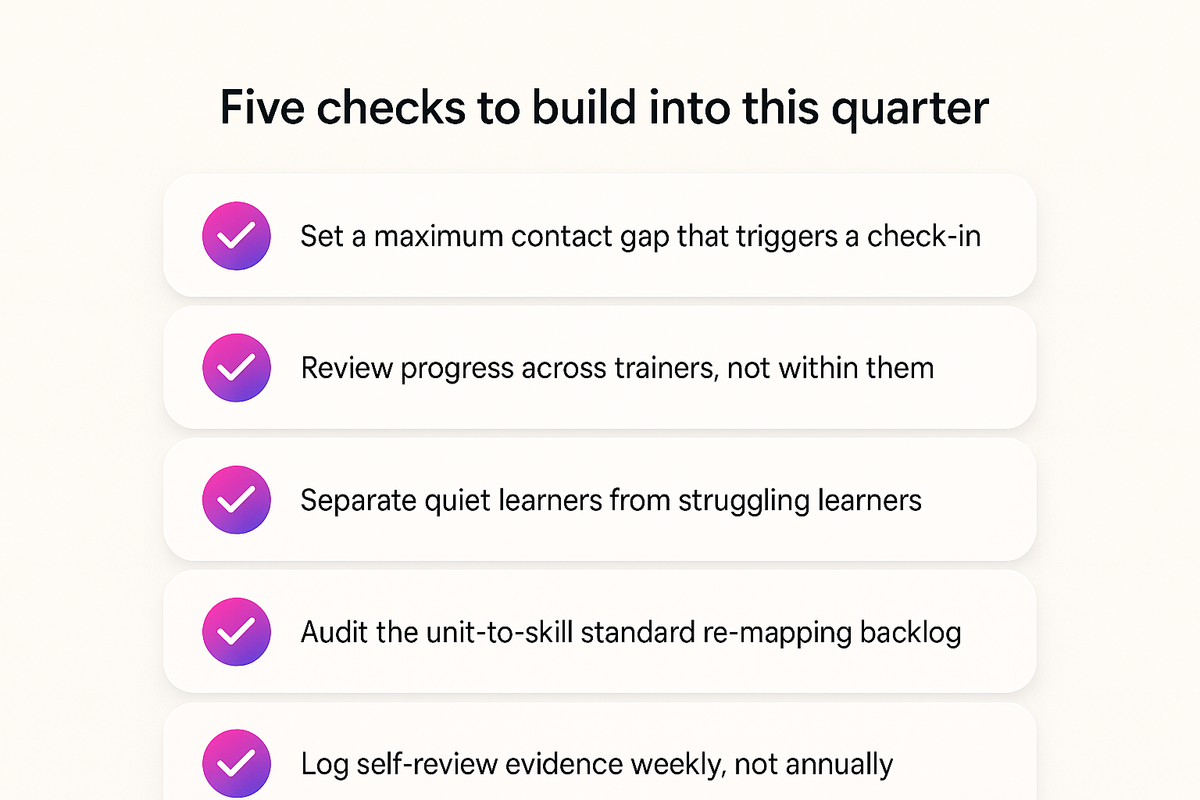
- Set a maximum contact gap. Define, in writing, the longest acceptable period without contact or submission from a learner before it triggers a check-in — not a withdrawal process, a conversation.
- Review progress across trainers, not within them. A fortnightly look across your whole caseload, not each trainer's individual list, is what surfaces the cluster patterns a single trainer can't see.
- Separate "quiet" from "struggling." A learner who's gone quiet on communication but still submitting on time is a different risk profile from one submitting late but staying in contact. Track both signals, not just one.
- Audit your re-mapping backlog. If unit standard to skill standard re-mapping is behind, that's hours of trainer time diverted from noticing learners — treat the backlog itself as a risk indicator.
- Build your self-review evidence as you go. Under the new quality management system requirement, a monitoring log kept weekly is worth more than a strong narrative written in December.
Key takeaways
- NZQA's integrated Quality Assurance Framework (from 19 January 2026) removes External Evaluation and Review and consistency reviews, replacing them with provider-led self-review and a quality management system required by 1 January 2027 — the evidence burden is now entirely yours.
- National workplace-based learner numbers have dropped by more than 36,000 since the 2022 peak, with new entrants down 16% in 2025 and five-year apprenticeship completion at 43% — the downside case for unmonitored disengagement is already visible in the data.
- The Tertiary Education Strategy 2025-2030 links future TEC funding (from 2027) to completion and outcome measures, making early identification of drop-off a funding issue, not only a pastoral one.
- Lower-level programmes carry both higher drop-off risk and a weaker outcomes gap (58% employment at three years versus 78% for degree completers) — they deserve your closest monitoring, not your lightest.
- The live unit standard to skill standard transition is adding exactly the kind of paperwork load that buries early warning signs — treat re-mapping backlogs as a risk signal in their own right.
Our take
Self-review will fail in exactly the way you'd expect a paperwork exercise to fail: it'll get done well in the weeks before it's due, and quietly deprioritised the rest of the year. That satisfies the letter of the new quality management system requirement while missing the entire point of removing external checks — which was to trust providers to know their own learners better than an outside reviewer ever could.
The providers who come out ahead here won't be the ones with the best self-review document. They'll be the ones who can point to a running log and say, with a straight face, "we saw this learner slip in week four and here's what we did about it" — because that's what actually protects completion numbers and, from 2027, the funding tied to them.
FAQ
What exactly changes for training providers from 19 January 2026? NZQA's new integrated Quality Assurance Framework discontinues External Evaluation and Review and consistency reviews. Providers move to mandatory provider-led self-review, with a quality management system required to be in place by 1 January 2027.
Does provider-led self-review mean less external accountability overall? Less external checking, yes — but higher stakes on internal systems. With Industry Skills Boards now holding statutory moderation authority over assessment (from 1 January 2026, replacing Workforce Development Councils) and future TEC funding tied to completion and outcome measures under the Tertiary Education Strategy 2025-2030, gaps that used to surface in an external review now surface in your funding position instead.
How does the funding link in the Tertiary Education Strategy 2025-2030 actually work? TEC guidance due by March 2026 is expected to govern funding decisions from 2027, tied explicitly to completion rates, employment outcomes and skills relevance. That makes learner progress data — not just enrolment numbers — directly relevant to future funding, not simply an internal quality metric.
What should a Head of Training prioritise first ahead of the 2027 quality management system deadline? Start with a documented, weekly cross-trainer progress review and a defined maximum contact gap that triggers a check-in. Both give you the running evidence self-review requires, and both catch disengagement while there's still time to act on it — rather than reconstructing what happened after a learner has already withdrawn.