Learner Progress Tracking for NZ PTE Heads of Training
12 October 2026 · 7 min read
Attendance reports tell you who turned up. They don't tell you who is progressing, and by the time the measures that do (retention, completion, credit achievement) have moved, the chance to change them has gone. For a Head of Training at a PTE, assessment-level evidence is the earlier signal. NZQA's new annual self-review gives you a reason to build it.
Why this lands on your desk
Since 1 January 2026, NZQA's integrated Quality Assurance Framework has required providers to complete an annual self-review, submit a summary report and meet NZQA to discuss an improvement plan. NZQA has said it would provide templates and discuss scheduling of first submissions during 2026. You probably don't write that report alone, but you own much of the delivery and assessment evidence behind it. A late view of learner progress makes it a weaker document.
The Quality Assurance of Tertiary Education Providers Rules 2026 replace the 2022 rules. They cover an up-to-date quality management system, annual self-reviews, reporting to NZQA, monitoring, sub-contracting and retention of assessment records. Self-review is an ongoing duty, so progress evidence has to be gathered through the year. It can't be assembled in a scramble beforehand.
Then there are the numbers you answer for. TEC's Educational Performance Indicators (EPIs) for provider-based delivery are first-year retention, qualification completion, successful course completion and progression. The work-based indicators are apprentice first-year retention, programme completion and credit achievement rate. These are outcome measures. Once they're visible, they're locked in.
What attendance can and can't tell you
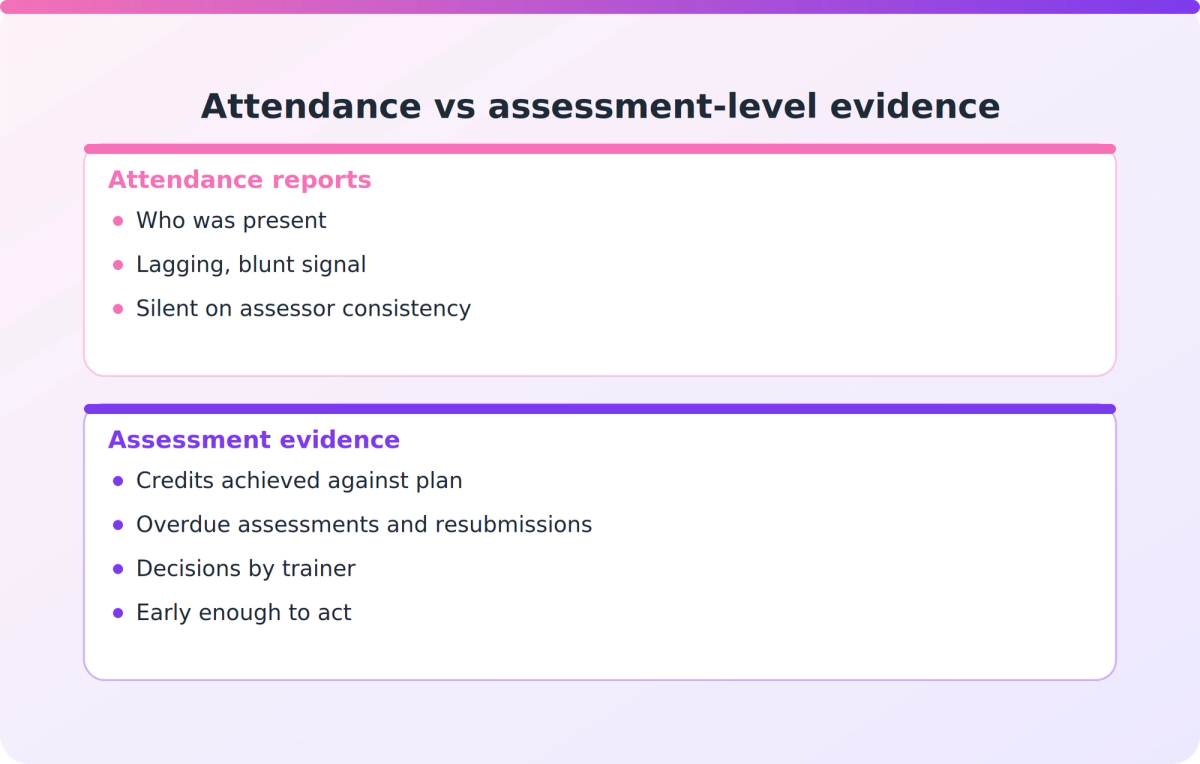
Attendance is useful. A learner who has stopped coming is a learner at risk, and you'd want to know. But it's a lagging, blunt signal. A learner can attend every session and still sit three assessments behind. A learner can miss a week and be fully on track.
A caveat: the research behind this post found no New Zealand evidence linking attendance to completion, so this is a practitioner argument, not a statistic. It's one you can test against your own cohorts. Pull last year's non-completers and check when assessment evidence first showed they were struggling, then when attendance did.
What assessment-level evidence shows that attendance can't
The credit achievement rate is the closest EPI to a direct measure of progress. Its early-warning equivalent sits inside your own assessment records. Credits achieved against plan, assessments outstanding, resubmissions and the decisions assessors have made all show where a learner actually is, weeks before an end-of-term result does.
Moderation is a learner-risk signal too
NZQA's moderation principles say assessment should be fair, valid and consistent. "Consistent" means assessor judgements are reliable regardless of who assesses or when. NZQA says internal moderation helps ensure that consistency within an organisation, over time and between assessors.
This matters for progress tracking. If one trainer's learners achieve at a very different rate from another's on the same standard, you have two possible problems. Either one cohort needs more support, or the judgements aren't aligned. Both are worth knowing about now. Both are invisible if progress data lives in separate trainer spreadsheets and only gets reviewed at the end.
Programme approval criteria also expect an effective system for moderating assessment materials and decisions. Patterns in decisions by trainer are evidence that the system is working, or that it isn't.
Why you can't wait for someone else's view
Ownership of standards and moderation is shifting. From 1 January 2026, Industry Skills Boards (ISBs) develop and maintain industry qualifications and unit standards, run national external moderation and endorse consent-to-assess applications. Eight ISBs now exist. Workforce Development Councils were disestablished on 31 December 2025, and the transition for Te Pūkenga work-based learning divisions runs until the end of 2027.
Arrangements may move during that period. External moderation outcomes will keep arriving, but they arrive after the fact and from outside. An internal view of progress and assessment consistency is the one thing that stays stable while everything around it changes.
A practical starting point this quarter
You don't need a grand programme. Try this:
- Choose three or four progress signals. Credits achieved against plan, overdue assessments, resubmission counts and assessment decisions by trainer is a workable set.
- Set your own trigger. Decide what "behind" means for each programme, and who calls the learner when it happens. A signal with no owner is just a report.
- Review decisions by trainer monthly. Feed anything odd into internal moderation before it becomes a pattern.
- Read the Consent and Moderation Requirements for the standards you deliver. Every standard on the Directory of Assessment and Skill Standards has them. Some set record-keeping and reporting obligations. For example, CMR 0078 requires student credit achievement to be reported to NZQA and the student notified within three months of assessment. That applies to that standard only, and requirements vary by standard and ISB.
- Keep a dated record. A monthly snapshot of progress and the actions taken turns into the evidence trail your self-review needs.
Key takeaways
- Attendance shows presence. Credits achieved and assessment decisions are closer to showing progress.
- TEC's EPIs measure outcomes after the fact, so your early warning has to come from your own assessment records.
- NZQA's annual self-review, live since 1 January 2026, makes progress evidence an ongoing duty, not an end-of-year task.
- Assessment decisions by trainer reveal both learner risk and moderation risk.
- With ISBs taking over standards and national moderation, an internal view of progress is more valuable, not less.
Our take
Most providers already hold the data that would warn them early. It sits in assessment records, trainer spreadsheets and moderation notes, and nobody looks at it together until the results are in. That is a visibility problem, not a data problem.
We think the annual self-review is worth treating as an opportunity rather than another report to produce. A Head of Training who can show, month by month, what they saw and what they did about it has a much stronger story than one with a tidy end-of-year summary. Attendance will always be part of the picture. It just shouldn't be the first place you look.
Here's a question worth sitting with: if a learner in your largest programme were quietly falling behind today, which report would tell you, and when?
FAQ
What does NZQA's annual self-review require from a PTE?
Since 1 January 2026, providers must complete an annual self-review, submit a summary report to NZQA and meet NZQA to discuss an improvement plan. NZQA said it would provide templates and discuss scheduling of first submissions during 2026.
Which TEC measures relate to learner progress?
TEC's provider-based EPIs are first-year retention, qualification completion, successful course completion and progression. The work-based EPIs are apprentice first-year retention, programme completion and credit achievement rate. Credit achievement rate is the closest to a direct progress measure.
Is attendance data useless for spotting at-risk learners?
No, but it shows presence, not achievement. The research behind this post found no New Zealand evidence linking attendance to completion, so treat the argument as practitioner judgement and test it against your own past cohorts.
Do moderation arrangements change under the ISBs?
ISBs now run national external moderation and develop unit standards, and the transition runs until the end of 2027. Arrangements may shift, so check the Consent and Moderation Requirements for each standard you deliver and keep your own internal moderation visible.