Non-Compliance Risk Early Warning for NZQA PTEs
12 October 2026 · 7 min read
NZQA no longer starts new external evaluation and review (EER) processes, so your biggest exposure is no longer an audit date. It is the gap between when drift begins inside your PTE and when you notice it. Under iQAF, your self-review is the early-warning system, and it only works if it runs all year.
Why this lands on your desk
NZQA reported on 15 January 2026 that its integrated Quality Assurance Framework (iQAF) is live. From 1 January it stopped starting new EERs and consistency reviews, though those already underway will be completed. In their place, providers submit an annual self-review summary report and meet NZQA to discuss the improvement plan. NZQA's design document says quality assurance activity will be informed by risk assessments.
That report and that conversation are yours. You answer for what they surface and, more to the point, for what they miss. A cycle built around a visit let you rehearse. A risk-informed model rewards the provider that can already see its own weak spots.
Then there is the January 2026 rewrite. The updated NZQA Rules came into force on 19 January 2026, and the person asked "have we re-mapped everything?" is you.
Where drift hides now
Four places deserve a regular look. None needs a new system to check. They need a date in the diary and a named owner.
Your QMS and where requirements now sit
The PTE Rules 2026 replace the PTE Registration Rules 2025 and the PTE Enrolment and Academic Records Rules 2022. They also require a copy of your quality management system, as required under the Quality Assurance of Tertiary Education Providers Rules 2026. Other changes are smaller but real: the annual fee is removed, and the annual financial return becomes biennial unless NZQA notifies a particular PTE otherwise.
If your policies still cite the old rule names, you have drift. It is small today. It looks careless in a risk conversation.
Sub-contracting and programme monitoring
The Programme Approval, Recognition and Accreditation Rules 2026 move the sub-contracting rule and programme monitoring into the Quality Assurance of Tertiary Education Providers Rules. SAARA, an industry body, says this relocation needs immediate attention from PTEs and affects the QMS. That is a secondary source, so read the rules themselves.
If you are on self-monitoring status, NZQA's transition note says it will ask for annual programme evaluation reports (APER) this year as a transition measure. Check now whether your monitoring data could produce one without a scramble.
Who owns each standard you deliver
Workforce Development Councils were disestablished on 31 December 2025. Eight Industry Skills Boards now provide standard-setting functions. Ohu Ahumahi notes that NZQA has approved new skill standards replacing the 6400 series unit standards (6400-6402), plus twelve new Health and Wellbeing Core Skill Standards.
Confirming which ISB owns each standard you deliver is a sensible check. That is my inference, not a published rule. It is cheap to do and painful to discover late.
The Pastoral Care Code risk record
The Education (Pastoral Care of Tertiary and International Learners) Code of Practice 2021 requires providers to maintain a record of reported risks, including concerns about the effective administration of the Code. NZQA administers the Code, monitors compliance and can take action against signatories found in breach.
The iQAF design document says monitoring of learner safety and wellbeing practice will be integrated with other quality assurance activities. In practice, wellbeing evidence now sits inside the wider QA picture. A thin or stale risk record is no longer just a pastoral problem. It is a compliance signal.
Use old EER reports as a free checklist
Past EER reports are still public, and they show what evaluators found weak. The Techtorium report, for example, noted that evidence that programme delivery design complies with NZQA requirements had been weak.
Read five or six reports from providers like yours. Turn each recurring finding into a question for your own self-review. You are borrowing the evaluator's eye without waiting for the evaluator.
A rhythm you can start this quarter
The point is to move from one big annual write-up to small, regular checks. Whatever form your evidence takes, the questions are the same.
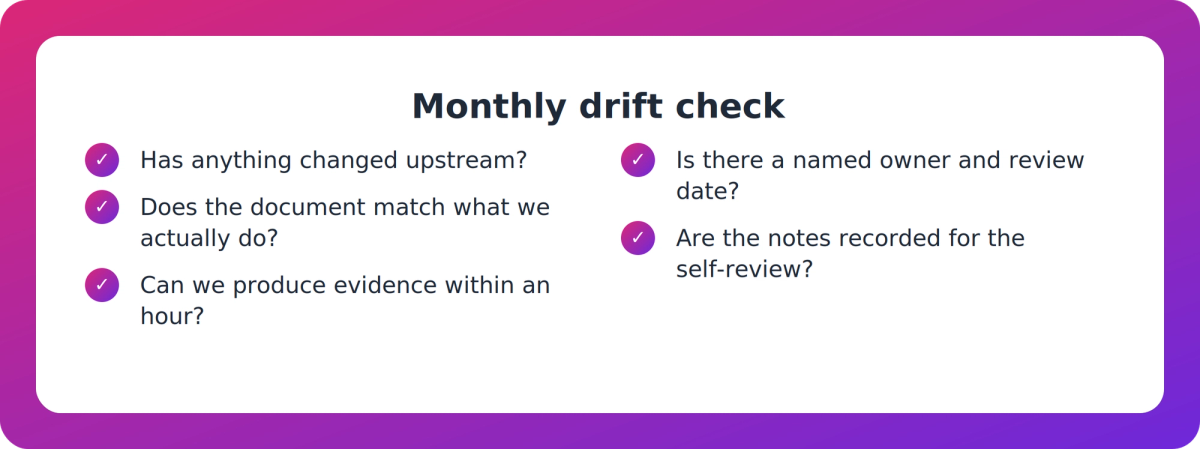
Run a short monthly drift check
Pick one of the four areas each month and ask three things. Has anything changed upstream? Does our document still say what we actually do? Can we produce the evidence in an hour, not a week?
Record the answers. Those notes become the raw material for your annual self-review summary report, and they stop you reconstructing the year from memory.
Make owners explicit
Each requirement needs a named owner, a review date and a place where the evidence lives. If you are the only person who knows where things are, you are a single point of failure as well as a bottleneck. Ownership that sits with the person closest to the work also gets you out of reviewing every document yourself.
What we still can't tell you
Some questions have no public answer yet. Immigration New Zealand says it will continue using existing EER ratings for 12 months from early 2026 while NZQA transitions. The research found no public statement of what replaces EER ratings for visa purposes after that window. If international learners matter to your PTE, watch that closely and don't assume.
Likewise, public sources don't confirm the current attestation mechanics for the Pastoral Care Code under iQAF. Ask NZQA directly rather than guessing.
Key takeaways
- NZQA stopped starting new EERs on 1 January 2026. Your annual self-review summary report and improvement-plan discussion are now the main early-warning mechanism.
- The 19 January 2026 Rules changes moved requirements, including sub-contracting and programme monitoring. Re-map your QMS to where they now sit.
- Confirm which of the eight Industry Skills Boards owns each standard you deliver. This is a sensible check, not a published rule.
- Treat the Pastoral Care Code record of reported risks as a live compliance matter, because NZQA monitors the Code.
- Flag the open questions, including what replaces EER ratings for visa purposes, and watch them.
Our take
The quiet danger of iQAF is that it feels lighter. No EER date means no countdown, and no countdown means the work slides. We think the opposite is true. A risk-informed regulator rewards providers that find their own problems first, and punishes those who learn about them from someone else.
So stop treating self-review as a document you write in the final weeks before it is due. Treat it as the log of what you noticed, when, and what you did. If the log is thin, that is your first finding.
FAQ
What has replaced EER under NZQA's iQAF?
NZQA has stopped starting new EERs and consistency reviews from 1 January 2026, though existing ones will be completed. Providers now submit an annual self-review summary report and meet NZQA to discuss the improvement plan, with quality assurance informed by risk assessments.
Which NZQA Rules changed in January 2026?
Updated Rules came into force on 19 January 2026. They include the PTE Rules 2026, the Quality Assurance of Tertiary Education Providers Rules 2026 and the Programme Approval, Recognition and Accreditation Rules 2026. Sub-contracting and programme monitoring moved into the quality assurance rules.
What happens to EER ratings used for student visas?
Immigration New Zealand says it will continue using existing EER ratings for 12 months from early 2026 while NZQA transitions. Public sources don't say what replaces them afterwards, so treat that as an open question and monitor announcements.
Does the Pastoral Care Code still matter under iQAF?
Yes. The 2021 Code requires a record of reported risks, and NZQA monitors compliance and can act against signatories in breach. NZQA's design document says wellbeing monitoring will be integrated with other quality assurance activities.
Here is a question worth sitting with: if NZQA asked tomorrow what your PTE had noticed about itself in the last three months, what would you hand over?