Non-Compliance Risk Indicators Every PTE Should Track
1 September 2026 · 7 min read

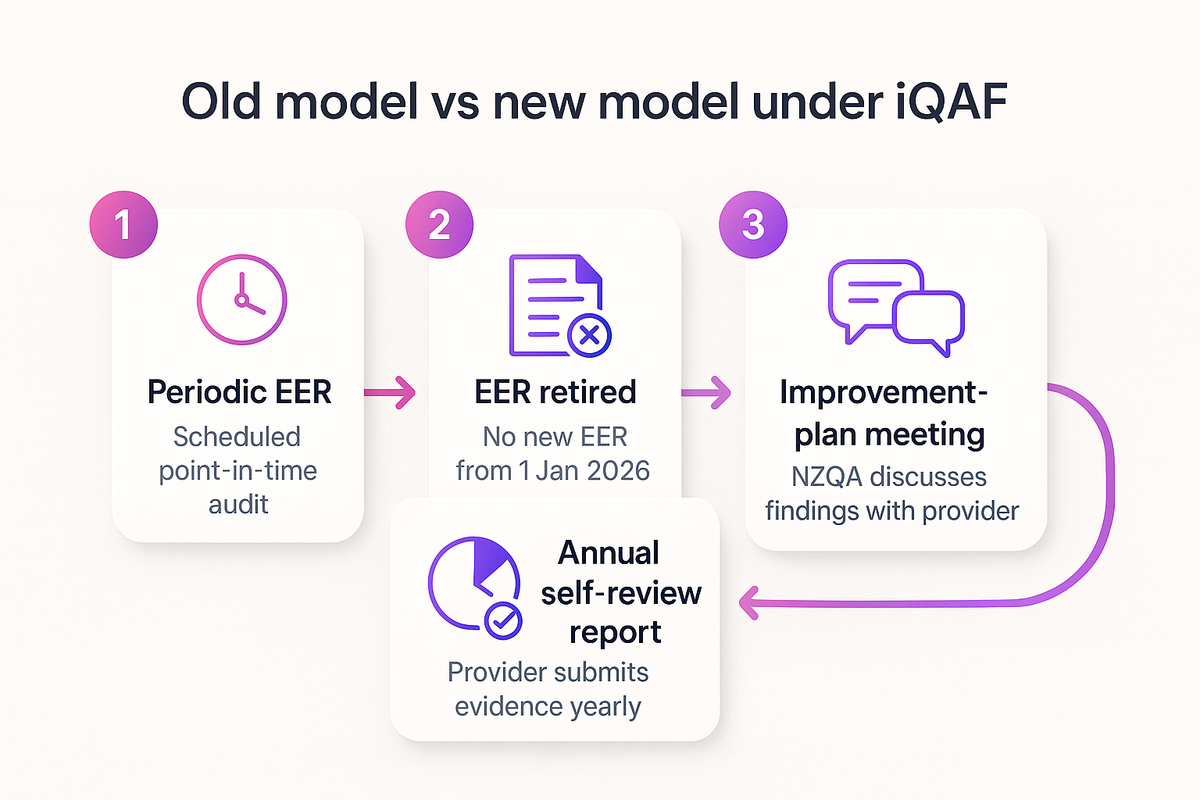
NZQA is quietly retiring the idea that compliance has a due date. From 1 January 2026, new External Evaluation and Review processes and consistency reviews stop altogether, replaced by an annual self-review summary report and an improvement-plan meeting under the new integrated Quality Assurance Framework. The real risk in this transition isn't a rule you haven't read yet — it's the lag between a standard changing and you noticing your evidence no longer matches it.
Why this lands on your desk
For years, the compliance calendar had a rhythm you could plan around: build the evidence base, brace for the External Evaluation and Review, recover, repeat. That rhythm is gone. Under iQAF, you submit an annual self-review summary report and sit down with NZQA to talk through an improvement plan — which means the proof of compliance now has to exist continuously in your own records, not get assembled in a scramble before a scheduled visit.
That alone would be a big shift. It's landing at the same time as three major rule-replacement cycles in under twelve months: the updated NZQ Qualifications and Credentials Framework and five NZQA Rule sets from 1 July 2025, followed by wholly new Private Training Establishment Rules 2026 from 1 January 2026, which replace both the 2025 PTE Registration Rules and the 2022 Enrolment and Academic Records Rules. Each cycle means re-checking policies, your Training and Assessment Strategy, and your evidence base against a target that has already moved again.
On top of that, the bodies that set interpretation guidance for standards have themselves just changed. Industry Skills Boards became operational on 1 January 2026, replacing Workforce Development Councils as standard-setters — the same date consistency reviews were discontinued under the Education and Training (Vocational Education and Training System) Amendment Act 2025. "This is how we've always read the standard" is no longer a safe assumption, because the people who'd confirm that reading are new too.
From scheduled audit to standing self-review
The practical mechanics of iQAF matter for how you structure your year. Instead of a periodic External Evaluation and Review landing on your calendar, you're now producing an annual self-review summary report and meeting NZQA to discuss an improvement plan. NZQA has framed this explicitly as more targeted, risk-informed monitoring — intended to ease the burden on providers who can already show ongoing compliance, rather than rewarding those who simply scramble well once every few years.
There's a transition wrinkle worth flagging if you enrol international learners: Immigration New Zealand will keep using existing External Evaluation and Review ratings for visa purposes for twelve months from early 2026. That means a temporary period of dual reporting expectations — your iQAF self-review evidence has to stand up on its own terms, while a historic EER rating still does work elsewhere in the system.
Three rule cycles, one moving target
The rule changes aren't cosmetic. The Private Training Establishment Rules 2026 replace both the 2025 Registration Rules and the 2022 Enrolment and Academic Records Rules, and they arrive alongside new terminology under Te Hono o Te Kahurangi quality assurance. Financial reporting has moved too — the separate Annual Financial Return was dropped in favour of standard annual financial statements and a duty to maintain adequate internal financial controls, then changed again under the 2026 Rules to biennial financial returns for non-funded PTEs.
Each of those changes touches a different part of your evidence base: registration conditions, enrolment records, financial controls, programme and qualification listing. If your policy library was last reconciled against the 2025 Rules, and your reality now runs on the 2026 Rules, that gap is exactly the kind of thing an improvement-plan meeting is designed to surface.
What non-compliance now costs, in dollars
NZQA compliance visits — scheduled or unannounced — are billed at $190 per staff member per hour, GST exclusive. That's a quotable, budgetable cost of being caught under-prepared, on top of the reputational one: NZQA retains its full enforcement toolkit independent of iQAF, including compliance notices, conditions on registration, withdrawal of accreditation, or cancellation of registration, and it publishes the outcomes of compliance actions.
The Education (Pastoral Care of Tertiary and International Learners) Code of Practice 2021 already runs on a version of this model — an annual self-review attestation to NZQA, with evidence able to be requested at any time. If you've managed that obligation well, you've already built a small working version of what iQAF now expects sector-wide. The question is whether that same discipline extends to every other rule set you carry.
Building your own early-warning system
You can't wait for NZQA to tell you a standard has moved past your evidence. A few habits close that gap:
- Map every current rule set — NZQCF, the five 1 July 2025 Rules, and the PTE Rules 2026 — to the specific policy, TAS clause, or evidence file it governs, so a rule change flags exactly what needs review.
- Date-stamp evidence at the point it's created, not when it's filed, so you can see at a glance what's aged past a rule change.
- Assign a named owner to each compliance obligation, so "someone will get to it" never survives a improvement-plan conversation.
- Treat the Pastoral Care Code attestation as a rehearsal for iQAF, not a separate task — the muscle is the same.

Key takeaways
- iQAF ends new External Evaluation and Review and consistency review processes from 1 January 2026, replacing them with annual self-review summary reports and improvement-plan meetings.
- Immigration New Zealand keeps using existing EER ratings for visa purposes for twelve months from early 2026, creating a temporary dual-reporting period for providers with international learners.
- Three rule cycles in under a year — the July 2025 NZQCF and Rule sets, then the PTE Rules 2026 — mean policies and evidence have to be re-checked against a moving target, not a fixed one.
- Industry Skills Boards replaced Workforce Development Councils as standard-setters from 1 January 2026, so long-standing interpretations of standards need re-confirming, not assuming.
- NZQA compliance visits are billed at $190 per staff member per hour, GST exclusive, and outcomes of compliance action are published — under-readiness now has a direct cost and a public one.
Our take
The sector conversation about iQAF has mostly focused on reduced burden for high performers, and that's a fair reading of NZQA's own framing. But reduced burden only applies if your self-review evidence is actually current. A provider whose policy library trails the rules by even one cycle isn't getting the lighter-touch version of iQAF — they're walking into an improvement-plan meeting with a gap they didn't know they had. The compliance managers who come out of 2026 ahead won't be the ones who read every Rule set the fastest. They'll be the ones who built a habit of knowing, at any given moment, exactly which evidence is current and which isn't — because that's the only thing iQAF actually rewards.
FAQ
Does the integrated Quality Assurance Framework replace all NZQA monitoring, or just the External Evaluation and Review cycle? It replaces the periodic External Evaluation and Review and consistency review processes from 1 January 2026. NZQA's separate enforcement toolkit — compliance notices, conditions on registration, withdrawal of accreditation, and cancellation of registration — remains fully in force alongside iQAF.
If we enrol international learners, do we still need our old EER rating after 2026? Yes, for a transition period. Immigration New Zealand will continue using existing External Evaluation and Review ratings for visa purposes for twelve months from early 2026, so providers with international learners carry a temporary dual reporting obligation.
Which rule sets should we be reconciling our policies against right now? At minimum: the updated NZQ Qualifications and Credentials Framework and the five NZQA Rule sets effective 1 July 2025, and the Private Training Establishment Rules 2026, which replace both the 2025 PTE Registration Rules and the 2022 Enrolment and Academic Records Rules.
What changed with our financial reporting obligations? The standalone Annual Financial Return was dropped in favour of standard annual financial statements plus a duty to maintain adequate internal financial controls. The Private Training Establishment Rules 2026 then introduced biennial financial returns for non-funded PTEs, so the obligation itself has shifted twice in a short window.
Who do we go to now for interpretation guidance on standards, if Workforce Development Councils are gone? Industry Skills Boards became operational on 1 January 2026 and have taken over the standard-setting role previously held by Workforce Development Councils. Existing interpretations should be checked against current Industry Skills Board guidance rather than assumed to carry over unchanged.