NZQA Rule Changes Compliance: A Manager's Field Guide
12 August 2026 · 7 min read

NZQA has quietly rewired how it decides who gets scrutinised, and that shift matters more than any single rule update. External Evaluation and Review stopped taking new cases from January 2026. In its place: an annual self-review summary report, an improvement-plan discussion, and a stated intention to chase risk signals in provider data before anyone schedules an audit.
Why this hits your desk
You now own an artefact nobody has written before. The annual self-review summary report and the improvement-plan discussion that follows it, under the new integrated Quality Assurance Framework (iQAF), replace the old EER category rating - and there is no bank of exemplars, no established sense of what "good" looks like. If the format or evidence base falls short, you're the first name on the file.
The lead time you used to plan around has also shrunk. NZQA has said plainly it wants to move from EER-based categories to risk-based, data-driven monitoring - increasing monitoring frequency or intensity wherever its own data, complaints, or agency information flag a risk to learners. A gap that once surfaced quietly during a scheduled EER visit can now trigger scrutiny with no warning, because there's no scheduled visit left to hide behind.
Then there's the paperwork under your feet. Three rule sets changed on the same day - 19 January 2026 - each moving obligations between documents. If your policy library or TAS evidence still references the old structure, it isn't just outdated, it's wrong.
And one job has no finish line. Skill standards are replacing unit standards progressively, via NZQA's monthly Directory of Assessment and Skill Standards (DASS) change reports, not a single cut-over date. NZQA has said watching that report is an expectation, not a courtesy. That someone is you, indefinitely.
The end of EER, and what replaces it
For a long time the rhythm was predictable: prepare for EER, get a category rating, coast until the next cycle. From 1 January 2026, NZQA stopped starting new EER processes, and the category rating tied to it ceases. What replaces it is continuous: an annual self-review summary report, followed by a discussion with NZQA about an improvement plan, sitting inside iQAF.
The practical difference is a compliance function that is either audit-ready every day or exposed the day someone checks. That's the design intent behind swapping a scheduled external review for ongoing data-driven monitoring.
One transitional wrinkle worth flagging to enrolment and marketing teams: Immigration New Zealand will keep relying on existing EER ratings for visa purposes for twelve months from early 2026. A provider's external-facing quality signal - the one international agents and students see - can lag its actual iQAF status for the best part of a year. Better to manage that gap proactively than explain it reactively.
Three rule sets, one effective date
On 19 January 2026, NZQA brought in a rewrite across three instruments simultaneously:
- The Quality Assurance of Tertiary Education Providers Rules 2026, which now houses sub-contracting requirements previously sitting in programme rules.
- The Programme Approval, Recognition, and Accreditation Rules 2026.
- The PTE Rules 2026, which removed the annual fee and changed the financial return frequency for non-funded PTEs to biennial, unless NZQA specifies otherwise.
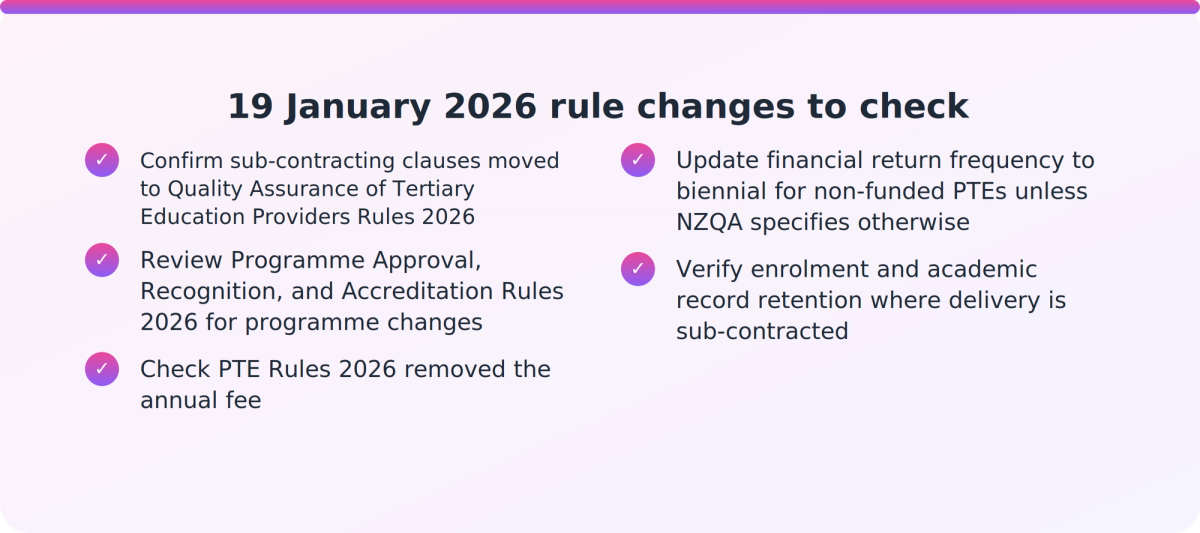
None of these are cosmetic. The sub-contracting relocation matters because the 2026 provisions are explicit: the contracting PTE must retain all student enrolments and academic records even where delivery itself is sub-contracted out. That traceability obligation sits with the compliance function to enforce and evidence, not with whoever happens to hold the sub-contract file.
If your rule map was built even a year ago, treat it as unreliable until you've checked it clause by clause against the January 2026 versions.
The standards migration that never quite finishes
Unit standards are being replaced by skill standards on the DASS, with no single switch-over date - it's happening qualification by qualification, reported monthly. Skill standards become mandatory wherever a qualification or micro-credential specifies them.
NZQA's expectation is that providers watch the monthly change reports as approvals and changes happen, not catch up after an audit finding tells them a standard has moved. There's no point at which this task ends, because the migration itself has no announced finish date.
A restructured sector, a longer contact list
The Vocational Education and Training legislation passed in October 2025 disestablished Te Pūkenga, replacing it with a transitional entity (NZIST) while ten regional polytechnics and eight Industry Skills Boards - taking over from Workforce Development Councils - stood up from 1 January 2026. Work-based training arrangements get a two-year transition period.
Practically, this changes who you deal with for standard-setting and programme approval. Worth mapping that new contact structure now, rather than discovering mid-application that the body you used to call no longer exists in that form.
What hasn't changed
Some obligations carry on exactly as before, and it's worth not losing them in the noise:
- Annual return documents are still required and reviewed by NZQA, who follow up if concerns arise.
- Complaint-driven investigations continue regardless of your self-review status.
- Annual student fee protection audits, completed by a chartered accountant within five months of financial year-end, remain a hard deadline.
Key takeaways
- EER has stopped taking new cases; the annual self-review summary report and improvement-plan discussion under iQAF are the new artefact, with no established precedent for what "good" looks like.
- NZQA has stated it will monitor providers using integrated data and complaints, escalating scrutiny where risk signals appear - collapsing the lead time compliance teams used to plan around.
- Three rule sets changed simultaneously on 19 January 2026: the Quality Assurance of Tertiary Education Providers Rules 2026, the Programme Approval, Recognition, and Accreditation Rules 2026, and the PTE Rules 2026.
- Sub-contracting rules relocated into the 2026 Quality Assurance Rules and now explicitly require the contracting PTE to retain all enrolments and academic records.
- The unit-to-skill-standards transition runs via monthly DASS change reports with no fixed end date, making it an ongoing compliance watch rather than a one-off project.
Our take
The instinct after a change like this is to treat it as a document exercise - update the policy library, note the new rule numbers, move on. That undersells what's happening. NZQA has told the sector it wants earlier signal, not just correct paperwork. The self-review report and improvement-plan conversation only work in your favour if they reflect what's actually happening on the ground, continuously, not what your files said six months ago.
The honest reading of the risk-based monitoring language is that NZQA expects providers to find their own problems first. That's a harder discipline than passing a scheduled review, because there's no fixed date to build toward and no external checklist to reverse-engineer. It rewards providers who can see, at any given moment, exactly what's current, who owns it, and when it last changed - and it will be unkind to those who can only answer that question during a scramble.
FAQ
Does the retirement of EER mean less scrutiny overall? No - it means differently timed scrutiny. NZQA has stated its intention to increase monitoring frequency or intensity where data, complaints, or agency information indicate risk to learners, rather than waiting for a scheduled review cycle.
Do the 19 January 2026 rule changes apply to all PTEs immediately? Yes. The Quality Assurance of Tertiary Education Providers Rules 2026, the Programme Approval, Recognition, and Accreditation Rules 2026, and the PTE Rules 2026 all took effect that day. Check current policy and TAS documentation against them directly rather than assuming prior interpretations still hold.
Who now needs to check the DASS monthly change reports? NZQA expects providers to monitor these reports on an ongoing basis, since the shift from unit standards to skill standards is happening progressively rather than on a single cut-over date. In most providers, this sits with the compliance or quality function.
Does my EER category rating still mean anything? For visa purposes, yes for now. Immigration New Zealand has said it will continue relying on existing EER ratings for twelve months from early 2026 during the transition, even though NZQA itself has moved to the iQAF model.