Operations Maturity: Is Your PTE Firefighting or Improving?
17 August 2026 · 9 min read

NZQA has stopped scheduling new External Evaluation and Review engagements for PTEs. From 1 January 2026, the external safety net that used to catch messy processes is gone — replaced by an annual self-review report and an improvement-plan meeting you own. For the COO, operational discipline just became the primary compliance control, not a nice-to-have.
Why this lands on your desk now
This isn't an academic quality question. It's an operations one, and it sits with you specifically.
You're the one who owns Single Data Return (SDR) and Workforce Questionnaire submissions through DXP Ngā Kete. You're the one who signs off on sub-contracting arrangements and carries the compliance exposure when a delivery partner's system doesn't talk to yours. And you're the one who has to work out whether your team can take on a new work-based training contract from a regional polytechnic without simply hiring three more people to cope.
The integrated Quality Assurance Framework (iQAF), the Private Training Establishment Rules 2026, and the disestablishment of Te Pūkenga have landed in the same twelve-month window. Individually, each is manageable. Together, they mean the quality of your processes is now visible — to NZQA, to TEC, and to anyone comparing funding-linked completion data — in a way it wasn't before.
The self-review era: no more waiting for the auditor
Under the iQAF, which has replaced the earlier Evaluative Quality Assurance Framework, NZQA is not commencing any new External Evaluation and Review or Assuring Consistency processes from 1 January 2026 (engagements already underway will be completed). In their place, providers submit an annual self-review summary report and meet with NZQA to discuss an improvement plan.
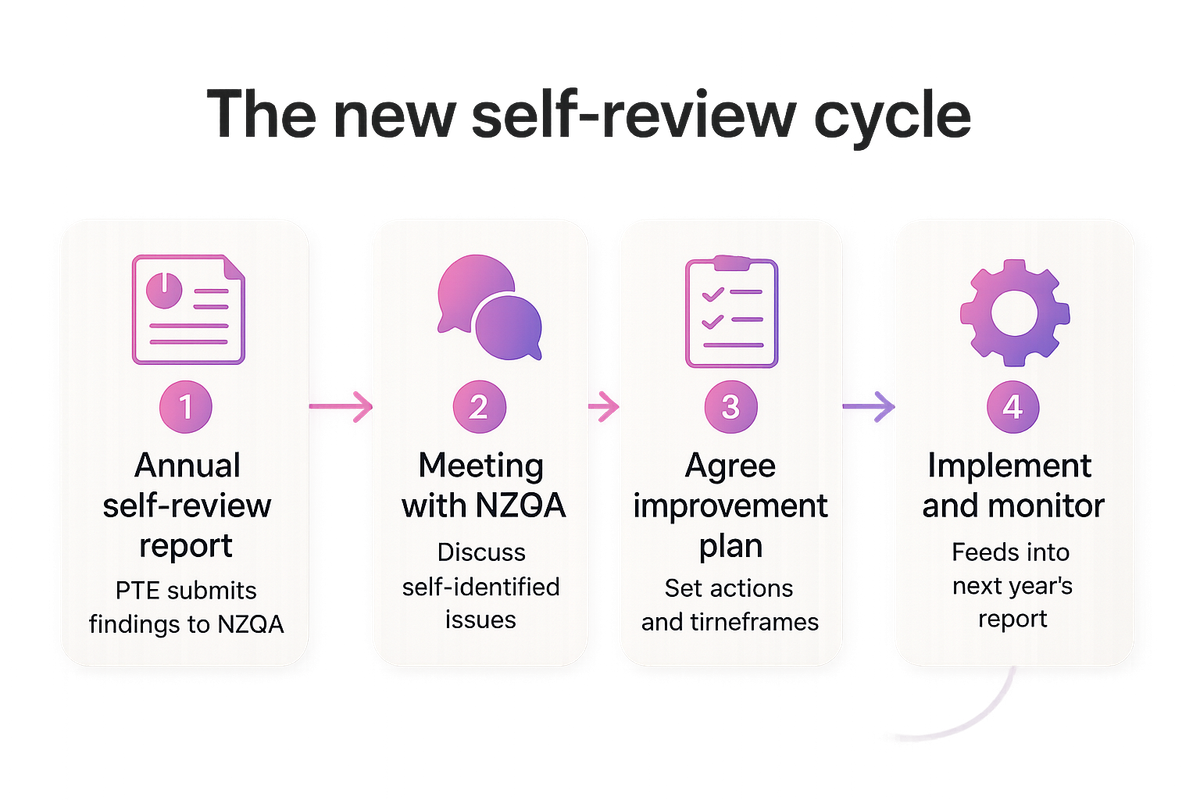
That's a genuine shift in mechanism, not just terminology. EER was episodic — NZQA came to you, on a cycle, and found what it found. The new model is continuous and self-initiated. You have to notice your own weak points before NZQA does, document them, and show a credible plan to fix them, every year.
NZQA has also dropped the old four-category EER rating and proposed a simpler compliant/non-compliant view, though no replacement rating system has been confirmed after consultation pushed back for something more graduated. In the interim, Immigration New Zealand will keep using existing EER ratings for 12 months from early 2026 to protect visa continuity — worth knowing if your PTE enrols international students and relies on that rating for recruitment or agent conversations.
For operations, the practical implication is this: your self-review report is only as good as the data behind it. If your enrolment, delivery and outcomes data live in three disconnected systems and get reconciled manually before every deadline, your self-review process will be unreliable in exactly the way NZQA is now trusting you to catch.
Your records, your responsibility — even when someone else delivers
The Private Training Establishment Rules 2026, in force from 19 January 2026, tighten record-keeping directly. PTEs must retain all student assessment materials, or full copies, for at least 12 months from completion — including materials generated by sub-contractors. Non-funded PTEs move to biennial rather than annual financial returns, unless NZQA advises otherwise.
Sub-contracting provisions have shifted to the Quality Assurance of Tertiary Education Providers Rules 2026. NZQA will only approve a sub-contracting arrangement where the PTE remains fully responsible for the sub-contractor's compliance. Enrolments and academic records must be held and maintained by the PTE itself, even where the delivery is outsourced.
Read that again from an operations seat. If a delivery partner runs its own student management system and you're relying on periodic exports to reconcile against yours, that gap is now a direct compliance exposure — not a data-hygiene inconvenience. The rule doesn't ask who taught the class. It asks who holds the record, and the answer has to be you.
One quiet system migration, one public data problem
TEC's own review of Techtorium found that the majority of its SDR submission issues traced back to a single cause: a change in its student management system. Not fraud, not neglect — a systems migration that wasn't controlled tightly enough, quietly feeding errors into data that TEC uses to calculate and publish EFTS-weighted completion-rate rankings.
That's the risk in concrete terms. The SDR, submitted alongside the Indicative Enrolment Collection and Workforce Questionnaire through TEC and the Ministry of Education's DXP Ngā Kete platform, isn't a form you fill in once a year and forget. It's a pipeline, and every provider must report all confirmed enrolments, funded and non-funded. If the pipe changes shape — a new system, a migrated database, a new integration — and nobody stress-tests the output before it's submitted, the error doesn't stay internal. It becomes part of a public, funding-linked ranking that NZQA and TEC both act on.
A COO doesn't need to be a data engineer to manage this risk. You need a standing rule: no system or process change touching enrolment, attendance or outcomes data goes live without a reconciliation check against the previous period's numbers, before the next SDR cycle closes.
The maturity ladder: firefighting, coping, improving
Most operations teams sit somewhere on a rough three-rung ladder. Being honest about which rung you're on is more useful than any external rating ever was.
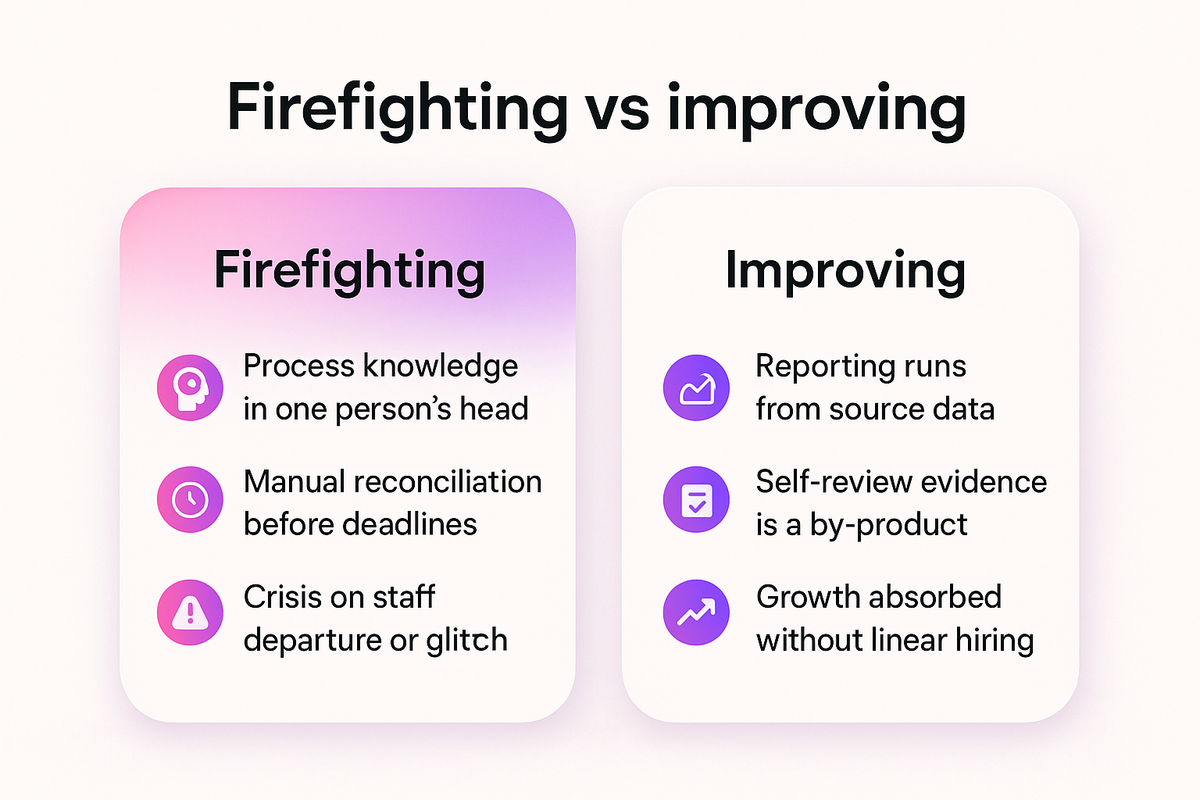
Firefighting. Process knowledge lives in one or two people's heads. Reporting gets reconciled manually, under deadline pressure, before every SDR and every board pack. A staff departure or a system hiccup creates a genuine crisis.
Coping. Processes are documented, but systems still don't talk to each other. Someone re-keys enrolment data into the finance system, then again into the reporting extract. Growth gets absorbed by adding people, roughly one-for-one with enrolment growth.
Improving. Systems are integrated enough that reporting runs from source data, not from someone's memory or a end-of-month scramble. Self-review evidence is a by-product of normal operation, not a special project. New delivery volume gets absorbed without a proportional headcount increase.
This matters beyond compliance. Te Pūkenga has been disestablished, replaced for a two-year transitional period by the New Zealand Institute of Skills and Technology, alongside ten regionally governed polytechnics and eight Industry Skills Boards from 1 January 2026. That's a genuine reshaping of the delivery landscape across a sector training roughly 250,000 people a year, and it's opening near-term partnership and sub-contracting opportunities for PTEs in work-based training. But only providers already on the improving rung can take on that volume without simply hiring their way through it — and hiring your way through it eats the margin the opportunity was supposed to create.
Key takeaways
- From 1 January 2026, NZQA is not starting new EER or Assuring Consistency reviews; PTEs instead submit an annual self-review report and meet NZQA to agree an improvement plan.
- No replacement EER rating system is confirmed yet; Immigration New Zealand will keep using existing ratings for 12 months from early 2026 for visa purposes.
- The Private Training Establishment Rules 2026 require 12 months' retention of assessment materials, including sub-contractor-generated evidence, and move non-funded PTEs to biennial financial returns.
- Under the Quality Assurance of Tertiary Education Providers Rules 2026, PTEs must hold all enrolment and academic records themselves, even for sub-contracted delivery — the sub-contractor's system doesn't discharge your responsibility.
- TEC's review of Techtorium shows a single uncontrolled student management system change can corrupt SDR data that feeds public, funding-linked completion-rate rankings.
Our take
The old EER cycle let some providers coast on good luck rather than good process — a strong evaluator visit could paper over patchy internal reporting for years at a time. That option is closing. The annual self-review is, in effect, an audit you have to run on yourself, and the quality of what you produce will say more about your operational maturity than any rating category ever did.
We'd argue the sub-contracting and record-keeping tightening is the more consequential change for most operations teams, precisely because it's less visible. It's easy to notice a new reporting deadline. It's easy to miss that your delivery partner's separate enrolment system has quietly become your direct compliance liability. If you haven't audited every sub-contracted arrangement against the new holding-and-maintaining requirement, that's worth doing before your next self-review cycle, not after.
FAQ
Do we still get an external quality check under the iQAF? Not in the form of a scheduled External Evaluation and Review. From 1 January 2026, NZQA is not commencing new EER or Assuring Consistency engagements; existing ones in progress will be completed. The ongoing mechanism is an annual self-review summary report plus a meeting with NZQA to agree an improvement plan.
Does the old EER rating still matter? For most purposes it's being superseded, and no confirmed replacement rating system has been finalised — NZQA proposed a simpler compliant/non-compliant view but received pushback favouring a graduated option. Immigration New Zealand will keep using existing EER ratings for 12 months from early 2026 specifically to protect visa continuity, so if you enrol international students, that transition window is worth tracking.
We sub-contract some delivery — who's responsible for the enrolment records now? You are. Under the Quality Assurance of Tertiary Education Providers Rules 2026, NZQA will only approve sub-contracting arrangements where the PTE remains fully responsible for the sub-contractor's compliance, and all enrolments and academic records must be held and maintained by the PTE itself, regardless of who delivers the training.
What's the practical lesson from the Techtorium SDR review? That a student management system change, if not properly controlled and reconciled, can quietly produce errors in your Single Data Return submission — errors that feed directly into TEC's published, funding-linked completion-rate data. Any system or process change touching enrolment or outcomes data warrants a reconciliation check against prior figures before your next SDR cycle closes.