PTE Revenue Diversification NZ: A CEO's Hidden Risk
6 October 2026 · 7 min read
Every new revenue stream a PTE adds in 2026 lands inside one quality system that NZQA expects you to self-review every year. That makes diversification a core-business decision, not a side bet. A stream's margin matters less than what it asks of your compliance capacity and of the few people who hold your quality knowledge.
Why this lands on your desk
You own the growth strategy and the P&L. The 2026 reset has handed you plenty of tempting openings: work-based learning, partnered delivery, international enrolment, new programmes. Each one looks sensible as a standalone business case.
But you also answer for regulatory standing. The Quality Assurance of Tertiary Education Providers Rules 2026, in force from 19 January 2026, replace the 2022 rules. They require an up-to-date quality management system and annual self-reviews. Sub-contracting and partnered delivery now sit inside that wider quality assurance, according to SAARA, an industry body rather than a regulator, so read the rules text yourself.
The practical consequence is simple. A stream that is poorly governed no longer fails alone.
What the 2026 reset changed
The structural shift took effect on 1 January 2026. Legislation passed in October 2025 disestablished Te Pūkenga, established 10 regional polytechnics and set up Industry Skills Boards (ISBs). Te Pūkenga was renamed NZIST and acts as a transitional entity for two years.
Eight ISBs lead standard-setting and qualification development, and temporarily manage work-based training. After the transition ends in 2027, they focus solely on standards-setting and programme endorsement. Trade press (FE News) expects polytechnics, PTEs and Wānanga to take over delivery. That makes work-based learning an obvious diversification target for PTEs, though the Ministry of Education page is the primary source to check.
On the quality side, NZQA's iQAF replaced the EQAF for PTEs and ITPs, and consistency reviews were discontinued. More weight now falls on your own self-review. The regulator is trusting your internal system to do more of the work.
Four streams, four different loads
A margin forecast tells you what a stream might earn. It does not tell you what the stream costs your quality system. Each option brings its own demands and its own gatekeeper.
- Sub-contracted or partnered delivery. This is now part of organisational quality assurance and self-review. SAARA says NZQA approval is needed before training starts where the sub-contractor is already accredited. You carry the oversight of someone else's delivery.
- Work-based learning. The opening is real, but the ISB relationship is a dependency. A TEC consultation document noted that a programme would not be funded without ISB endorsement. Whether that made it into the final legislation is unconfirmed, so treat it as a risk to verify, not a settled fact.
- International learners. You must be an approved signatory to the Education (Pastoral Care of Tertiary and International Learners) Code of Practice 2021 before enrolling international students. Immigration NZ will keep using existing EER ratings for 12 months from early 2026. What applies after that window, I could not find.
- New programmes. These go through programme approval and then into the same self-review cycle as everything else.
None of these is a bad idea. The point is that each draws on the same pool of people and the same system.
The rating risk, flagged as inference
The proposed iQAF design, as reported secondhand by Indian Newslink (I could not find NZQA's own page), would replace compliant/non-compliant with Highly Effective, Effective and Not Effective. It would assess four weighted criteria: programme and micro-credential design, education delivery, assessment practice, and quality management systems.
If that design is adopted, a weak new stream could pull down the whole provider's rating. That is my inference, not a published finding, and the final design is unconfirmed. It is still worth planning for.
Key-person risk is the quiet multiplier
In most PTEs, quality-system knowledge sits with one or two people. They know where the evidence lives, how the self-review is built, and what NZQA asked last time. Every new stream that needs their time is a concentration risk.
The link between the reset and this risk is inference, not a published finding. But the logic holds. An annual self-review of a single system depends on people who can describe and defend it. If a growth project pulls those people away, the core business pays.
Build a single view before you commit
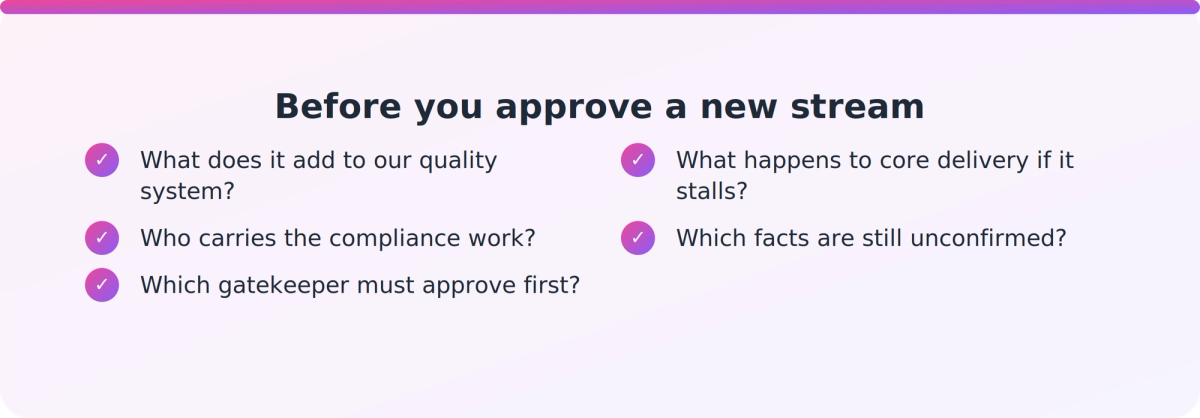
Before approving a new stream, ask for one page that answers the same questions for every option. Put it next to the margin forecast.
- What new obligations does this stream add to our quality management system and annual self-review?
- Who has to do that work, and what are they not doing while they do it?
- Which gatekeeper must say yes first: NZQA, an ISB, a Code signatory process, Immigration NZ?
- What happens to our core delivery if this stream underperforms or is paused?
- Which facts are still unconfirmed, and by when will we know?
If your team cannot answer these quickly, that is the finding. It means you lack a single view of what each stream adds to compliance load, and you are about to add more.
Key takeaways
- Under NZQA's Quality Assurance Rules 2026 (in force 19 January 2026), every stream sits inside one quality system with annual self-review.
- Sub-contracting and partnered delivery are now part of that wider quality assurance, so check the rules text before relying on secondary summaries.
- Test each growth option against compliance load and key-person strain, not margin alone.
- Each stream has its own gatekeeper: ISB endorsement (unconfirmed as a funding condition), Code of Practice signatory status, NZQA approval.
- Treat the proposed iQAF rating design as a planning risk, not a fact, until NZQA confirms it.
Our take
The sector conversation about 2026 is mostly about opportunity, and the opportunity is real. But the reset also makes the quality system the one asset every revenue line shares. That raises the price of getting governance wrong.
My position: no new stream should reach a board paper without a compliance-load estimate beside the margin line. If you cannot size the load, you are not ready to commit. Growth that thins out the people who hold your quality knowledge is not growth. It is borrowing against your regulatory standing.
I would also rather you pause a stream than approve it on unconfirmed assumptions. The ISB endorsement point and the post-12-month immigration position are both open. Wait for them where you can.
FAQ
Does a new revenue stream really affect my whole PTE's quality standing?
It can. The Quality Assurance Rules 2026 require an up-to-date quality management system and annual self-review across the organisation. Sub-contracting and partnered delivery now sit within that wider quality assurance, so a poorly governed stream is part of what you review and answer for.
Is ISB endorsement required before a programme is funded?
A TEC consultation document noted that a programme would not be funded without ISB endorsement. The research could not confirm whether this is in the final legislation. Verify it with TEC before building a funding model around it.
What do I need before enrolling international learners?
You must be an approved signatory to the Education (Pastoral Care of Tertiary and International Learners) Code of Practice 2021 before enrolling international students. Immigration NZ will keep using existing EER ratings for 12 months from early 2026. What applies after that is not yet clear.
Could a weak new stream affect my iQAF rating?
Possibly, but this is inference. A proposed design reported secondhand would use Highly Effective, Effective and Not Effective ratings across four weighted criteria. If adopted, weakness in one area could affect the overall rating. NZQA has not confirmed the final design in the material reviewed.
The first step this week is small. Pick your most promising growth option and write down, in one page, who in your organisation would carry its compliance load. If the answer is the same two names as always, you have your next conversation.