Single View of Business Performance: A PTE CEO's Test
12 October 2026 · 7 min read
Your board doesn't need a better dashboard. It needs to know whether the answer to "are we financially sustainable, compliant and ready to grow?" lives in a system or in one person's head. In 2026, with the PTE rules reset and no extra funding on offer, that is a governance question, not an IT one.
Why this lands on your desk
You answer to the board for growth, margin and regulatory standing. All three have been reshuffled at once.
The Private Training Establishment Rules 2026, made under section 452 of the Education and Training Act 2020, took effect on 19 January 2026. They replace the PTE Registration Rules 2025 and the PTE Enrolment and Academic Records Rules 2022, and they remove the annual fee (NZQA). Non-funded PTEs now provide annual financial returns biennially unless NZQA notifies otherwise.
The evidence your board uses to judge "are we in good standing?" has changed too. The 2026 rule changes remove references to external evaluation and review (EER). NZQA is replacing the Evaluative Quality Assurance Framework with iQAF for PTEs and institutes of technology and polytechnics.
The quality evidence has moved from event to ongoing
EER was an event. You prepared, you were reviewed, you got a rating. NZQA's September 2025 eQuate said the proposed iQAF recommended discontinuing the current consistency-assurance process from 1 January 2026.
The brief doesn't spell out how iQAF will work day to day, so treat what follows as my read, not NZQA's words. A model without a periodic review cycle puts more weight on what you can show, at any time, about your own quality. That favours PTEs whose evidence is already in one place.
If you enrol international students, there is a specific watch-point. Immigration New Zealand said it would keep using existing EER ratings for 12 months from early 2026 while NZQA transitions. That window is closing around now. We couldn't find INZ's position after the transition, so check with INZ directly rather than assume.
Funding: plan on none, and be ready to prove sustainability
TEC's 2026 Plan Guidance says additional funding is unlikely and providers should plan on none. It expects reprioritisation of existing funding. That puts the margin squeeze squarely on your side of the table.
The 2027–2029 Investment Plan Gazette notice goes further. It requires information that lets TEC judge financial sustainability in line with its published financial monitoring framework. Providers with $5 million or more in TEC funding also need a Council- or Board-approved Learner Success Plan and Disability Action Plan.
You will be asked for a coherent story of cost, margin and capacity. If producing it means three people, five spreadsheets and a fortnight of reconciling, the story will also be late and hard to defend.
The wider sector shows how fast financial strain reshapes things. Te Pūkenga staffing fell from 10,480 in 2023 to 9,625, and the Minister told a select committee disestablishment would not be completely equitable because insolvent entities cannot be stood up (RNZ).
The growth window after 2027 needs clear numbers
Te Pūkenga is being disestablished. Eight Industry Skills Boards were established on 1 January 2026, industry-led, with at least six of eight board members from industry. Work-based training sits temporarily with them, but they cannot enrol, manage or assess learners after 31 December 2027.
After that, new apprenticeship and traineeship programmes will be offered by industry-led private providers, polytechnics and wānanga (TEC consultation document). That is a real opening for a PTE.
It is also a decision that punishes guesswork. To say yes you need delivery cost per learner, trainer and assessor capacity, and an honest read on whether your quality system can carry the extra load. Fragmented data means you either move too slowly or commit blind.
Key-person risk is the real dashboard test
Here is the test I'd put to any CEO. Pick the one person who knows your compliance position best. If they were out for a month, could you still tell your board where you stand?
Sub-contracting is a live example. The rule has moved into the new Quality Assurance of Tertiary Education Providers Rules. SAARA, a secondary source, says PTEs must check what has to happen before delivery begins and the effect on their quality management system. Confirm that against the NZQA rules themselves. The point stands either way: knowledge like this tends to sit with one or two people.
That is why the "one dashboard" question belongs to the board. It isn't about screens. It is about whether the organisation's picture of itself survives a resignation.
What one trusted view should answer
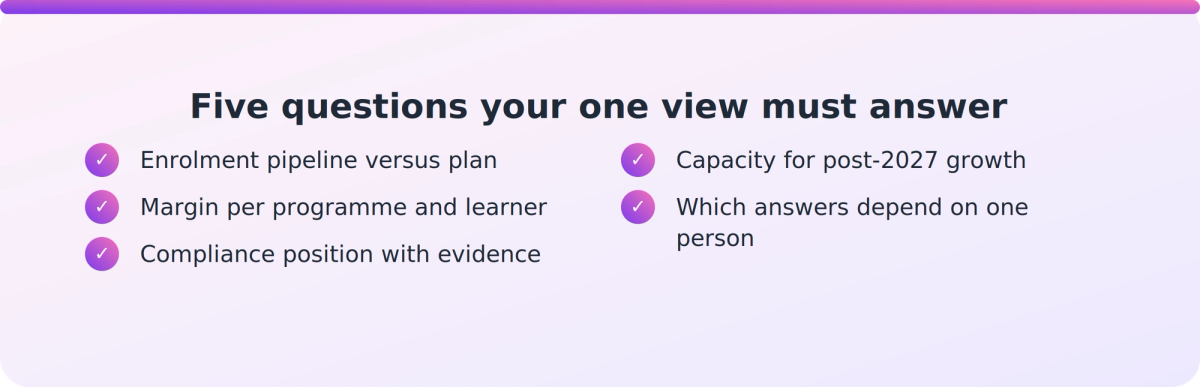
You don't need forty metrics. You need a short list you would stake a board paper on:
- Enrolments: where is the pipeline now, and how does it compare with what we planned?
- Margin: what does each programme cost to deliver per learner, and what does it return?
- Compliance: what is our current position against the PTE Rules 2026, and what evidence backs it?
- Capacity: can our people and facilities take on more, such as post-2027 work-based programmes?
- Dependency: which of these answers rely on one person to produce?
AI is your call, not the regulator's
NZQA's AI guidance is about assessment integrity. It recommends providers regularly review academic integrity policies for generative AI and support staff to understand its use in teaching, learning and assessment. NZQA also says it is exploring AI for better, faster, more consistent services, with an ethical and responsible focus.
The research found no NZQA rule mandating or prohibiting specific AI use in PTE back-office operations. That gives your board latitude, and with it responsibility, to set its own position on how technology helps build and maintain your view of the business.
Key takeaways
- The PTE Rules 2026 took effect on 19 January 2026, and EER is being replaced by iQAF, so the evidence behind "good standing" has changed.
- TEC says plan on no additional funding, and the 2027–2029 Investment Plan process asks for information to assess financial sustainability.
- After 31 December 2027, new apprenticeship and traineeship programmes move to industry-led private providers, polytechnics and wānanga. That is a growth opportunity that needs clear cost and capacity data.
- Key-person risk in compliance is a board-level issue, not an admin one.
- No NZQA rule found governs back-office AI use. Setting that approach is a leadership decision.
Our take
Most PTEs don't have a data problem. They have a dependency problem. The numbers exist, but the picture of how they fit together is held by whoever has been here longest.
A single view of business performance matters because it makes that picture portable, checkable and boardable. Whether you build it with a well-run spreadsheet model or something more sophisticated is secondary. What matters is that it is trusted, current and not hostage to one person.
A first step you can take this week: ask your board chair to pick one question from the list above and ask you to answer it live, without calling anyone. How long it takes, and who you reach for, tells you most of what you need to know.
FAQ
Does NZQA require a single dashboard or a particular reporting system under the PTE Rules 2026?
The research found no requirement of that kind. The PTE Rules 2026 set the registration and enrolment and records requirements. How you assemble evidence of financial health, compliance and delivery is a leadership decision.
What does TEC expect on financial sustainability?
The 2027–2029 Investment Plan Gazette notice requires information so TEC can judge financial sustainability in line with its published financial monitoring framework. TEC's 2026 Plan Guidance also tells providers to plan on no additional funding and to reprioritise existing funding.
Is external evaluation and review still part of the picture?
The 2026 rule changes remove references to EER, and NZQA is replacing the Evaluative Quality Assurance Framework with iQAF for PTEs and institutes of technology and polytechnics. International-student providers should check Immigration New Zealand directly. INZ said it would use existing EER ratings for 12 months from early 2026, and we found no stated position after that.
Why raise key-person risk at board level?
Compliance and training-management knowledge often sits with one or two people. With sub-contracting rules now in the Quality Assurance of Tertiary Education Providers Rules, and sector commentary urging PTEs to check their quality management systems, the board needs confidence that its position can be shown without relying on one person's memory.