Student Management System Integration NZ: A COO's Guide
13 October 2026 · 6 min read
Re-keying looks like a clerical habit, but for a PTE it is an operational risk with a deadline attached. Each time a learner record is typed into a second system, you add another place for it to drift. The TEC's Single Data Return (SDR) is where that drift finally shows.
Why this lands on your desk
You own the chain from enrolment to funding return. That means you answer for the SDR, even though the errors were made weeks earlier, in someone else's day.
The SDR is submitted in set windows, and the TEC's submission dates page (updated 15 April 2026) lists them: 16–29 April, 8–21 August, and 1–31 January the following year. Forecast EFTS goes in alongside the April, August and December returns. The windows don't move for a bad month. If a system export is late or a record is wrong, the problem lands on a fixed date.
Learner data in the SDR is also validated against National Student Index (NSI) data, and the extract date works as the "as-at" date for that data. Our reading, not a sourced finding, is that records entered slightly differently in different systems are most likely to surface at validation. That is the worst moment to be discovering them.
Where re-keying hides
No source we reviewed puts a dollar figure on re-keying, so we won't invent one. What we can say is where it tends to sit: in the gaps between tools that each do their own job well.
A typical path looks like this:
- An enquiry becomes an enrolment form.
- The enrolment is typed into the student management system.
- Key details are copied into a spreadsheet for the programme team.
- Results and credits are entered again for academic records.
- Someone rebuilds the lot into the SDR file.
None of those steps feels expensive on its own. Together they are a cost line that never appears in a budget. It shows up as staff time, as the quiet fix-up before each return, and as the capacity you don't have for improving anything.
It also ties to a pain you already know: process knowledge in people's heads. When the real workflow is "ask Sam, she knows which sheet is right", re-keying is how that knowledge gets stored.
Three clocks running on your records
The SDR cycle
Three returns a year is a steady, repeating load. If each one needs a clean-up sprint, you are paying for the same problem three times. Integration is also a practical option here, not a theoretical one. The TEC's SDR page lists Data Specifications for SDR 2026 v3.1 and points to an API portal covering how to submit data to the Data Exchange Platform (DXP) by API.
The NZQA rulebook
The Private Training Establishment Rules 2026 came into force on 19 January 2026. They replace the PTE Registration Rules 2025 and the PTE Enrolment and Academic Records Rules 2022, so enrolment and academic records requirements now sit in one rulebook. The rules also reference a quality management system under the Quality Assurance of Tertiary Education Providers Rules 2026. We haven't reviewed the detailed clauses, so check them yourself, but the direction is clear: documented, repeatable processes are part of what you answer for.
NZQA is also replacing the Evaluative Quality Assurance Framework (EQAF) with the integrated Quality Assurance Framework (iQAF). When your next review is framed around how your system works day to day, records that reconcile are easier to defend than records that need explaining.
If you enrol international learners, the Education (Pastoral Care of Tertiary and International Learners) Code of Practice 2021 adds another recurring evidence task. Self-review and attestations are due 1 November for PTEs and Wānanga. Confirm the current-year date with NZQA.
The sector reshuffle
From 1 January 2026, most Te Pūkenga programmes, functions, assets and staff transfer to regional polytechnics. Work-based training sits with Industry Skills Boards for up to two years. The TEC expects work-based learning in many sectors to move from those boards into providers during 2026.
No source quantifies what that means for PTE enrolments or competition, so treat it as a planning question rather than a forecast. If volume did rise, could your current processes absorb it without headcount rising in step?
Trace one record before the August return
The sound way to cost re-keying is to measure it yourself. It takes a week, not a project.
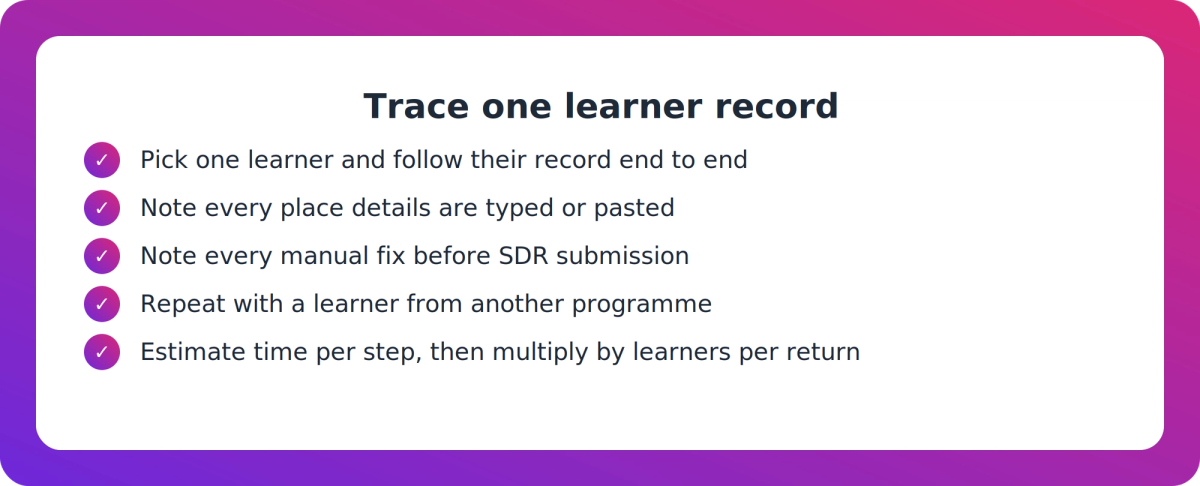
Pick one learner and follow their record from enrolment to SDR submission. Record every place their details are typed, pasted or re-checked by hand. Then repeat with a second learner from a different programme.
What you count tells you more than any vendor claim, and more than any benchmark we could quote.
Key takeaways
- Re-keying is an operational risk, not a clerical nuisance, because it sits underneath fixed TEC SDR windows (April, August, January).
- SDR learner data is validated against NSI data, so inconsistent entry across systems is most likely to be exposed at submission time.
- The PTE Rules 2026 (in force 19 January 2026) and the move to iQAF put documented, repeatable processes at the centre of compliance.
- The TEC publishes an API route to the DXP, so connected systems are a practical option and not a theoretical one.
- The research gives no cost figure for re-keying. Measure your own by tracing records from enrolment to SDR.
Our take
Most conversations about student management system integration in NZ start with technology. We think they should start with a stopwatch.
The sources are clear on the external pressures: fixed return windows, a new rulebook, a sector still being reorganised. They are silent on what duplicate entry costs any particular PTE. That is a good reason to find out before spending money on anything.
And the finding may be modest. Some PTEs will trace their records and discover re-keying happens in one or two places that a process fix alone can close. Others will find it everywhere. Either way you will know whether growth, or work-based learning arriving in 2026, means more people or just better flow.
Here is a first step that costs nothing: before the next return window opens, ask the person who prepares your SDR which fields they correct by hand every time. That list is your starting map.
FAQ
What is the SDR, and when is it due?
The Single Data Return is the set of data items the Ministry of Education and TEC require for funding, performance monitoring, publishing performance information and statistical reporting. The TEC lists return periods of 16–29 April, 8–21 August and 1–31 January the following year. Confirm current dates on the TEC's submission dates page.
Can a PTE submit SDR data through an integration instead of manual upload?
The TEC's SDR page points to an API portal with information on integrating with the TEC to submit data to the Data Exchange Platform (DXP) using an API. It also lists the SDR 2026 data specifications. Check the portal for the technical requirements that apply to you.
Do the PTE Rules 2026 require integrated systems?
The sources we reviewed don't say so. The rules came into force on 19 January 2026 and combine registration with enrolment and academic records requirements. They also reference a quality management system under the Quality Assurance of Tertiary Education Providers Rules 2026. Read the detailed clauses against your own processes.
How do I put a number on the cost of re-keying?
No source in our research quantifies it, so measure it internally. Trace several learner records from enrolment to SDR submission and count each point where data is entered more than once. Multiply by the time each step takes and the number of learners per return.