TAS Policy Version Control NZ: A Compliance Manager's Guide
30 September 2026 · 7 min read
Policy currency used to be a pre-audit clean-up. Under NZQA's 2026 model it is a standing obligation. The real test is no longer whether your policies are good. It's whether you can show, on any given day, which version of each one was in force, what it reflected, why it changed and who owns the next review.
Why this lands on your desk
The Quality Assurance of Tertiary Education Providers Rules 2026 came into force on 19 January 2026. They replace the Quality Assurance (including EER) Rules 2022. They require a quality management system that is created, maintained, kept up to date and given effect across all aspects of your education or training business.
You are the person who has to show that's true in practice, not just on paper. NZQA can ask for a copy of the system on request. There is also no scheduled EER to prepare for, because from 1 January 2026 NZQA stopped starting new EER processes. Reviews already underway will be completed.
That removes the deadline that used to organise your year. Audit-readiness becomes a permanent state, and a permanent state needs a mechanism, not a sprint.
The annual pressure point is the self-review. Providers must conduct an organisational self-review each calendar year. From July 2026, non-university tertiary providers submit a TEO self-review summary report covering context, areas of interest to NZQA, a quality improvement plan and rules compliance. NZQA then meets each TEO annually to discuss it. Someone will ask you to substantiate the compliance statements in that report. Code self-review reporting is combined into the same submission, and the Code attestation is signed or authorised by the CEO, Principal or Chair of the Governing Board. That person is relying on your records being right.
Why an annual policy refresh no longer works
The old rhythm was simple. Review everything before the evaluation, fix what's stale, file the evidence. That only works when the target date is known and the ground stays still.
Neither is true now. Several things are moving at once:
- Standards-setting. Legislation passed in October 2025 disestablished Te Pūkenga and established 10 regional polytechnics and eight Industry Skills Boards from 1 January 2026. The boards set training standards, endorse programmes and moderate assessments. The work-based training transition period runs from 2026 to the end of 2027.
- Rule locations. According to SAARA (industry commentary, not the regulator), sub-contracting requirements were removed from the Programme Approval, Recognition, and Accreditation Rules and now sit in the 2026 QA Rules. If you sub-contract, read the rule text yourself.
- Guidance. NZQA has said it will keep engaging with providers through 2026 on detailed changes, and templates and guidance are still being issued.
- Reporting. The PTE Rules 2026 change the PTE annual financial return to biennial unless NZQA notifies otherwise.
A policy set refreshed once a year is out of date for most of the year. You won't see it happen, because nothing announces the moment a document stops matching its source.
The version record that answers any question
The answer to that drift is a version record that does more than store files. For every policy, procedure and TAS-type document in your system, you want to be able to answer five questions without a hunt through drives and inboxes.
What a defensible record holds
- Which version applied on a given date. Version number, effective date and superseded date.
- What it reflected. The rule, standard or NZQA guidance it was aligned to, and the date of that source. This matters most while templates and guidance are still changing.
- Why it changed. A one-line reason: a rule change, a self-review finding, a complaint, a moderation outcome.
- Who approved it. A named person, not a committee label.
- Who owns the next review, and when. A named owner and a date.
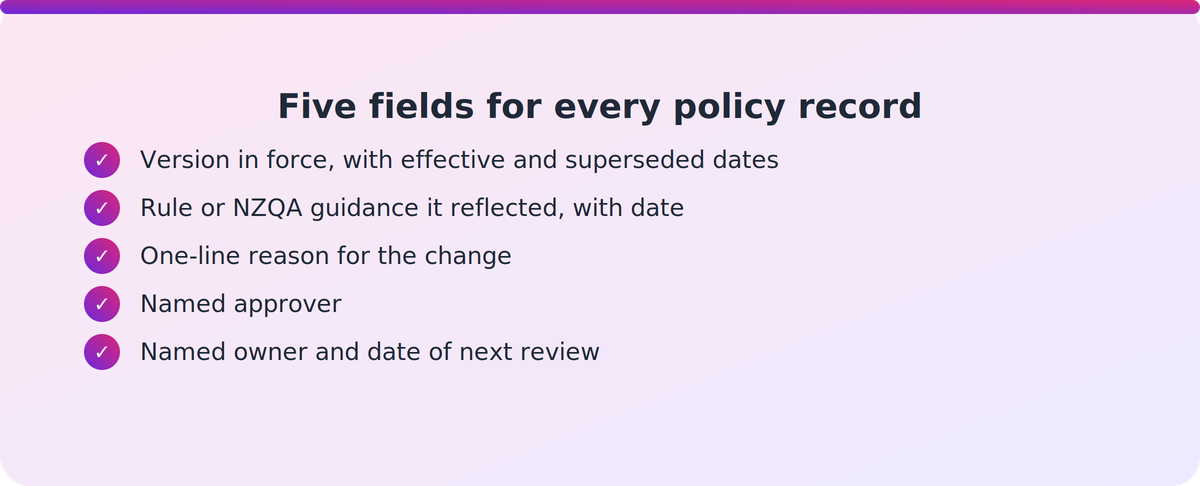
The second item is the one most providers lack. If a document says "aligned to NZQA guidance" but not which issue or date, you can't tell whether it went stale or was simply never updated. A dated alignment note turns a vague claim into evidence.
The QA Rules also specify what the system must include: coherent policies and procedures for developing and implementing the system, organisational self-review, enrolment procedures and meeting the relevant requirements of the Pastoral Care Code. Start your register there. Providers without a system on 1 January 2026 must have one before 1 January 2027, so if you're in that position, the register is also your build plan.
Where currency quietly slips
In our experience, policies rarely go out of date in the big, obvious ways. They slip at the edges.
Standards ownership moves. If your programmes were tied to a Workforce Development Council's standards, check who now sits behind them. Note the date you checked and what you found.
Copies multiply. A policy gets saved into a staff handbook, a learner handbook and a sub-contractor pack. One is updated; the others aren't. Keep one controlled source and treat every other copy as a pointer.
You become the bottleneck. If every change routes through you for review, changes queue up and people work around you. Name a content owner for each policy and reserve your review for the high-risk ones. Your job is the register and the trigger, not writing every word.
Pending changes get ignored. NZQA consulted on an overall quality rating with three descriptors (Highly Effective, Effective, Not Effective), assessed against four weighted criteria including quality management systems. Consultation closed on 7 September 2026, and we found no outcome in the sources reviewed. Immigration New Zealand will keep using existing EER ratings for 12 months from early 2026, and what it uses afterwards wasn't in those sources. You can't prepare for a rule you can't see, but you can log it as a watched item with an owner.
A first step this month
Pick your five highest-risk documents. Enrolment, self-review, pastoral care and any sub-contracting arrangements are good candidates. For each, fill in the five fields above. Where you can't, you've found your real exposure, and you've found it on your own timetable rather than NZQA's.
Key takeaways
- The Quality Assurance of Tertiary Education Providers Rules 2026 (in force 19 January 2026) require a quality management system that is kept up to date and given effect, and NZQA can request a copy.
- With no new EER cycles, audit-readiness must be continuous. The annual organisational self-review and the TEO self-review summary report are the checkpoints.
- Standards-setting is moving to Industry Skills Boards, and NZQA guidance is still being issued, so every policy needs a dated record of what it was aligned to.
- A defensible record shows the version in force, its source, the reason for change, the approver and the next review owner.
- Spread ownership across content owners. Reserve your own review time for high-risk documents.
Our take
Most compliance teams treat version control as admin. We think it's the core of the job now. When NZQA meets you annually to discuss your self-review, the strongest thing you can offer isn't a polished policy. It's a clean history showing you noticed a change, acted on it and recorded why.
The framework is also still in flux, and that's the point. A provider that can show a dated, owned trail through an unsettled year will be in a far better position than one with a perfect manual that nobody can date. Judge your system by how fast you can answer "which version applied on this date?", not by how good your documents look.
FAQ
Do we still need to prepare for an EER?
Not as a scheduled event. From 1 January 2026 NZQA stopped starting new EER processes and assuring consistency reviews, though those already underway will be completed. The annual self-review and the self-review summary report now set the rhythm.
What must our quality management system cover?
Under the Quality Assurance of Tertiary Education Providers Rules 2026, it must cover all aspects of your education or training business. It must include coherent policies and procedures for developing and implementing the system, organisational self-review, enrolment procedures and meeting the relevant requirements of the Pastoral Care Code. You must give NZQA a copy on request.
How often do we have to review policies?
The Rules require the system to be kept up to date and given effect, and require an organisational self-review each calendar year. We found no fixed review interval for each policy in the sources reviewed, so set review dates by risk and trigger a review whenever a rule, standard or guidance changes.
What should we do about pending changes like the overall quality rating?
Consultation on the rating closed on 7 September 2026 and we found no outcome. Track it as a watched item with a named owner and a check date, and update your documents only when NZQA confirms the detail.