Trainer Currency in NZ: Proving It Without a Paper Chase
12 August 2026 · 8 min read

Trainer Currency in NZ: Proving It Without a Paper Chase
NZQA no longer turns up every few years to check your trainers are current. From 1 January 2026 it wants an annual self-review report instead, which moves the burden of proof from a periodic audit to something you need on hand at any moment, for any trainer, against whatever version of a standard was live when the assessment happened.
Why this lands on your desk
You own the self-review summary report and the improvement-plan discussion NZQA now expects in place of external evaluation and review. That's not a compliance team job — it's yours, because it rests on evidence that assessment judgements are fair, valid and consistent across every trainer you manage.
You're also the one who signs off the annual assessment plan for national external moderation, at the exact moment responsibility for moderating industry-specific unit standards is shifting from Workforce Development Councils to Industry Skills Boards. For a year or two, you may genuinely not know which body to report a moderation outcome to, or which version of a standard it applies against.
Layer on real staffing pressure — restructuring at Wintec, Whitireia, WelTec and Toi Ohomai has already meant unfilled roles with duties absorbed by whoever's left — and you're being asked to prove more, continuously, with fewer hands than before.
What iQAF actually replaces — and what it doesn't
NZQA's integrated Quality Assurance Framework went live on 1 January 2026. No new external evaluation and review or consistency reviews are being initiated; anything already underway will run to completion, but the annual self-review summary report and an improvement-plan conversation with NZQA is now the standing mechanism.
The Programme Approval, Recognition, and Accreditation Rules 2026, in force from 19 January 2026, revoke the Quality Assurance (including EER) Rules 2022 and strip out references to external evaluation and consistency. Sub-contracting and endorsement requirements are simplified too. On paper, this looks lighter.
It isn't lighter where it matters most for a Head of Training. National external moderation still applies in full. If you hold consent to assess, you still submit an accurate annual assessment plan and still need to produce evidence that your trainers' judgements are fair, valid and nationally consistent, tied to the Consent and Moderation Requirements for each standard on the Directory of Assessment and Skill Standards. The audit event disappeared. The underlying obligation to prove trainer currency and assessment consistency didn't — it just moved onto your desk permanently, rather than visiting once every few years.
The moderation handover you can't wait out
Here's the part that makes trainer currency a moving target through 2026–2028, not a fixed compliance checkbox.
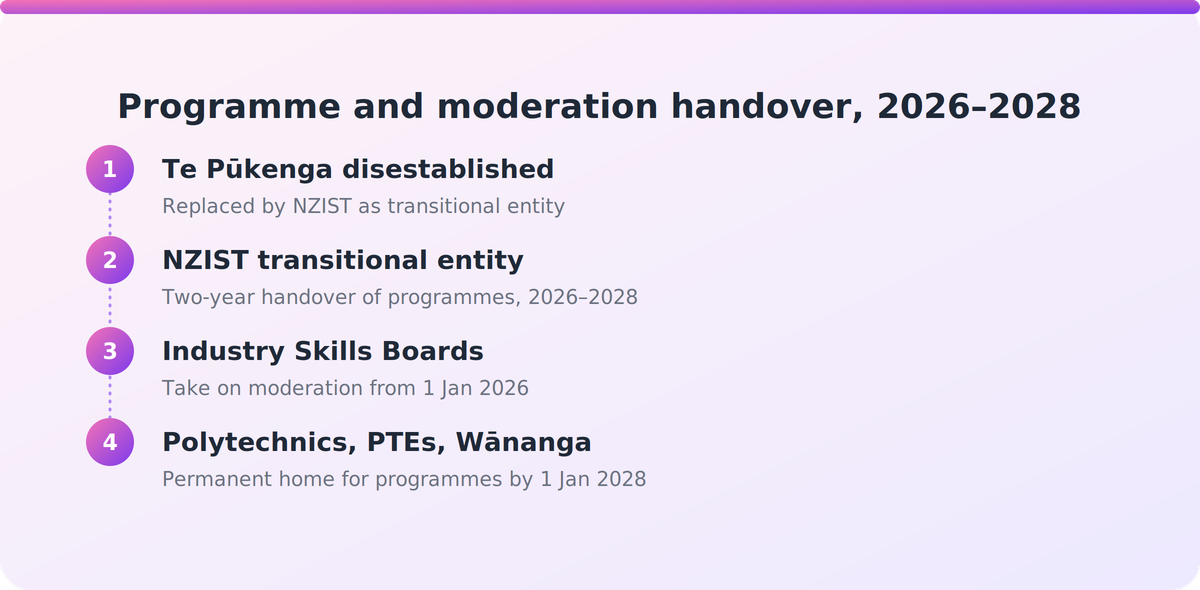
Te Pūkenga has been disestablished and replaced by NZIST, which is acting as a two-year transitional entity to hand programmes onward. From 1 January 2026, ten regional polytechnics and eight Industry Skills Boards became operational, with the ISBs taking on responsibility for work-based learning divisions and moderation of industry-specific unit standards. But the ISBs are themselves transitional — every programme and enrolment they hold is required to shift to polytechnics, Private Training Establishments or Wānanga by 1 January 2028.
Practically, that means the standard your assessors are working to, and the body that will moderate the outcome, can both change mid-cycle. You can't treat "which version was current" as a settled fact you check once a year. It's a live variable for the next two years at least, and government framing of the ITP sector's financial position suggests structural change is likely to keep going rather than settle any time soon.
Workload risk is documented, not anecdotal
This isn't a theoretical burden. Wintec, Whitireia, WelTec and Toi Ohomai had already made significant cuts ahead of Te Pūkenga's disestablishment. The Tertiary Education Union's national secretary has noted that where roles went unfilled, their duties fell to remaining staff. If your response to the new self-review model is to reconstruct trainer currency evidence once a year from scratch, you're handing that reconstruction job to trainers who are already covering gaps.
The sector delivers to roughly 250,000 learners a year, split between on-campus and online delivery through polytechnics, PTEs and Wānanga, and work-based training through apprenticeships and traineeships. Whatever evidence approach you build has to hold up across both modes — a moderation file that only works for classroom delivery is only half a solution.
From annual reconstruction to continuous evidence
The providers who cope well with this won't be the ones with the tidiest folder once a year. They'll be the ones who treat currency evidence as a by-product of everyday delivery, not a separate project.
A few things worth doing this quarter, none of which require new tools:
- Log the standard version at the point of assessment, not the point of review. If a standard's CMR changes hands from a Workforce Development Council to an Industry Skills Board mid-year, you want a timestamp showing what was current when the judgement was made.
- Assign a named owner per standard or standard family — someone who tracks which body currently holds moderation responsibility for it, so nobody's guessing in March.
- Turn self-review into a running log, updated as moderation outcomes land, rather than a document someone builds in the week before the NZQA conversation.
- Sample assessor consistency routinely, in small batches, rather than waiting for an annual push that pulls every trainer off delivery at once.
None of this removes the underlying workload. But it spreads it across the year, in small increments, instead of concentrating it into a crunch that lands on whoever's still standing after the next restructure.
Key takeaways
- NZQA's iQAF (live from 1 January 2026) replaces external evaluation and review with an annual self-review summary report and improvement-plan discussion — a standing obligation, not a periodic event.
- The Programme Approval, Recognition, and Accreditation Rules 2026 removed EER language, but national external moderation — accurate assessment plans, evidence of fair, valid and consistent assessor judgements against each standard's CMR — still applies in full.
- Moderation of industry-specific unit standards is moving from Workforce Development Councils to Industry Skills Boards, which are themselves transitional until programmes and enrolments shift to polytechnics, PTEs or Wānanga by 1 January 2028.
- Documented staffing cuts at Wintec, Whitireia, WelTec and Toi Ohomai mean the workload of proving currency is landing on fewer people — build evidence continuously, not as an annual reconstruction.
- Evidence needs to work across both delivery modes serving the sector's roughly 250,000 learners a year: on-campus/online and work-based training.
Our take
The shift away from periodic external review looks, on the surface, like less oversight. It isn't. It's oversight that never switches off. A Head of Training who treats the annual self-review report as a document to be assembled once a year is setting themselves up to fail it — because by the time you sit down to write it, the standard versions, the moderating body and possibly the trainer who did the work may all have changed. The providers who come through this transition well will be the ones who stopped thinking of trainer currency as something you prove in March, and started treating it as something you can show on any random Tuesday, for any trainer, against whatever standard version was actually live at the time.
FAQ
Does NZQA still audit trainer currency directly? No new external evaluation and review or consistency reviews are being initiated under the iQAF, which went live 1 January 2026. Anything already underway completes, but new oversight runs through an annual self-review summary report and an improvement-plan discussion with NZQA instead.
Has national external moderation changed? Not in substance. Providers holding consent to assess still submit an accurate annual assessment plan and must provide evidence that assessor judgements are fair, valid and nationally consistent, tied to each standard's Consent and Moderation Requirements on the Directory of Assessment and Skill Standards.
Who moderates industry-specific unit standards now — Workforce Development Councils or Industry Skills Boards? Industry Skills Boards took over responsibility for work-based learning divisions, including moderation of industry-specific unit standards, from 1 January 2026. But ISBs are transitional: all their programmes and enrolments must move to polytechnics, PTEs or Wānanga by 1 January 2028, so the reporting line may shift again within this window.
What happened to Te Pūkenga, and does it affect programme ownership? Te Pūkenga was disestablished and replaced by NZIST, which is acting as a two-year transitional entity handing programmes onward. From 1 January 2026, ten regional polytechnics and eight Industry Skills Boards became operational, meaning ownership of programmes and standards is actively in motion, not settled.