Trainer Retention Is a Margin Lever, Not an HR Problem
29 September 2026 · 7 min read
Ask a CEO in vocational training why a senior trainer just resigned and most will call it a labour-market problem, nothing to do with strategy. That's the wrong read. From 2026, the assessment and moderation knowledge that trainer carries is exactly what NZQA expects you to demonstrate continuously — and losing it mid-reform is a compliance and growth risk, not a staffing gap.
Why this hits your desk
Two things changed at once for New Zealand's training providers, and neither sits comfortably in the people team's lane.
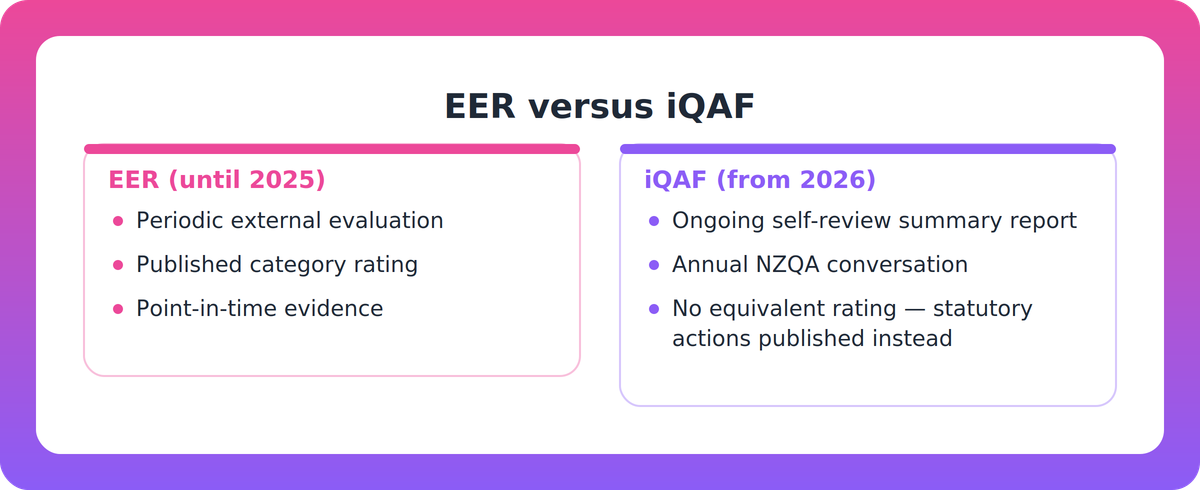
First, from 1 January 2026, NZQA's integrated Quality Assurance Framework (iQAF) replaces External Evaluation and Review (EER). No new EERs will be conducted. Instead, providers submit a self-review summary report and take part in an annual conversation with NZQA. That shifts the evidence base for your regulatory standing from a periodic external snapshot to an ongoing internal capability — the kind of capability that lives in your trainers' heads, not just your policy folders.
Second, the Education and Training (Vocational Education and Training System) legislation passed in October 2025 disestablished Te Pūkenga, renamed it the New Zealand Institute of Skills and Technology (NZIST) as a transitional entity, established 10 regional polytechnics, and replaced Workforce Development Councils with Industry Skills Boards from 1 January 2026. Work-based learning is now open to a wider field of providers, PTEs included. That's a growth opportunity if you're chasing it. But TEC's own work-based learning consultation material is explicit: providers taking on new programmes will likely need additional investment in systems, processes and people, and government needs confidence a provider is appropriately prepared. Trainer capacity isn't a footnote to that decision — it's the gate.
There's a sharper edge if international enrolments matter to your revenue. Immigration New Zealand has confirmed it will keep using existing EER category ratings for visa purposes for 12 months from early 2026, even as the sector moves to iQAF. Your provider is effectively judged on two systems at once through the transition — a legacy rating that can't be refreshed, and a new self-review regime still bedding in. Any wobble in delivery consistency during that window carries more weight, not less.
What instability actually costs
Otago Polytechnic's experience during the Te Pūkenga transition is worth sitting with, not because your provider is the same size or shape, but because it shows the direction the risk travels. Financial pressure during the reform led to internal restructuring and a chief executive resignation, with a new CEO only appointed in mid-December 2025. Instability at the top unsettles the workforce underneath it. It works in reverse too: trainer churn destabilises the compliance and financial picture your board is judging you against. Whichever direction it starts from, leadership and workforce stability move together — and a board rarely cares which one moved first.
From external snapshot to continuous self-review
Under EER, a provider's compliance reputation was set periodically, by an external category rating that everyone could see. Under iQAF, NZQA has confirmed the rating won't be replaced with an equivalent. Instead, NZQA will publish information about statutory actions taken for non-compliance. That's a meaningful shift in how risk becomes visible. A dropped category rating was bounded and public. Internally-driven quality drift, surfacing only once it forces statutory action, is not something you want your board or a funder discovering after the fact.
Assessment quality now has a new upstream owner
Under the reformed governance model, Industry Skills Boards are responsible for setting standards, endorsing programmes and moderating assessments from 1 January 2026. Trainer expertise sits directly upstream of your ability to demonstrate consistent assessment quality to the body now writing the rules. Losing an experienced trainer isn't only a delivery gap. It's a gap in the evidence trail you'll need to show the Industry Skills Board that oversees your qualifications.
The benchmark you don't have
Here's the uncomfortable part: there is no published New Zealand benchmark for trainer or tutor turnover in the PTE or ITP sector. The closest available reference point is the secondary-teacher retention rate — 88.5% in 2024, projected to rise to 90.5% by 2026 — but that's a school-sector figure and should be treated as a loose comparison only, never as a vocational-sector fact.
That gap matters for how you make decisions. Without a sector instrument panel, internal visibility into your own trainer stability is a safer basis for any growth or margin call than assuming your provider looks like the sector average, because there isn't a reliable sector average to compare against.
Questions worth asking this quarter
You don't need a sector benchmark to get a clearer read on your own exposure. A few internal questions will tell you more than any external number could:
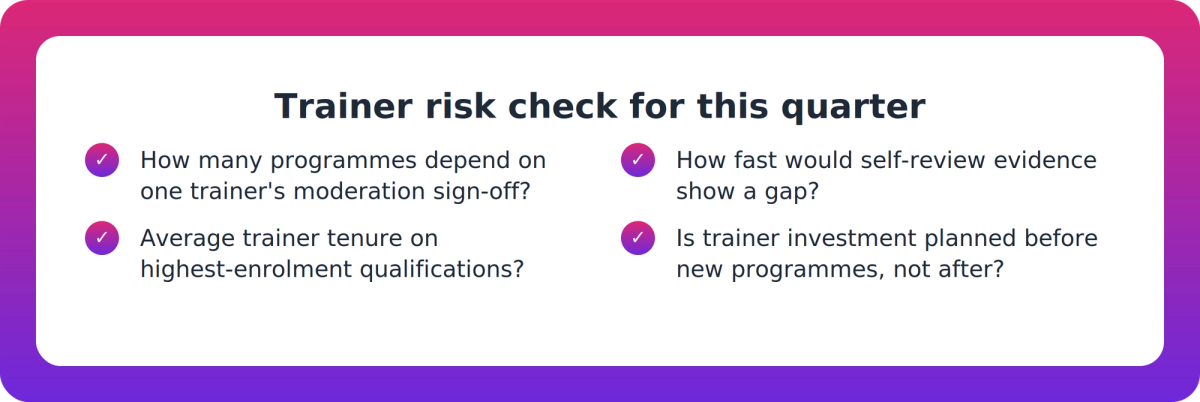
- How many current programmes depend on one trainer's moderation sign-off?
- What's the average tenure of trainers delivering our highest-enrolment qualifications?
- If our most experienced trainer left tomorrow, how quickly would that show up in our self-review evidence?
- Are we investing in trainer capacity before we commit to a new programme, or scrambling to catch up afterwards?
Key takeaways
- From 1 January 2026, iQAF replaces EER: providers submit an ongoing self-review summary report and take part in an annual NZQA conversation, making trainer knowledge a continuous compliance asset rather than a point-in-time one.
- NZQA won't replace EER category ratings with an equivalent; it will instead publish statutory actions for non-compliance, so internally-driven quality drift is now the harder risk to spot early.
- Immigration New Zealand will keep using legacy EER ratings for visa purposes for 12 months from early 2026, meaning international-facing providers are judged on two systems at once during the transition.
- TEC's own work-based learning guidance says new programmes require investment in people as well as systems, putting trainer capacity directly in the path of growth decisions under the widened, contestable market created by the disestablishment of Te Pūkenga.
- No NZ-specific benchmark exists for trainer or tutor retention in PTEs or ITPs, so internal visibility — not assumption — is the safer basis for margin and growth decisions.
Our take
Treating trainer retention as an HR metric made sense under EER, when the evidence that mattered arrived in one external snapshot every few years. It doesn't make sense under iQAF, where your regulatory standing is built continuously from the knowledge your trainers hold about assessment and moderation. We'd put average trainer tenure, by qualification, on the same board report as enrolment and margin figures — not because it's a nice culture metric, but because it's now one of the clearest early warnings you have of audit and delivery risk. Otago Polytechnic's transition shows what happens when nobody's watching that line until it's already a headline.
FAQ
What exactly changes when iQAF replaces EER on 1 January 2026? No new EERs will be conducted from that date. Providers instead submit a self-review summary report and take part in an annual conversation with NZQA, and EER category ratings will not be replaced with an equivalent — NZQA will publish information about statutory actions for non-compliance instead.
Does the reform change international student visa risk immediately? Not immediately. Immigration New Zealand has confirmed it will keep using existing EER category ratings for visa purposes for 12 months from early 2026 during the iQAF transition, so providers with international enrolments are effectively assessed against two systems at once for that period.
Is there a published benchmark for trainer turnover in NZ PTEs or ITPs? No NZ-specific public data was found quantifying trainer or tutor turnover or retention in the PTE or ITP sector. The closest reference point is the secondary-teacher retention rate — 88.5% in 2024, projected to rise to 90.5% by 2026 — but that's a school-sector figure and should be used only as a loose, non-equivalent comparison.
How does the vocational reform change who can deliver work-based learning? The Education and Training (Vocational Education and Training System) legislation passed in October 2025 disestablished Te Pūkenga, established the New Zealand Institute of Skills and Technology (NZIST) as a transitional entity, created 10 regional polytechnics, and replaced Workforce Development Councils with Industry Skills Boards from 1 January 2026. Work-based learning can now be offered by any provider that meets requirements, widening the field for PTEs and ITPs alike.
Worth putting one extra line in this quarter's board pack: average trainer tenure by qualification, sitting next to your enrolment and margin figures. It costs nothing to add, and it will likely tell you more about your regulatory exposure than your last audit did.