Trainer Workload Planning for Heads of Training in NZ
30 September 2026 · 6 min read
Most timetables are built around rooms and cohort start dates. In 2026 the scarcer resource is trainer time, and some of the heaviest demands on it, such as assessment planning, moderation and resource management, never appear on a room-booking grid. Schedule trainer capacity first, then place cohorts inside it.
Why this lands on your desk
You own the trainers and the timetable, so you also own the gap between them. NZQA's external moderation requirements turn straight into calendar commitments. A TEO with consent to assess must provide an accurate annual assessment plan, meet moderation deadlines, supply assessment materials and evidence, and nominate a moderation liaison.
The compliance clock adds pressure. NZQA's Quality Assurance of Tertiary Education Providers Rules 2026 replace the 2022 rules. They require a quality management system that covers assessment and moderation, plus programme and micro-credential management, including resources. A provider without a compliant system on 1 January 2026 needs one before 1 January 2027. You're likely to be asked to show that the timetable supports those functions.
Funding tightens the margin. TEC's 2026 rates for Levels 3–7 combine targeted-area increases (3% from Budget 2025 and 2% for VET) with a 10% decrease for all work-based delivery. When the rate falls, idle or misallocated trainer time is harder to absorb.
What a room grid can't see
A room grid answers one question: is the space free? It says nothing about whether the person teaching in it also has time to design an assessment, prepare evidence for moderation or check a resource. Three kinds of load tend to hide.
Internal moderation
NZQA says internal moderation must be embedded in every TEO's quality management system. It doesn't prescribe how you manage it. That leaves you to decide how much trainer time internal moderation gets and where it sits in the calendar. If it isn't a fixed block, it becomes whatever is left over on a Friday afternoon.
External moderation and the assessment plan
Assessment plans must state which standards will be assessed in the next academic year and when materials will be available for moderation. That is a promise made in advance, and your trainers have to keep it. A cohort start date that lands the assessment-design work in the same fortnight as peak delivery puts that promise at risk.
Consent and Moderation Requirements
CMRs set conditions on the skills and knowledge of teachers and assessors, special resources, learner access to resources, practical experience and national external moderation. Check the CMR for each standard you deliver. Some of those conditions decide who can be timetabled where, and a timetable that fills rooms but ignores them puts assessment validity at risk.
The Programme Approval, Recognition and Accreditation Rules 2026 make the same point from the other side. The assessment criterion is fair, valid, consistent and appropriate methodology, backed by an effective system for moderating materials and decisions. A timetable with no room for assessment design and moderation works against that criterion.
A capacity-first sequence you can run this quarter
The research doesn't give a figure for how many trainer hours moderation or assessment planning takes. You'll need to measure that in your own organisation. The sequence below works without the number.
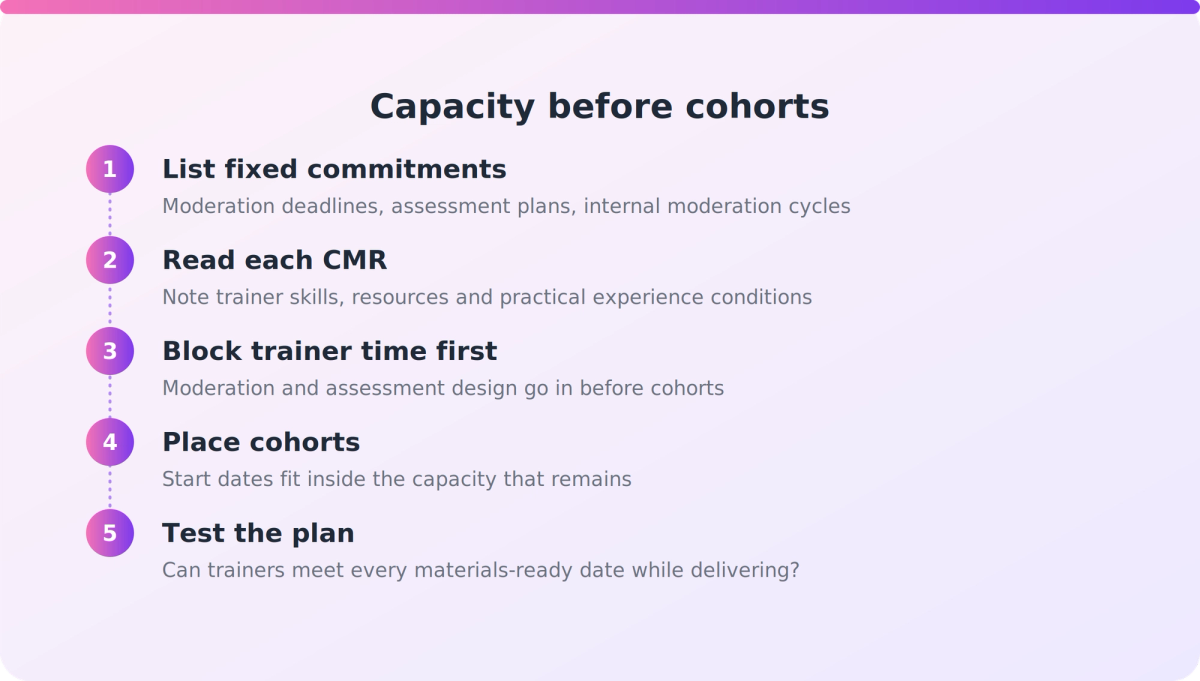
- List the fixed commitments. Write down every moderation deadline, assessment-plan submission and internal moderation cycle for the next academic year.
- Read the CMR for every standard. Note the trainer-related conditions: skills, knowledge, practical experience, resources.
- Block that time first. Put moderation, materials preparation and assessment design into trainer calendars before any cohort is scheduled.
- Place cohorts in what remains. Start dates become an output of capacity rather than an input.
- Test the result. Ask whether each assessment-ready date in your plan is one your trainers can meet while still delivering.
This also gives you something concrete to show NZQA. A calendar with moderation blocked in advance is visible evidence that assessment, moderation and resourcing are planned, not squeezed in.
Plan for a moving sector
The ground is still shifting. Te Pūkenga was disestablished and 10 regional polytechnics and eight Industry Skills Boards were established from 1 January 2026. One Industry Skills Board's 2026–27 operational plan says its policy frameworks are under comprehensive review, with a focus on alignment across the eight boards.
I haven't verified the current position for every board. The practical point is that moderation requirements and contacts may keep changing. Leave slack around moderation windows, and assign one person to track changes from the relevant board rather than relying on whoever happened to get the last email.
Budget 2025 also provides up to $10 million per annum for strategically important VET provision at institutes of technology and polytechnics over 2026 and 2027. Whatever your provider type, expect trainer time to be watched more closely.
Key takeaways
- Room availability is the easy constraint. Trainer time, including moderation and assessment design, is the binding one.
- NZQA's 2026 rules require assessment, moderation and resource management to sit inside your quality management system, with a compliant system due before 1 January 2027 for providers that didn't have one.
- External moderation obliges you to state in advance what you'll assess and when materials will be ready. Timetable accordingly.
- Check the CMR for every standard delivered. Trainer conditions are timetable constraints.
- With a 10% decrease in 2026 rates for work-based delivery, misallocated trainer time is harder to absorb.
Our take
The usual debate is whether the timetable is efficient. The better question is whether it is honest. A timetable that shows every room full and every cohort on schedule, while the moderation and assessment work is absorbed by trainers' evenings, is not efficient. It has moved the cost somewhere you can't see it.
That hidden cost shows up later as burnout, inconsistent assessment and learner-progress surprises. Treat moderation and assessment as fixed commitments, the same as a booked classroom. Some cohorts will start later than you'd like, and that is a fair price for assessment that holds up.
FAQ
What does trainer workload planning mean for vocational training in NZ?
It means scheduling trainer time for all the work the quality system requires, not only for contact hours. That includes assessment design, internal moderation, external moderation obligations and resource management, all of which NZQA's 2026 rules expect to sit inside the quality management system.
Does NZQA tell TEOs how much time to give internal moderation?
No. NZQA says internal moderation must be embedded in every TEO's quality management system but does not prescribe how TEOs manage it. The decision on time and calendar placement is yours.
What must a TEO with consent to assess do for national external moderation?
It must provide an accurate annual assessment plan, meet moderation deadlines, supply assessment materials and evidence, and nominate a moderation liaison. The plan must state which standards will be assessed in the next academic year and when materials will be available for moderation.
How do Consent and Moderation Requirements affect the timetable?
CMRs can set conditions on the skills and knowledge of teachers and assessors, special resources, learner access to resources and practical experience. Checking the CMR for each standard shows which trainer-related conditions your timetable must respect.
Next time you lock a start date, ask one question first: which trainer is doing the moderation work for that cohort, and in which week?