Training Material Version Control for PTE Heads of Training
6 October 2026 · 7 min read
Delivery consistency isn't won in moderation. It's won weeks earlier, when one current version of the materials, assessment plan and marking guidance either reaches every trainer or doesn't. If you only find variation at moderation, you've found it too late. For a PTE, training material version control is a quality decision, not an admin chore.
Why this lands on your desk
You own the quality of delivery and assessment. NZQA's Programme Approval, Recognition, and Accreditation Rules 2026 expect assessment methodology that is fair, valid, consistent and appropriate to the stated learning outcomes. They also expect an effective system for moderating assessment materials and decisions. When two trainers work from two versions, you are the one who explains the gap.
The ground is also moving. NZQA's new iQAF applies to PTEs, wānanga, polytechnics, industry skills boards and government training establishments. NZQA's 2026/27 Statement of Performance Expectations says the design was completed in 2025/26 and implementation is planned for 2026/27. Consistency reviews are discontinued from 1 January 2026, and external evaluation and review is being replaced by self-review and monitoring.
That shifts the burden. More of the proof that your assessment is consistent has to come from your own systems, not from an external visit.
Then there's TEC. Its 2026 Plan Guidance signals limited Vote Tertiary Education funding and reduced funding or disinvestment for low-performing provision, with a focus on retention and qualification completion. B2B News, a secondary source citing official data, reports that levels 4–7 non-degree qualifications have the lowest completion rate in the system at 56%. Check that against Ministry of Education data before you quote it. Even so, the direction of travel is clear.
What NZQA says, and what it doesn't
Let's be straight about the gap. We found no NZQA rule that specifically requires version control of training materials. Nobody will audit you on a naming convention.
But NZQA's national external moderation principles define consistency as assessor judgements being reliable and accurate across all learners, regardless of who does the assessing or when the assessment occurs. That is "one trainer, one version" written as a regulatory principle. You can't meet it if trainers are marking against different guidance.
Two other obligations make the point practical:
- Providers with consent to assess must take part in national external moderation. They must also give NZQA an accurate annual assessment plan, updated during the year if required.
- For PTEs, learner assessment materials must be retained for moderation under the PTE Enrolment and Academic Record Rules. Knowing which version a learner was assessed against is part of that evidence trail.
No rule says "control your versions". The moderation and consistency requirements make it a practical necessity anyway.
Where version drift does its damage
Before the assessment, not after
NZQA's internal moderation guidance advises moderation both before and after assessment. That feeds back to assessment writers, assessors and programme developers. Pre-assessment moderation is where version discipline pays off, because you are checking that the task, the marking guidance and the intended standard line up before a single learner is marked.
If a revised task reaches half your trainers, post-assessment moderation will show variation. It won't show you why.
Across sites and trainers
The same guidance says that where assessment is delivered at several sites, learner samples should be selected from each location to check marking consistency across assessors. Sampling by site is useful. It's also expensive to run if the underlying problem is that Site B still has last term's marking schedule.
The cheapest consistency check you have is making sure everyone starts in the same place.
Rework you never see
Version drift rarely shows up as a crisis. It shows up as re-marking, learners told to resubmit, and a trainer's Friday spent reconciling two documents. That cost lands on people already stretched. A cross-sector CTU Mood of the Workforce 2026 survey, reported by the Tertiary Education Union, points to understaffing, excessive workloads and burnout. It isn't vocational-specific, so treat it as context rather than proof. But it means any fix has to remove work, not add a new sign-off step.
Four moves you can make this quarter
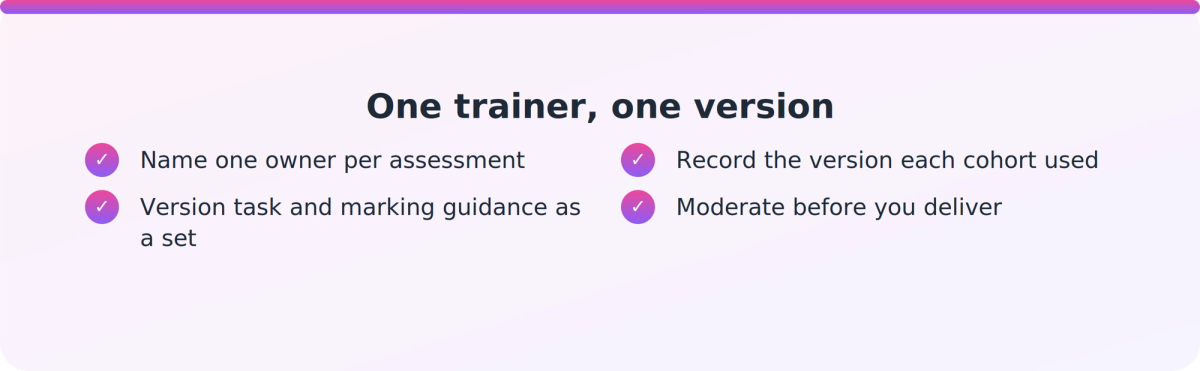
- Name one owner per assessment. One person decides what the current version is. Everyone else pulls from there, not from an email thread or a USB stick.
- Pair the task with its marking guidance. Version them as a set. A new task with old guidance is the most common way for trainers to drift apart.
- Record the version used. For each cohort, note which version of the materials and assessment plan applied. That gives you a clean answer when moderation asks.
- Moderate before you deliver. Use pre-assessment moderation as your release gate. Nothing goes to trainers until it has passed.
A moving target upstream
Standard-setting is shifting too. Eight Industry Skills Boards replace workforce development councils. They lead standard-setting and qualification development, and temporarily manage work-based training for a two-year transition. NZIST, formerly Te Pūkenga, is a transitional entity for two years.
We found no authoritative source on how consent and moderation requirements will change. Confirm with the relevant board. What we can say is that revisions to source standards will make it more important to know which version you're delivering and assessing against.
Key takeaways
- NZQA defines consistency as reliable, accurate judgements regardless of who assesses or when. Whether every trainer starts from the same materials largely determines whether you meet it.
- There is no specific NZQA version-control rule. The moderation and consistency criteria make it a practical necessity.
- With consistency reviews discontinued from 1 January 2026 and iQAF moving to self-review and monitoring, your internal moderation and document records carry more weight as evidence.
- Moderate before assessment, pair tasks with marking guidance, and record which version each cohort used.
- Confirm with your Industry Skills Board how consent and moderation requirements will change as standards are revised.
Our take
Most providers treat consistency as a moderation-cycle problem: sample, find variation, fix, repeat. We think that's backwards. Moderation is a smoke alarm. It tells you something has gone wrong, and it can't tell you the room was set up badly.
The Head of Training has more control upstream than anywhere else. You can't make every trainer judge identically. You can make sure they all start from the same current task, the same assessment plan and the same marking guidance, and that you can prove it later.
Here is a first step that costs nothing. Pick one assessment and ask three trainers for the version they're using right now. If you get three answers, you've found your starting point.
FAQ
Does NZQA require version control of training materials?
We found no NZQA rule specifically on version control of training materials. However, the 2026 approval rules require assessment that is fair, valid and consistent, plus an effective moderation system for materials and decisions. Uncontrolled versions make those hard to demonstrate.
How does iQAF change what a Head of Training needs to evidence?
Under iQAF, external evaluation and review is being replaced by self-review and monitoring, and NZQA discontinued consistency reviews from 1 January 2026. More of your evidence of consistent assessment will come from your own internal moderation and records. Implementation is planned for 2026/27.
Why does version control matter for moderation?
NZQA's guidance advises pre- and post-assessment moderation and sampling from each site where assessment runs at several locations. PTEs must also retain learner assessment materials for moderation. If you can't show which version a learner was assessed against, the moderation evidence trail is weaker.
Will the move to Industry Skills Boards affect our materials?
Probably, but confirm the detail with the relevant board. Eight Industry Skills Boards now lead standard-setting and qualification development. We found no authoritative source on how consent and moderation requirements will change. Revisions to source standards will make version control more important.