Training Provider Technology Stack NZ: A COO's View
7 October 2026 · 5 min read
Buying another platform feels like action, but for most PTE operations problems it moves the mess instead of clearing it. The 2026 NZ settings reward documented, repeatable processes and clean data flow between the systems you already run. A new tool adds one more place for data and process knowledge to get stuck.
Why this lands on your desk
You own the quality management system (QMS), the self-review cycle and the reporting calendar. In 2026 those three things have become one compliance conversation.
NZQA's updated rules came into force on 19 January 2026. The PTE Rules 2026 replace the PTE Registration Rules 2025 and the PTE Enrolment and Academic Records Rules 2022. They also remove the annual fee and require a copy of the PTE's quality management system.
So process documentation is no longer only an efficiency goal. It is something NZQA can ask to see.
You also answer for accurate, on-time TEC reporting, for cost control, and for viability while the sector restructures. None of those jobs is made easier by a fifth login.
What NZQA asks for, and what it doesn't
External evaluation and review (EER) has been replaced by self-review and monitoring. Consistency reviews were discontinued from 1 January 2026. Immigration New Zealand describes NZQA replacing the EQAF with the integrated Quality Assurance Framework (iQAF).
Self-review only works if your processes are written down and repeatable. If enrolment checks, moderation hand-offs or record corrections live in one person's head, you have a continuity risk and a QMS gap.
We found no NZQA statement setting out specific system or software requirements. The expectation is a working, documented QMS, not a particular product. Buying a system does not meet that expectation by itself, and it can bury the process knowledge you most need to write down.
The SDR calendar is where hand-offs hurt
TEC collects the Single Data Return (SDR) and the Indicative Enrolment Collection (IND) through its Data Exchange Platform (DXP). It publishes the SDR 2026 data specifications (v3.1) and a generic 2026 enrolment form, and it offers API submission to the DXP.
The annual cycle is fixed:
- IND in March
- SDRs in April and August
- A December SDR, submitted in January
The December 2025 round ran from 1 January to 5.00pm on 31 January 2026. Those dates don't move for staff leave, system migrations or a late enrolment batch.
Every manual step between systems, such as re-keying an enrolment, reconciling a status or fixing a field by hand, lands in the same few weeks each year. That is why the useful question is not "do we need another tool?" It is "do we capture clean data once, at enrolment, and does it flow to reporting without being retyped?"
We found no public data on how many PTEs run disconnected systems, so we won't claim it is universal. You can check your own shop in an afternoon.
Flat funding means capacity comes from design
TEC's 2026 Plan Guidance says additional funding in 2026 is unlikely and providers should plan on that basis. Foundational Funds rates rise 3%, but TEC's worked examples show a 10% VET decrease for all work-based delivery. Those examples were still subject to consultation when published, so check the final rates on TEC's funding rates page.
The 2026 Funding Conditions Catalogue also includes a financial viability assessment condition for PTEs. Headcount and licences are the two levers that most often grow as enrolments grow. With funding flat, you can't keep pulling either one.
Capacity has to come from fewer touches per learner record, fewer exceptions and fewer tasks only one person can do.
Restructuring rewards boring operations
Legislation passed in October 2025. Ten regional polytechnics and eight Industry Skills Boards became operational on 1 January 2026. Te Pūkenga is a transitional entity until it is disestablished on or before 31 March 2027, and former work-based learning divisions have moved to an Industry Skills Board for up to two years.
Careerforce says industry-governed PTEs are underway, which may mean more competition for learners and funding. A PTE with documented processes and a clean data trail can absorb that kind of change. One that depends on a few heroes and a spreadsheet may not.
The Pastoral Care Code 2021 also remains in force. Outcomes 1–4 apply to all tertiary providers and Outcomes 8–12 to those enrolling international learners. NZQA administers it and monitors compliance, so that is another set of records your process design has to serve.
A pre-purchase audit you can run this quarter
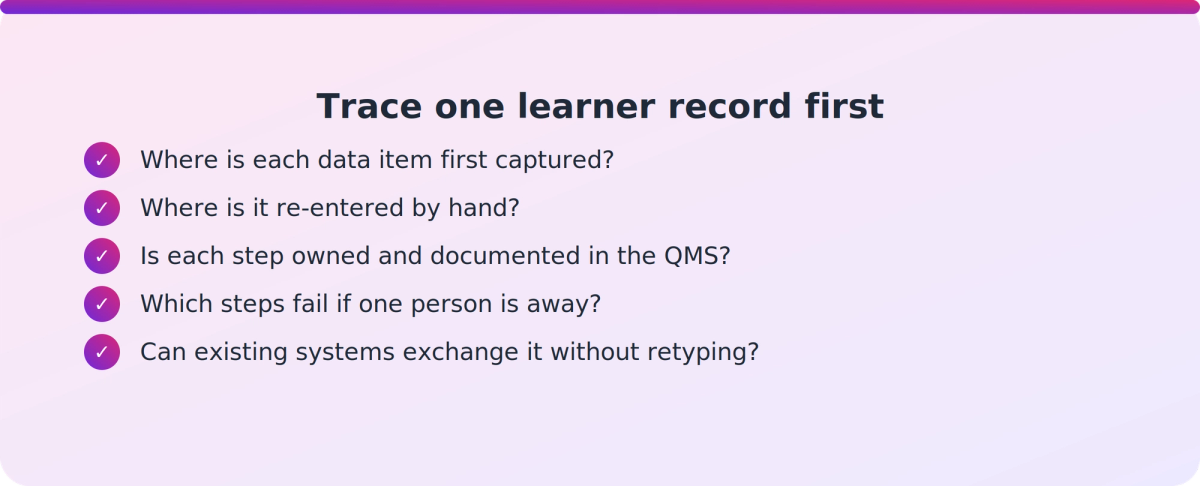
Before approving any new system, trace one learner from enquiry to SDR line and ask these questions.
- Where is each data item first captured, and where is it re-entered?
- Who owns each step, and is it documented in the QMS?
- Which steps fail if one named person is away in the last week of January?
- Which reconciliations only happen because someone remembers them?
- Can the systems you already have exchange this data, by export, integration or API, without a retype?
If the answers expose a genuine capability gap, buy to close that gap. If they expose ownership and hand-off gaps, a new platform won't close them.
Key takeaways
- NZQA's PTE Rules 2026, in force from 19 January 2026, require a copy of your QMS. Documented process is now a compliance matter.
- EER has been replaced by self-review and monitoring. Self-review depends on written, repeatable processes, not on individuals' memory.
- We found no NZQA software requirement. A working, documented QMS is the expectation, not a specific platform.
- TEC's SDR and IND dates are fixed, so manual hand-offs between systems concentrate risk in the same weeks every year.
- With TEC advising providers to plan on no extra funding, capacity has to come from process design and clean data flow.
Our take
The usual instinct is to treat an operations problem as a tooling gap. We think that misreads the 2026 settings. The pressure on a PTE COO is to prove the organisation runs on documented, repeatable processes, and to move data cleanly to TEC on dates that never change.
A new system can help, but only after you know who owns each step and where data gets re-keyed. Before it, a new system tends to bring a new place to keep undocumented workarounds.
This week, pick one learner record, trace it from enquiry to SDR, and count the times a person retypes it. That number is a better brief for your next investment than any vendor demo.