Unstructured Data: NZ Agribusiness's Untapped Asset
18 August 2026 · 6 min read
New Zealand agribusiness has no shortage of data. What it lacks is a way to turn soil tests, animal health notes, drone imagery and advisor reports into decisions. AgResearch, ANZ and KPMG have all reached the same conclusion in recent months: the value locked inside this unstructured data remains largely untapped, and closing that gap — not collecting more data — is the real productivity lever.
What counts as unstructured data on a New Zealand farm?
Ask a farmer what data they hold and most will underestimate it. Unstructured data is everything that doesn't sit neatly in a spreadsheet or database field, and on a working farm that's most of what gets generated day to day.
- Weather logs and soil condition notes jotted by hand or in a phone app
- Animal health records, treatment histories and condition-score observations
- Drone and satellite imagery used to map fertiliser spread, pasture cover or pest activity
- Sensor and monitoring feeds from irrigation, effluent or livestock systems
- Advisor and vet reports, often delivered as PDFs or free-text emails
AgResearch, working directly with dairy farmers in Southland, Canterbury and Gore, found this trove is exactly what large language models are suited to interpreting — yet the sector still hasn't captured most of that benefit.
Why does the value stay locked away?
The honest answer is fragmentation, not volume. A farm can generate years of rich records and still make decisions on gut feel, because nothing connects the imagery to the animal health log to the advisor's notes.
KPMG's global head of agribusiness, writing via Farmers Weekly, makes the point sharply: a farm's data becomes exponentially more valuable once it's integrated with data from other organisations across the value chain. Held in isolation on one property, in one format, in one person's notebook, that same data is worth a fraction of its potential.
Coverage of Fieldays in the NZ Herald backs this up from the ground up. Drones and sensors are now common for mapping fertiliser use, counting stock and tracking pests — but every new sensor adds another stream of unstructured imagery and notes. Without a way to connect it to existing records, more data collection just means a bigger pile, not better insight. Commentary from Changeable.co.nz makes the same warning about dairy-sector AI tools: new technology has to sharpen decision support, not add another layer of digital noise on top of what's already unread.
What is the opportunity actually worth?
ANZ's agri-insights paper puts a number on this: a $2.9 billion opportunity for New Zealand farmers tied to optimising farming systems. That figure isn't about growing more or spending more — it's about extracting value from information the sector already has but currently can't use at scale.
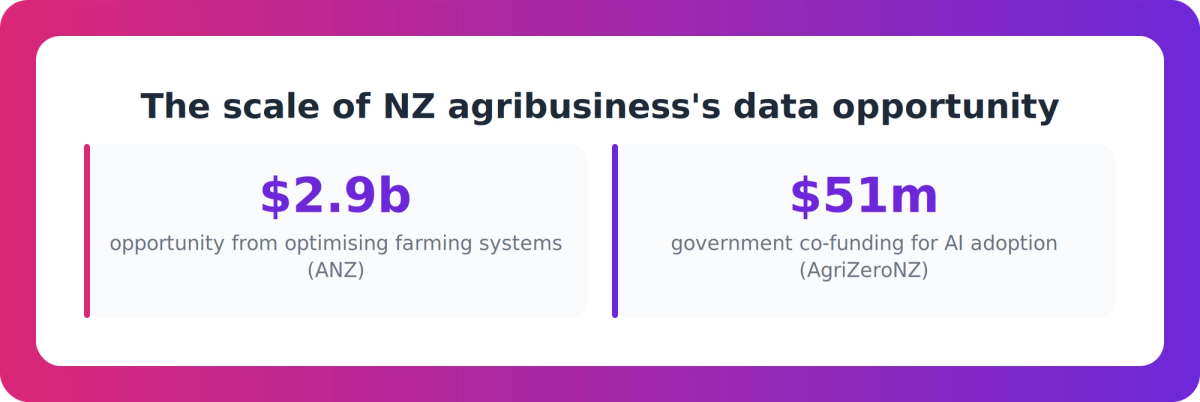
Government and industry bodies are treating this as an adoption barrier, not a data-availability problem:
- AgriZeroNZ's Early Adoption Accelerator is backed by up to $51 million in government co-funding over three years, specifically to remove the barriers stopping sector-wide uptake of tools that can put existing farm data to work.
- The focus of that funding is deliberately on adoption and integration, not on generating more raw data — reinforcing that the constraint is usability, not scarcity.
What does unlocking this data look like in practice?
Caberfeidh Station in North Otago, reported by NZ AgriBusiness Magazine, is a useful before-and-after. Before integrating its systems via FarmIQ, staff worked across multiple disconnected records, duplicating manual entry just to get a picture of what was happening on the farm. Daily gains, liveweights, condition scores and treatment records lived in separate places, and pulling them together took time nobody had spare.
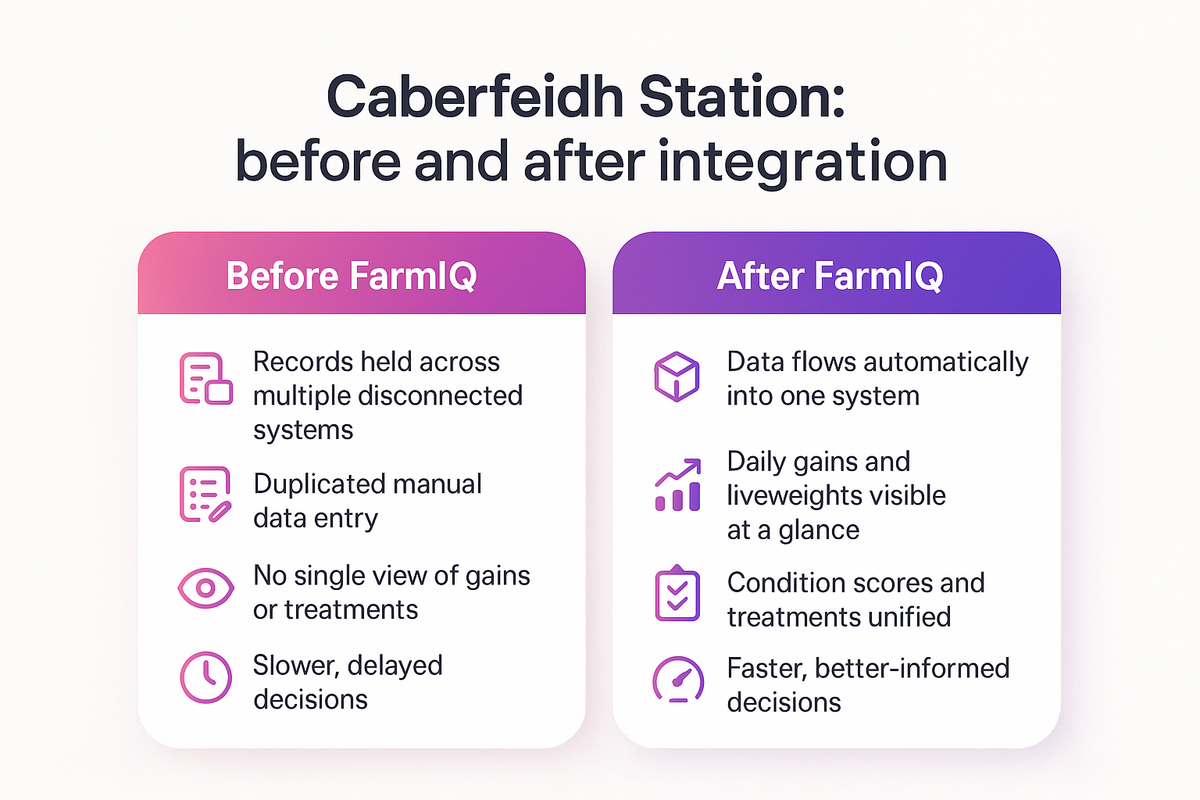
Once that data flowed automatically into one system, the picture changed. Staff could see daily gains, liveweights, condition scores and treatment records at a glance, and make faster decisions without reassembling the puzzle every morning. Nothing about the underlying data changed — the imagery, notes and readings were the same. What changed was structure: the information was organised, connected and made queryable, rather than scattered across notebooks, spreadsheets and PDFs.
That's the pattern worth noticing. The productivity gain didn't come from new sensors or more monitoring. It came from connecting what already existed.
Key takeaways
- New Zealand farms already generate large volumes of unstructured data — imagery, sensor feeds, animal health notes, advisor reports — but AgResearch confirms its value remains largely untapped.
- KPMG argues the value of farm data compounds only when it's integrated across the value chain, not held in isolated, farm-level records.
- ANZ puts a $2.9 billion figure on the productivity opportunity tied to better farming-system optimisation in New Zealand.
- Government is funding adoption, not data collection: AgriZeroNZ's Early Adoption Accelerator carries up to $51 million in co-funding aimed squarely at removing uptake barriers.
- Caberfeidh Station's experience with FarmIQ shows the practical shift: once fragmented records were unified, staff gained daily visibility and faster decisions — without collecting any new data.
Our take
The pattern across AgResearch, ANZ and KPMG's findings is consistent: New Zealand agribusiness doesn't have a data problem, it has an integration problem. More sensors and more drone flights won't close the $2.9 billion gap ANZ describes if the outputs still land as disconnected files nobody has time to read. The sector's real constraint is the last mile — turning scattered notes, images and logs into something a farmer or processor can act on without hiring a data team. That's a solvable engineering problem, not an inevitability, and the farms that solve it first will make faster, better-informed decisions while others are still flicking between spreadsheets.
FAQ
What is unstructured data in a New Zealand agribusiness context? It's information that doesn't fit into a standard database field — drone and sensor imagery, animal health notes, advisor reports, and weather or soil observations recorded in free text or images, rather than structured spreadsheets.
Why does AgResearch say the value of this data remains untapped? AgResearch's work with Southland, Canterbury and Gore dairy farmers found that despite large volumes of farm-generated data and the capability of large language models to interpret it, most farms still can't extract the full benefit — the data exists but isn't connected or structured for use.
How big is the productivity opportunity, according to ANZ? ANZ's agri-insights paper quantifies a $2.9 billion opportunity for New Zealand farmers tied to optimising farming systems, much of which depends on making better use of data that's currently fragmented rather than integrated.
What is AgriZeroNZ's Early Adoption Accelerator? It's a government-backed programme carrying up to $51 million in co-funding over three years, aimed at removing the barriers preventing wider uptake of data and AI tools across New Zealand's agribusiness sector.
Does unlocking farm data mean collecting more of it? No. The Caberfeidh Station example shows the gain came from integrating existing records into one system via FarmIQ, not from gathering additional data — the imagery, notes and readings were the same, only better connected.