AI Assessment Writing NZ: A Trainer Sign-Off Checklist
Yes, you can use AI to draft role-play scenarios for NZQA unit standard or skill standard assessments, but your organisation stays accountable for them. A qualified trainer must check each scenario against the standard, its conditions of assessment and the CMR. Pre-assessment moderation then follows. NZQA doesn't approve or list AI tools, so the checklist below is your own internal control.
What does AI assessment writing in NZ actually involve?
It means using AI to produce a first draft of assessment material, here role-play scenarios, which people then review, edit and approve. The AI does the blank-page work. It doesn't decide whether the scenario is valid.
That distinction matters because of how NZQA frames responsibility. Providers need consent to assess a standard. Once they have it, they must carry out internal moderation and take part in the national external moderation system (NZQA, Assessment of standards). The provider is accountable for the assessment, whichever tool drafted it.
We also couldn't find any NZQA guidance specific to AI-drafted role-play scenarios in tertiary settings. NZQA's generative AI material focuses on academic integrity. Its TEO guidance says providers should regularly review their academic integrity policy for generative AI and help staff understand how it can be used in teaching, learning and assessment. Nothing in it certifies a tool.
What should a trainer check before an AI-drafted role-play goes to moderation?
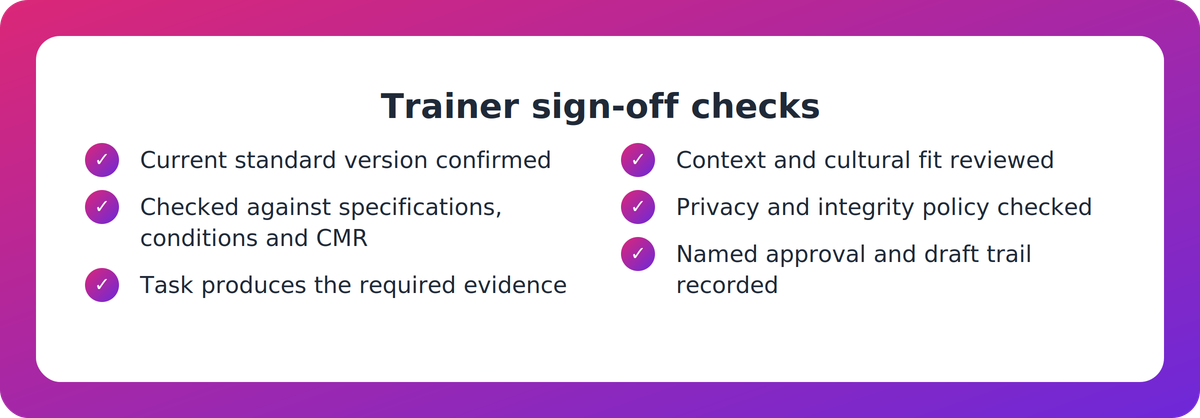
Treat every AI draft as an unreviewed first draft from a new author. Work through these checks, and record who did them.
- Right standard, right version. Confirm the scenario targets the current version of the standard on the DASS. Standards are shifting: skill standards are replacing unit standards (unit standards 6400–6402, for example, are set to expire on 31 December 2027). From 1 January 2026 Workforce Development Councils became Industry Skills Boards (ISBs), and pre-assessment moderation for new skill standards goes to the ISB before use. That's one sector example, so check each of your own standards.
- Against the Assessment Requirements. The NZQA Assessment Rules treat the standard, its specifications, conditions of assessment and the Consent and Moderation Requirements (CMR) as the Assessment Requirements. Read the scenario against that wording, line by line. Requirements vary by standard suite, so check your own CMR.
- Is the task valid? Does the role-play make the learner produce the evidence the standard actually asks for? A plausible-looking scenario that doesn't is a risk. In external moderation, providers must address issues the report raises, including invalid tasks.
- Subject expertise. An academic source on AI-drafted job scenarios and role plays notes that instructors who aren't subject experts may need subject matter expert verification. If the trainer isn't the expert, find one.
- Context and cultural fit. Is the scenario realistic for your learners and industry, and appropriate for them? Only a qualified, accountable person who knows your learners can judge that.
- Authenticity and academic integrity. Does it fit your generative AI policy? Can you still be confident the performance is the learner's own?
- Privacy. If learner voice recordings or performance data pass through a tool, the Privacy Act 2020 applies. More on that below.
- A named approval and a trail. Record the draft, the edits and who signed off. Then book moderation early.
How does this connect to pre-assessment moderation?
NZQA's internal moderation guidance says to schedule and complete pre-assessment moderation so the assessment developer has time to incorporate changes before use. It also says to keep the moderator independent of the designer and the assessor where possible.
AI-drafted scenarios belong inside that process, not beside it. If your trainer is both the person who prompted the tool and the person who signs it off, bring in an independent moderator.
How do you judge an AI tool against that checklist?
Start with what no tool can give you. There's no NZQA approval list for AI assessment-writing tools, so a vendor can't be "NZQA-approved" in any meaningful sense. Vendor claims aren't independent verification. Ask for evidence, and test the tool on a standard you know well.
Questions worth putting to any vendor:
- Standards currency. Which version of the standard does it map to? How does it handle the move from unit standards to skill standards and the ISB changes?
- Checkability. Can your trainer see each scenario next to the standard's wording, specifications, conditions and CMR?
- Moderation trail. Does it keep drafts, edits and named human approvals in a form you can show a moderator?
- Updating. How quickly can you revise a scenario when a standard or your context changes? NZQA's guidance is to update assessment materials regularly.
- Privacy. Where is data stored? Is it used to train models? How are learners told? Can the vendor support a Privacy Impact Assessment?
- Human judgement. Is the vendor clear that assessor judgement and sign-off stay with qualified people?
What about learner privacy in voice role-plays?
Voice role-plays raise the stakes. The Privacy Commissioner's AI guidance is non-binding, but it sets clear expectations: Privacy Impact Assessments, transparency with the people affected, human review, and limits on AI providers keeping personal information. Agencies remain responsible for decisions made using AI tools.
So don't leave this to the vendor's marketing page. Get the terms in writing, and have your privacy officer read them.
Where does Nova by Supahuman fit?
We'll be upfront: Supahuman makes Nova, so weigh this section accordingly. Nova describes itself as generating voice role-plays where an AI persona plays the counterpart against clear session objectives. Scenarios are generated per provider, built from the provider's own source material. That's Nova's own description, not independent verification.
Two features line up with the checklist. Nova lists outcome and competency mapping, and for NZ use the NZQF mapping is the relevant part. Your trainers should still check it against the current standard. Supahuman also says Nova applies an AI quality review to every experience, with human approval wherever the review isn't certain.
VETos, our related product for assessment work, says it's built to be moderation-ready. It doesn't remove professional judgement, and a qualified person still reviews and signs off. That's the premise of this checklist. We haven't reviewed Nova's privacy, data-residency or security terms here, so request them directly and run your own Privacy Impact Assessment. You can read more at supahuman.com.
A practical next step
Pick one assessment you already know well. Have AI draft a role-play for it, then run the eight checks above with a trainer and an independent moderator. You'll learn more about any tool, ours or anyone else's, from that one exercise than from a demo.
Key takeaways
- AI can draft role-play scenarios, but the provider and its qualified trainers remain accountable for the assessment.
- Check every scenario against the current standard, its specifications, conditions of assessment and the CMR before it goes anywhere.
- Put AI-drafted scenarios through pre-assessment moderation, with a moderator independent of the designer where possible.
- NZQA has no approved AI tool list and no AI guidance specific to tertiary role-plays, so your checklist is your control.
- Voice-based role-plays bring Privacy Act 2020 obligations. Test vendor claims, including ours, against your own process.
Our take
The real question isn't whether the AI draft is good. It's whether your process would catch it if it were wrong. Providers who get value from AI will be the ones with a boring, documented sign-off routine, not the ones with the cleverest tool. We think speed from AI is worth having only if your moderation trail gets stronger rather than thinner.
FAQ
Can we use AI to draft role-play scenarios for NZQA assessments, and who signs them off?
Yes. NZQA hasn't published AI guidance specific to tertiary role-plays, but the provider is accountable for its assessments. A qualified trainer should check each scenario against the standard, its conditions of assessment and the CMR, and the scenario should then go through pre-assessment moderation.
What should a trainer check in an AI-drafted role-play before moderation?
Check the standard's current version, the specifications, conditions of assessment and CMR, and whether the task is valid. Also check cultural and industry fit, authenticity and academic integrity, and privacy. Record who approved it and what changed.
What should a PTE or Te Pūkenga provider ask a vendor before buying?
Ask how it maps to the current standard version, including the skill standard transition. Ask about its record of drafts, edits and named approvals, and where learner data is stored and whether it trains models. Ask whether it supports a Privacy Impact Assessment and keeps sign-off with qualified people.
Does NZQA approve or certify AI assessment-writing tools?
No. We found no NZQA accreditation or approved-vendor list for AI tools. Vendor claims aren't independent verification, so test them against your own moderation and privacy process.