Most validation meetings fix problems that were built in months earlier. By the time assessors sit down to review a tool, trainers have delivered it and learners have been assessed against it. For a Head of Training, the lever that matters sits upstream of the meeting, not inside it.
Why this lands on your desk
You own assessment quality across every trainer. Inconsistent tools and inconsistent judgements are exactly what RTO validation and moderation exist to surface. If they surface only after delivery, the rework lands on your trainers: re-collecting evidence, re-assessing learners, rewriting tools mid-term.
The workforce makes that expensive. The Jobs and Skills Australia VET Workforce Study (October 2024) found VET teacher numbers shrank by 11-18% over the last decade, and that providers struggle to fill vacancies. It projects 3,800 more VET teachers are needed over five years. Almost half the workforce is over 50, and it is highly casualised.
That is a supply picture, not a workload survey, and we have no authoritative data on trainer burnout to offer. But the implication is plain. Every hour spent patching preventable defects in a meeting is an hour not spent on delivery, learner support or industry currency.
Then there is completion. NCVER reports 845,165 qualification completions in 2025, down 4.8%. Personal reasons were the most commonly cited reason for non-completion (29.5%). Assessment quality won't explain most of that, so don't overclaim. But it is one of the few levers you directly control, and it is worth asking how much of your own non-completion starts with an assessment that confused or stalled a learner.
Where quality is actually decided
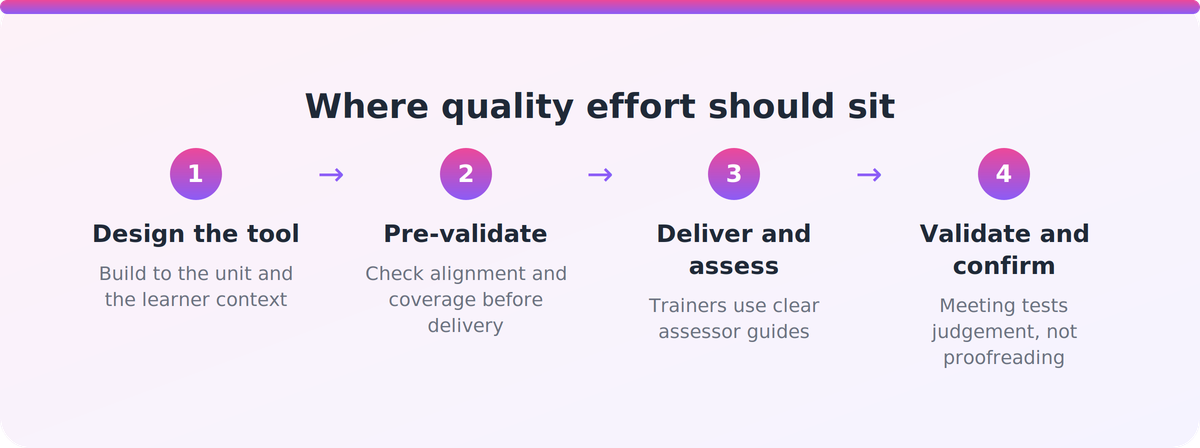
Quality is decided when the tool is designed. It is decided when someone interprets the unit of competency, chooses the evidence, and writes the instructions an assessor will follow at 4pm on a Thursday. The validation meeting comes after all of that.
A meeting can catch a gap in coverage. It can't undo a term's worth of assessment decisions made against a flawed tool. That is the salvage problem: the later you find a defect, the more people it has already touched.
Three upstream factors do most of the work:
- Tool design. Is the assessment built for the actual learner and workplace context, or adapted on the fly by whoever is delivering?
- Coverage evidence. Can you show, before delivery, how each requirement of the unit is addressed?
- Trainer practice. Do two assessors reading the same guide make the same call?
What the 2025 Standards signal
The Standards for RTOs 2025 took effect on 1 July 2025. They comprise the Outcome Standards, the Compliance Standards and the Credential Policy. ASQA-regulated RTOs are assessed against the 2025 Outcome and Compliance Standards Instruments plus the Credential Policy.
Secondary sources, including VET Resources and eSkilled, describe pre-validation of assessment tools under Standard 1.3 as happening before delivery. They also describe validation as risk-responsive. That means a maximum five-year cycle per training product on scope, with earlier or more frequent review where risk, product change or feedback point to it. They add that the person who designed or delivered an assessment cannot solely determine the validation outcome.
A caution: these are secondary readings. Confirm the exact wording of Standards 1.3 and 1.5 on legislation.gov.au (F2025L00354) before you build policy around them. DEWR also notes its policy-document versions do not impose legal obligations.
Even so, the direction of travel is clear. If a risk-based approach is the model, the Head of Training is the person deciding which products get earlier scrutiny, and defending that decision.
Moving effort upstream: what to do this quarter
You don't need a restructure. You need to change the order of work.
- Pre-validate before the tool reaches a trainer. Review alignment to the unit of competency and the training package requirements while changes are still cheap.
- Make coverage visible. For each tool, keep a simple record of how every unit requirement is addressed. If you can't produce it in minutes, you don't yet have it.
- Write assessor guides that remove judgement calls. Where two trainers could reasonably read a task differently, the guide is the problem, not the trainer.
- Set your risk triggers in advance. Product change, learner complaints, industry feedback and unusual results should each prompt a defined earlier review. Write them down so the call is defensible.
- Protect the meeting for judgement. Use it to test whether the tool and the evidence hold up, not to proofread.
Who is in the room
The Credential Policy includes credential requirements for people conducting validation of assessment, tied to Standard 1.5. Who sits at the table is therefore a compliance question as well as a quality one. Check your validators against the policy text, and check that your validation panel isn't made up only of the people who built or delivered the assessment.
Our take
The validation meeting has become the place where quality is proven, and that is the mistake. A meeting can confirm quality. It can't manufacture it.
We think the healthiest RTOs treat validation as a final check on work that was already designed to pass. If your meetings regularly produce long lists of fixes, that is not rigour. It is a signal that quality is entering the system too late.
This is also a trainer-time argument. With a shrinking, ageing and casualised workforce, the cheapest hour you can save is the one spent reworking something that should have been right before delivery.
Key takeaways
- Validation meetings find defects late. Assessment quality is decided at tool design, well before the meeting.
- Secondary sources say the 2025 Standards place pre-validation before delivery and make validation risk-responsive. Verify the wording of Standards 1.3 and 1.5 against F2025L00354.
- Coverage evidence, clear assessor guides and consistent trainer practice are the upstream levers you control.
- The Credential Policy covers who can conduct validation, so the composition of your panel is a compliance matter.
- With VET teacher numbers down 11-18% over a decade (JSA), trainer time is the scarce resource the quality system should protect.
FAQ
What is the difference between validation and moderation?
The brief doesn't supply authoritative definitions, so use the Standards for RTOs 2025 text on legislation.gov.au as your reference. In practice, the useful question is when each happens relative to delivery. Earlier checks protect trainers and learners from reworked assessment.
Does pre-validation replace the validation meeting?
No. Secondary sources describe pre-validation as a check on assessment tools before delivery, with validation continuing as a separate, risk-responsive obligation. Pre-validation reduces what the meeting has to fix. Confirm the exact requirements against the legislation.
How often should we validate a training product?
Secondary sources describe a maximum of five years per training product on scope, with more frequent validation where risk, product change or feedback indicate. Check this against the primary text and document your own triggers so the decision is defensible.
Who can sit on a validation panel?
The Credential Policy sets credential requirements for people conducting validation of assessment, linked to Standard 1.5. Secondary sources also say the designer or deliverer of an assessment cannot solely determine the outcome. Read the policy before you finalise your panel.
One question to sit with
Pick your last validation meeting and count how many of its findings could have been caught before a single learner was assessed. That number tells you where to start.