Most moderation meetings check that paperwork exists. The better ones check whether your trainers would reach the same judgement on the same piece of learner work. NZQA requires the first and rewards the second. For assessment moderation in a PTE in NZ, the meeting's design is your decision, not the regulator's.
Why this lands on your desk
NZQA requires every tertiary provider to run an effective system for moderating assessment materials and decisions. The system must make assessment fair, valid, consistent and appropriate for the level, given the stated learning outcomes. NZQA says it doesn't prescribe how providers run their internal systems for each programme.
That gap is yours. If moderation is a form filed after each cycle, that is a choice you made. If it is where your team learns what "meets the standard" looks like, that is also a choice.
Inconsistent assessment across trainers is likely already on your radar. Moderation is where it either surfaces or stays hidden.
Since 1 January 2026, the Quality Assurance of Tertiary Education Providers Rules 2026 have replaced the 2022 rules, including EER. Providers now keep an up-to-date quality management system and submit an annual self-review summary report. They then meet NZQA to discuss the improvement plan. You will be asked how assessment practice is monitored and improved, not just whether forms were filed.
What NZQA actually gives you to work with
NZQA's guidance is more useful than it first looks, because it contains the raw material for a better meeting.
- Pre-assessment moderation applies to all newly developed assessment materials before use, and again when they change. NZQA's focus areas include level alignment to the NZQF, suitability of assessment methods, and marking schedules detailed enough to help markers be consistent.
- Post-assessment moderation is recommended for each summative assessment. NZQA suggests randomly selecting at least three learner samples from a range of achieved marks or grades, and from each delivery site.
That sampling design is a comparison exercise. Samples across grades and sites put different trainers' judgements side by side, and you can use that.
A meeting built on live, comparative judgement
The argument here is practical reasoning, not proven outcomes. We found no authoritative NZ data on how moderation affects trainer capability or workload. What follows rests on NZQA's own sampling and marking-schedule guidance.
Before the meeting
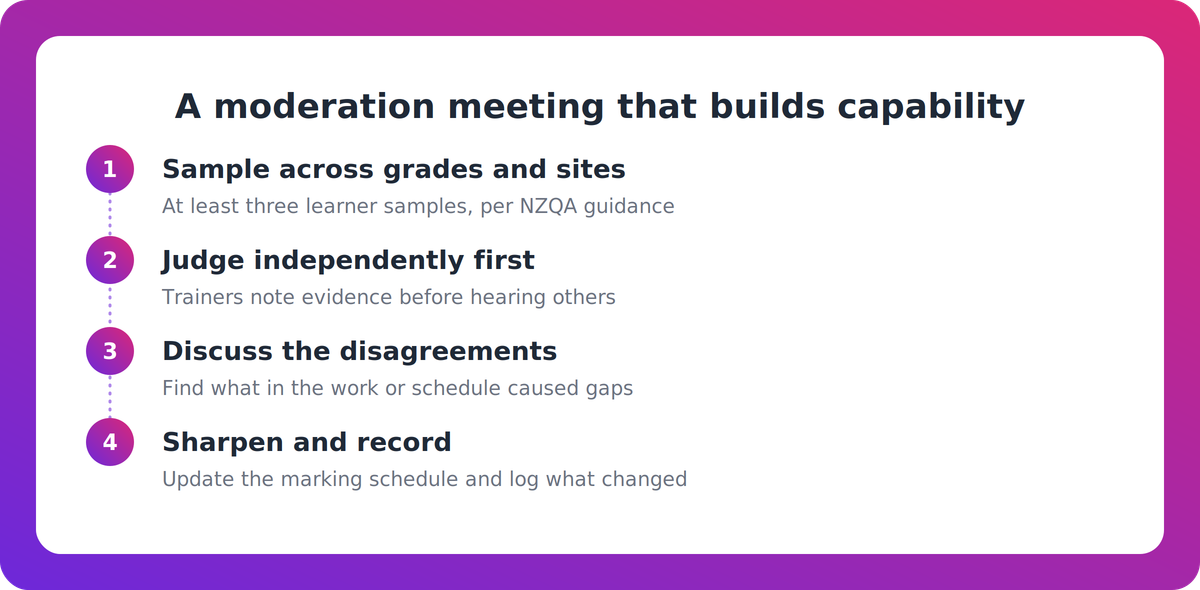
Pull samples the way NZQA describes: at least three, spread across achieved grades and every delivery site. Ask each trainer to judge the samples independently before they walk in, and to note the evidence behind each call. The point is that no one hears the "right answer" first.
In the room
Compare judgements, starting with the disagreements. Where two trainers read the same sample differently, ask what in the work, or in the marking schedule, produced the gap. Trainers spend most of the time on the real edge cases, not on samples everyone agrees on.
Senior trainers have to be willing to be wrong in front of newer ones. Your job is to make that safe. Judgement is calibrated by hearing how a colleague reasons, and a signed form can't do that.
After the meeting
The output is a sharper marking schedule. If two experienced trainers diverged, the schedule probably wasn't specific enough. NZQA's focus on marking schedules detailed enough to support consistent markers is exactly this. Record the change, update the version, and note which samples prompted it.
The evidence is a by-product
A meeting run this way leaves a trail: which samples were reviewed, where judgements differed, what changed in the marking schedule, and what was decided. That is a far better answer to "how do you monitor and improve assessment practice?" than a stack of completed forms.
This matters for two audiences.
- Your annual self-review. You can show assessment practice being improved, with specifics.
- Standards on the DASS. Every standard carries Consent and Moderation Requirements (CMRs), which set expectations for provider capability, including the skills and knowledge of teachers and assessors. Providers with consent to assess must evidence that assessor judgements are fair, valid and nationally consistent.
A second, less settled signal also points here. One trade-press report (Indian Newslink) says NZQA consulted on rating overall provider performance as Highly Effective, Effective or Not Effective, against four weighted criteria that include assessment practice. The consultation closed in September 2026 and we found no published outcome. Treat it as proposed, not confirmed. Even so, assessment practice is plainly something you should expect to evidence.
What the wider sector context changes
The 2025 legislation redesigning the vocational system created ten regional polytechnics and eight Industry Skills Boards (ISBs), operational from 1 January 2026. ISBs set and maintain standards, endorse programmes and moderate assessments. Skill standards are meant to support greater consistency in programme design and assessment.
If you moderate against standards that are being refreshed, your team needs a shared habit of reading a standard and judging evidence against it. One practical caution: NZQA's national external moderation page predates the 2026 changes and still refers to Workforce Development Councils, so check the current arrangements for your standards.
There is also a learner-side reason to care about early, consistent judgement. Education Counts data for 2025 shows the five-year apprentice qualification completion rate fell 3 percentage points to 40%, from a high of 58% in 2019. The share of trainees withdrawing rose to 19% from 16%. That covers workplace-based learners only, and it doesn't show moderation caused the trend. But it is a reminder that consistent assessment and early visibility of progress matter.
Key takeaways
- NZQA requires an effective moderation system that is fair, valid, consistent and appropriate for the level, but doesn't prescribe its form. The design is yours.
- NZQA suggests at least three learner samples from a range of achieved grades and from each delivery site. That sampling is a ready-made way to compare trainers' judgements.
- Have trainers judge samples independently before the meeting, then discuss disagreements. Make a sharper marking schedule the output.
- The records from this kind of meeting are better evidence for annual self-review than completed forms alone.
- The capability benefit is practical reasoning, not proven. No authoritative NZ data on moderation's effect on capability was found.
Our take
The temptation under any new quality regime is to produce more evidence. We'd argue for producing better practice and letting the evidence follow. A trainer team that can explain, specifically, why a sample meets or misses the standard is better prepared for any scrutiny than one with immaculate forms.
Time is the honest constraint, and we can't claim a meeting like this costs less. It may cost more in the room and less in rework later, but that is a judgement call, not a finding. Start small: one assessment, three samples, and a single marking-schedule change you can point to.
FAQ
Does NZQA tell PTEs how to run internal moderation?
No. NZQA requires an effective system for moderating assessment materials and decisions, and says it doesn't prescribe how providers run their internal systems for each programme. Its guidance on pre- and post-assessment moderation is a useful reference, but the format is your decision.
How many learner samples should we moderate?
For post-assessment moderation of each summative assessment, NZQA suggests randomly selecting at least three learner samples. They should come from a range of achieved marks or grades, and from each delivery site.
What replaced EER in 2026?
The Quality Assurance of Tertiary Education Providers Rules 2026 replaced the 2022 QA (including EER) Rules. They include an up-to-date quality management system, annual self-reviews reported to NZQA, monitoring, and assessment records retention. Providers submit an annual self-review summary report and meet NZQA to discuss the improvement plan.
Is the Highly Effective, Effective or Not Effective rating confirmed?
Not as far as we found. It comes from one trade-press report on an NZQA consultation that closed in September 2026, and no published outcome was found. Treat it as proposed and check NZQA directly.